
News
12 hours ago
Indian cement companies to invest ₹75,000 crore in FY27, FY28
The investment, which is 10 per cent higher than previous two fiscals, is to accelerate capacity expansion backed by a rise in demand
Indian cement companies are slated to invest ₹75,000 crore across this and next fiscal (FY27 and FY28) to accelerate capacity expansion backed by a rise in demand. The investment for the reporting period is 10 per cent higher than the previous two financial years.
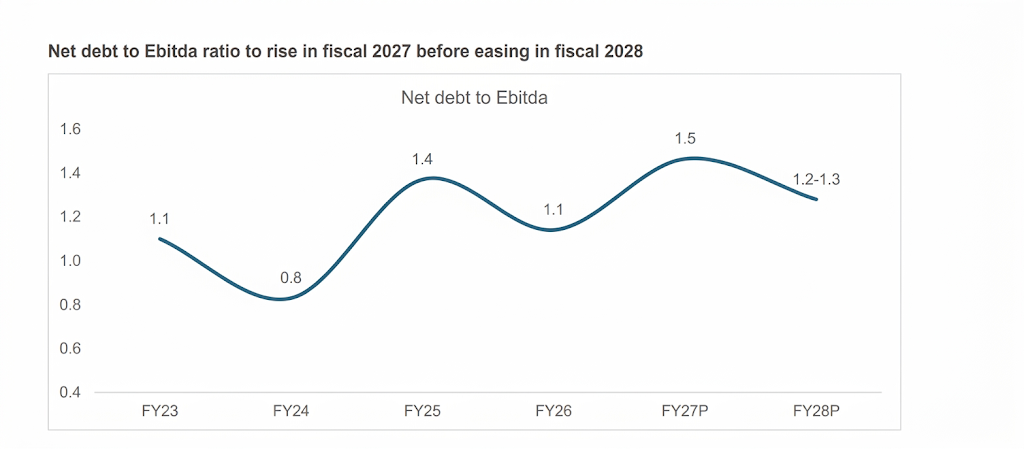
Elevated capex, coupled with near-term pressure on profitability, will push financial leverage – measured as net debt to earnings before interest, taxes, depreciation and amortisation (Ebitda) – higher this fiscal, before easing in fiscal 2028, according to a Crisil Ratings report.
The firm analysed 18 cement players, accounting for around 90 per cent of the country’s installed capacity as on March 31, 2026.
Cement makers have steadily expanded capacity over the past few years, adding 84 million tonne per annum (MTPA) in the preceding two fiscals, taking industry’s installed capacity to 718 MTPA as on March 31, 2026.
“We expect the industry to add 110-120 MTPA of capacity across fiscals 2027 and 2028. At the current capacity utilisation of about 70 per cent, these additions should broadly match the incremental demand, keeping utilisation levels range bound. Capacity additions will remain the primary driver, accounting for three-fourths of the Rs 36,000-38,000 crore annual capex planned over this fiscal and the next,” Crisil Ratings Director Anand Kulkarni said.
“About two-third of the incremental capacity will comprise split grinding units as cement makers leverage existing clinker availability and locate grinding units closer to market to improve logistics efficiency,” he added.
Balance capex will be towards green energy projects, efficiency enhancement initiatives and routine maintenance.
Investment in green energy is increasingly emerging as a key structural advantage and should continue to support operating profitability. Renewable sources already meet around 40 per cent of sector’s power requirement, and their share is expected to rise to nearly 50 per cent by next fiscal, helping offset cost pressures and improve energy efficiency.
Operating profitability to soften
However, operating profitability is expected to soften to ₹875-900 per tonne this fiscal from ₹980 per tonne in fiscal 2026, amid a more challenging cost environment. The West Asia conflict has driven a sharp rise in fuel prices, with petcoke and international coal prices surging by about 35 per cent on-year on average in the first half of this fiscal.
As a result, power and fuel costs, which account for over a quarter of total costs, have increased by ₹100-125 per tonne or 10 per cent, over the last fiscal. While calibrated price hikes by cement makers should partly offset this impact, a faster-than-expected commodity-price normalisation could provide upside to the profitability estimates this fiscal.
Profitability should recover to above the decadal average of ₹970 per tonne next fiscal on easing commodity prices, a higher share of renewable energy and blended cement, and continued cost-efficiency measures.
“The combination of sustained capex and lower profitability will raise capex intensity, measured as capex to Ebitda, to 0.8 time in fiscal 2027 against decadal average of 0.65 time, necessitating higher debt funding. Consequently, net debt to Ebitda is expected to rise to 1.5 times, the highest in five fiscals, albeit still at controlled levels,” Crisil Ratings associate director Parth Shah said.
“Leverage should ease to around 1.2-1.3 times in fiscal 2028 supported by recovery in profitability and cashflows from newly commissioned capacities. Overall, robust balance sheets and resilient cash flows should help maintain stable credit profiles across the sector,” he added.
However, material delays in commissioning planned capacities or a slower-than-expected recovery in profitability could temper the anticipated improvement in leverage metrics, the report added.
Most Popular

16 hours ago
IIT Guwahati Wins National Semiconductor Systems Engineering Competition
With 803 teams from 189 colleges competing, the Bengaluru finale highlights India's growing demand…

2 days ago
Why longevity is no longer just a healthcare Issue, but a ‘Financial Planning’ one
In India, where life expectancy at birth reached 72.2 years in 2024, the financial…

14 hours ago
NVIDIA CEO Jensen Huang says willing to return as CEO if board decides
The CEO and co-founder of the world’s largest semiconductor company expresses deep regret for…
12 hours ago
Indian cement companies to invest ₹75,000 crore in FY27, FY28
The investment, which is 10 per cent higher than previous two fiscals, is to…
