
Analysis
2 days ago
Why longevity is no longer just a healthcare Issue, but a ‘Financial Planning’ one
In India, where life expectancy at birth reached 72.2 years in 2024, the financial consequences of living longer—and ideally healthier—are becoming impossible to ignore.
For Indian banks, insurers, asset managers and fintechs, longevity is becoming a major product-design frontier. Only if they listen carefully to those heartbeats…
“We’re not trying to make us live forever… what we’re trying to do is extend the period of healthy life.”
So said Stuart Jay Olshansky – a leading American researcher on human ageing, longevity and population health.
But the larger question is – does longevity depend solely on the state of health? Go through the fine-print and you would find that longevity is equally a question of income, savings, risk protection and the quality of the years people live.
In India, where life expectancy at birth reached 72.2 years in 2024, the financial consequences of living longer—and ideally healthier—are becoming impossible to ignore.
The central shift is this: health span is now a financial asset. The longer people remain healthy, employable and independent, the more manageable retirement becomes. The longer illness or frailty begins, the greater the pressure on savings, insurance, family support and public systems.
Thus, it becomes a macro-economic issue too. A recent survey by McKinsey frames healthy longevity as an issue with direct consequences for economic growth, labour supply, healthcare spending, pensions and equity
Why longevity depends on finance: Traditional financial planning assumes a retirement period that is relatively short and broadly predictable. Longevity breaks that assumption: people may need to fund 25–35 years after leaving full-time work, while managing healthcare costs, changing housing needs and possible periods of reduced earning capacity.
This makes longevity a planning problem across four dimensions:
- Accumulation: More years of saving and investing may be needed before retirement.
- Decumulation: Retirement savings must last longer and withstand inflation, medical shocks and market volatility.
- Protection: Health insurance, disability cover, long-term-care planning and annuities become more important.
- Human capital: Staying healthy can extend productive working years, which is often the most valuable financial asset an individual has.
Surveys in the US show that every $1 invested annually in healthy-aging interventions can generate $3 in economic and healthcare benefits with potential relevance in other countries. The implication for India is straightforward: preventive health is not only a social-good agenda; it can be an economic and financial-resilience agenda.
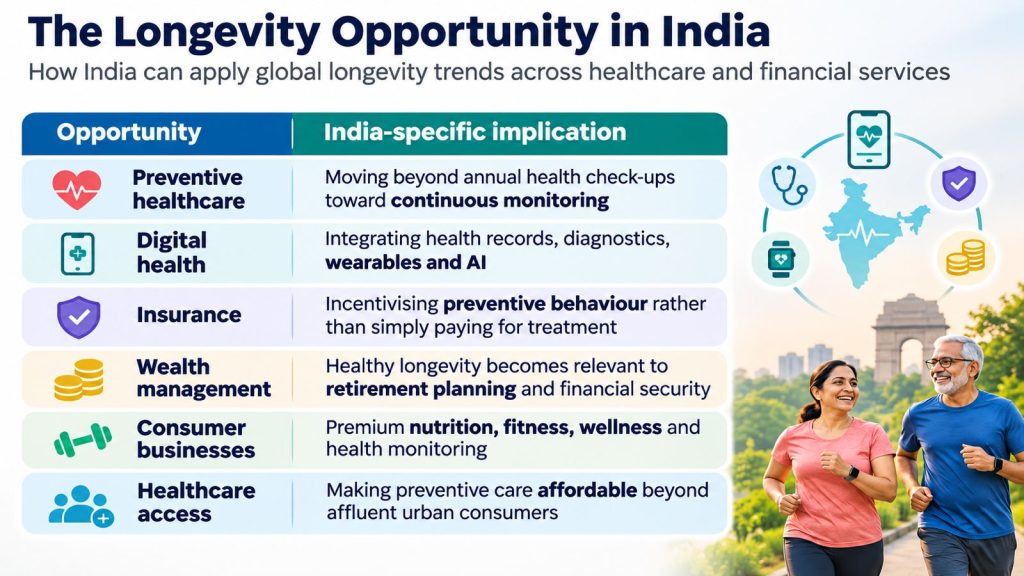
India’s opportunity: Our country has a distinctive opportunity because its longevity transition is happening alongside rapid digitalisation, a large informal workforce and an underdeveloped retirement-savings base.
The country’s pension coverage remains limited: EPFO, NPS and Atal Pension Yojana together cover less than a quarter of the workforce, while the Economic Survey 2025–26 highlights informality, irregular incomes and low awareness as major barriers to pension inclusion.
Emerging schemes and trends give us some hope though. India’s digital-health infrastructure gives this agenda a practical foundation. The Ayushman Bharat Digital Mission has linked more than 104 crore health records to over 93 crore ABHA accounts, and its ecosystem is designed to support integrated vitals, reminders, goal tracking and wearable syncing.
For the larger spectrum of insurance and retirement planning tools, that creates the raw material for a new kind of financial product: one that understands not only a customer’s assets and liabilities, but also their health risks and health behaviours.
For Indian banks, insurers, asset managers and fintechs, longevity could become a major product-design frontier. The opportunity is not merely to sell more insurance or retirement plans; it is to help customers manage the interaction between health, income and wealth over decades.
By Sreevalsan M
Most Popular

4 days ago
Microsoft restores services after 24 hours, rules out cyberattack
The disruption, which began on late Thursday, lasted nearly 24 hours and affected to…

14 hours ago
NVIDIA CEO Jensen Huang says willing to return as CEO if board decides
The CEO and co-founder of the world’s largest semiconductor company expresses deep regret for…
1 day ago
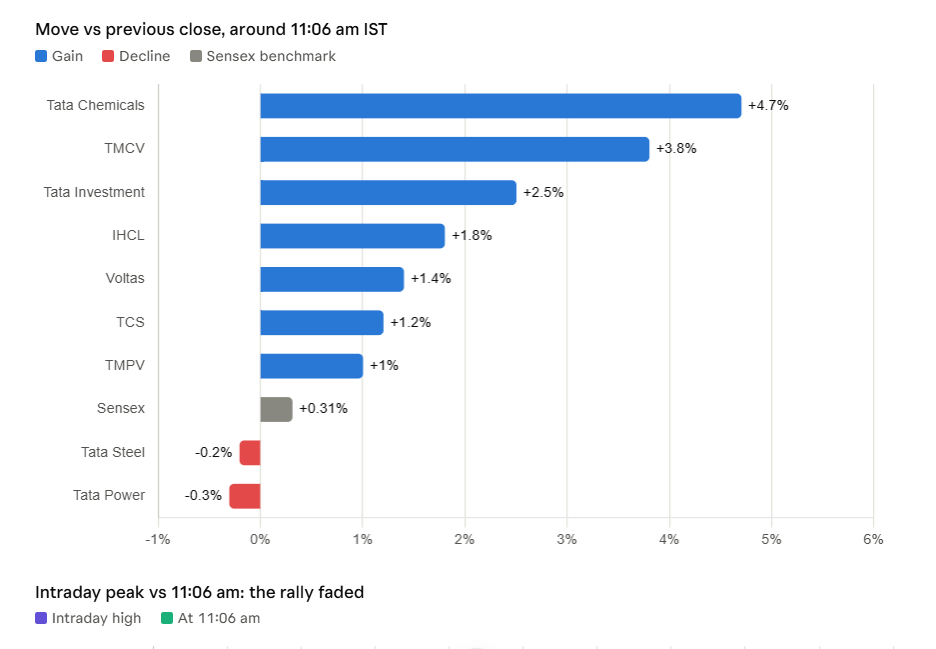
India’s Tata group shares rise as RBI reiterates mandatory of holding-investment company
Tata Chemicals, Tata Investment lead group stock gains after Reserve Bank of India letter
12 hours ago
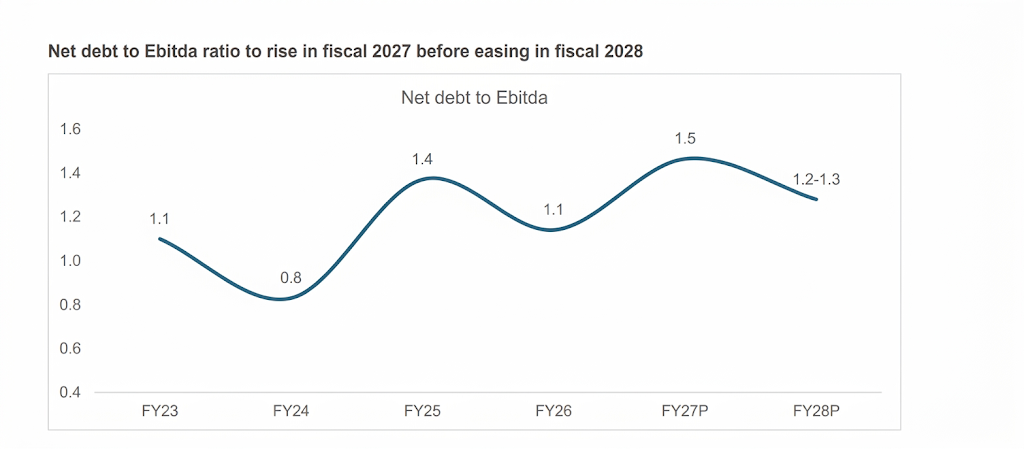
Indian cement companies to invest ₹75,000 crore in FY27, FY28
The investment, which is 10 per cent higher than previous two fiscals, is to…
