
Analysis
22 - 06 - 2026
Jio IPO, Green AI reveal Mukesh Ambani’s blueprint for RIL
Moving beyond its traditional oil-to-chemicals roots, the conglomerate is tying its massive telecom scale to a green-powered, Nvidia-backed computing grid
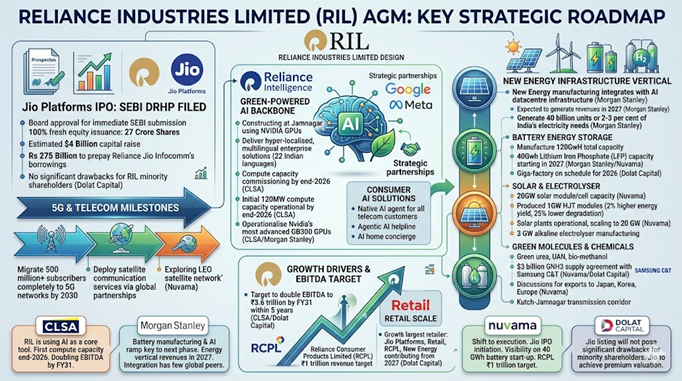
Reliance Industries Limited (RIL) Chairman Mukesh Ambani on Friday showcased a corporate blueprint at the conglomerate’s Annual General Meeting (AGM), officially confirming that Jio Platforms has filed its Draft Red Herring Prospectus (DRHP) for an initial public offering (IPO). He also unveiled expansion plans for sovereign Artificial Intelligence (AI) and clean energy infrastructure.
Addressing shareholders, Ambani said that the Jio Platforms board cleared the prospectus for immediate submission to the Securities and Exchange Board of India (SEBI), setting the stage for a 100% fresh equity issuance of 27 crore shares. The firm also unveiled plans to deploy satellite communication services across India via global constellation partnerships and announced a target to migrate its entire 500 million-plus subscriber base completely to 5G networks by 2030.
Further, under its newly formed, wholly owned subsidiary Reliance Intelligence, the company is constructing a green-powered AI backbone at Jamnagar utilising NVIDIA GPUs to deliver hyper-localised, multilingual enterprise solutions across 22 Indian languages. This would be supported by strategic partnerships with Google and Meta.
Here is how leading street brokerages view the conglomerate’s strategic roadmap, enclosed in edited excerpts from their latest research notes:
CLSA
RIL is using AI as a core tool across its businesses. The company is expected to commission its first compute capacity by the end of 2026. The AGM showcased a variety of RIL’s AI solutions for customers across businesses. A foray into underground coal gasification along with multi-sector exports were revealed as new areas of growth, and a target to double EBITDA to ₹3.6 trillion by FY31 in the next five years, CLSA said in a note.
Reliance Intelligence, RIL’s recently setup AI subsidiary, is set to commission the first 120 megawatts of its AI backbone by end-2026. This will be powered by Reliance’s own renewable energy from its solar farm in Kutch, and the company will operationalise its initial fleet of Nvidia’s most advanced GB300 GPUs.
Reliance Intelligence will also offer AI-powered solutions for commerce, healthcare, education, agriculture and general use. The AGM also showcased more consumer AI solutions like a native AI agent offered to all customers on its telecom network, an agentic AI helpline and an AI home concierge solution.
For media and commerce, Reliance showcased GenAI media studio to enable AI-native content production plus novel features like commerce with video content and multiview feeds for JioHotstar. The company is also actively using AI to improvise its internal business processes.
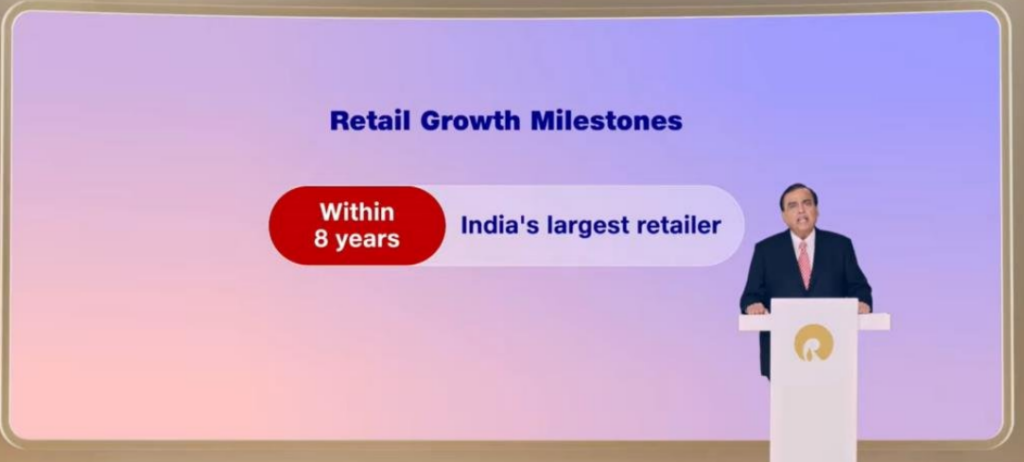
Within eight years, RIL had become India’s largest retailer. And in the fourth quarter of FY26, it crossed 20,000 stores – a scale no retailer in Asia has achieved in this timeframe, Ambani said at the AGM.
Morgan Stanley
“RIL manufacturing of battery energy storage along with an AI infrastructure ramp is key to its next phase, as investors continue to under-appreciate the company’s potential with rising focus on energy security by policymakers. RIL plans to generate 40 billion units or 2-3 per cent of India’s electricity needs,” Morgan Stanley said in a report.
RIL plans to more than double EBITDA in coming years after doubling it in the past five years. The new energy infrastructure vertical has seen building blocks deployed in the past three years and the company expects it to generate revenues in 2027. As with every vertical, integration and uniqueness of new energy manufacturing with AI datacentre infrastructure has few global peers and hence management expects revenues, especially from battery storage, to get a lot more investor attention.
RIL plans to manufacture 120GwH of battery energy storage with a Lithium Iron Phosphate (LFP) capacity starting at 40Gwh in 2027. All manufacturing equipment is already at site.
This will integrate with its 20GW solar panel manufacturing and alkaline electrolyser manufacturing with revenues expected in 2027. The company has already produced 1GW of Heterojunction Technology (HJT) technology panels with 2% higher energy yield and 25% lower degradation rates.
Management said the manufacture of batteries, panels and green hydrogen will help feed energy to the initial 120MW AI datacentre infrastructure to be ready in 2026 with GB300 chips secured.
“We see a ramp up of facilities over the next three years,” it said.
Nuvama
“RIL’s AGM highlighted a shift to execution, with key incremental developments such as Reliance Jio Infocomm’s IPO initiation, a rise in HJT solar module output, visibility on the 40 Gigawatt-hour (GWh) battery energy storage systems facility start-up, and Reliance Consumer Products Limited’s (RCPL) ₹1 trillion revenue target. Commercial validation of its Green Hydrogen (GH2) via a long-term Samsung C&T Green Ammonia (GNH3) offtake agreement, alongside an expanded green molecules portfolio, reinforces our multi-decadal growth opportunity thesis,” brokerage firm Nuvama said in a report.
The approval of Jio Platforms’ DRHP would result in gains to RIL shareholders. While premium valuation is likely, RIL shareholder gains may be limited by holding company discount. Jio is also exploring Low Earth Orbit (LEO) satellite network for global scale.
RIL’s new energy business will start contributing meaningfully from FY27. The solar module/cell plants are operational (scaling to 20 GW capacity).
“We reckon, on 10-GW module/cell capacity, it could add 5 per cent to FY26 net profit. The Kutch-Jamnagar transmission corridor is under construction. RIL is also setting up a 40 GWh battery facility (scalable to 120 GWh) and a 3 GW electrolyser facility. Green chemicals are on track [green urea, Urea Ammonium Nitrate, green ammonia (GNH3) and bio-methanol]; signed a $3 billion GNH3 supply agreement with Samsung C&T; discussions are underway for exports to Japan, Korea and Europe,” it added.
Dolat Capital
“The Jio listing will not pose significant drawbacks for RIL’s minority shareholders, as it is expected to attract a new class of investors, and we anticipate Jio will achieve a premium valuation upon listing, which should be beneficial for Reliance Industries,” brokerage firm Dolat Capital said in a report.
RIL has initiated the listing process of Jio Platforms, comprising a new issue of 270 million shares. This will lead to about a 2.9 per cent dilution for existing shareholders post-issue.
The capital raised, estimated at about $4 billion, will primarily go directly into the business, with Rs 275 billion earmarked to prepay Reliance Jio Infocomm’s borrowings. After the listing, Jio will remain a subsidiary of RIL.
The company’s management reiterated its confidence in greater than two times Earnings Before Interest, Taxes, Depreciation, and Amortisation (EBITDA) over the next five years on the back of growth engines of Jio Platform, Reliance Consumer Products Limited (RCPL) ambition to clock 46 per cent Compound Annual Growth Rate (CAGR) (FY26-30), Retail and New Energy to start contributing from 2027.
The New Energy sector has transitioned from construction to commissioning, with the production of 1 GW of solar HJT modules completed, a battery giga-factory on schedule for 2026, and a $3 bn green ammonia supply agreement with Samsung C&T.
The manufacturing lines for solar Photovoltaic (PV) cells and modules have been launched and are now operational. Nearly 1 GW of HJT modules have been produced, offering around 2 per cent higher energy yield and 25 per cent lower degradation compared to traditional modules.

Most Popular

4 days ago
DCGI Approves Toripalimab Combination Therapy for Advanced Oesophageal Cancer in India
Dr Reddy’s Laboratories’ Zytorvi, combined with cisplatin and paclitaxel, gains a first-line indication for…
7 minutes ago
L&T Q2 cons net profit rises 33% to at ₹5,202 crore
The group’s consolidated revenue rose 16% to ₹78,750 crore, driven by progress in its…

1 day ago
India’s Mumbai records 3,145 luxury property transactions in H1 FY27
The city registered 3,145 luxury residential property transactions worth ₹32,623 crore between April and…

3 days ago
Kotak Mahindra Bank’s profits soar, but margins refuse to join the party
Management expects the full-quarter impact of FCNR(B) deposits to weigh on margins in the…
