
Analysis
19 - 06 - 2026
Does El Niño really decide the fate of our Monsoon?
Data suggests that El Niño’s impact is most pronounced during the withdrawal phase of the monsoon rather than at its onset
Last week, the India Meteorological Department (IMD) confirmed that the sea surface temperatures in the central Pacific have surpassed the established El Niño threshold.
This may intensify during the southwest monsoon season, leading to a 60% likelihood of below-average rainfall. For the public at large, El Niño is frequently regarded as a synonym for a poor Indian monsoon.
However, an in-depth analysis of five decades of IMD data reveals a more intricate narrative. Examining all 17 El Niño years from 1951 to 2023, it is evident that only 11 resulted in below-normal seasonal rainfall (June–September), while six years — including 1953, 1994, and even the robust El Niño of 1997 — experienced normal or above-average rainfall.
Interestingly, the intensity of the El Niño event seems to have minimal impact on the monsoon’s outcome: for instance, 1972, which had a moderate El Niño, recorded the most significant seasonal deficit at -22.3%, whereas 1997, the sole ‘strong’ El Niño in the dataset, concluded with a marginally negative figure of -0.2%. This indicates that other climatic factors, particularly the Indian Ocean Dipole, often overshadow El Niño’s anticipated drying effect on the subcontinent.
In fact, the influence of El Niño is consistently observed in September; 15 out of the 17 years documented a rainfall deficit during that month, even in seasons that ended with near-normal totals, such as 1991 and 1997. This suggests that El Niño’s impact is most pronounced during the withdrawal phase of the monsoon rather than at its onset — a trend that has significant implications for late-kharif crops and reservoir replenishment, as a weak September can negate the advantages gained from a strong June or July.
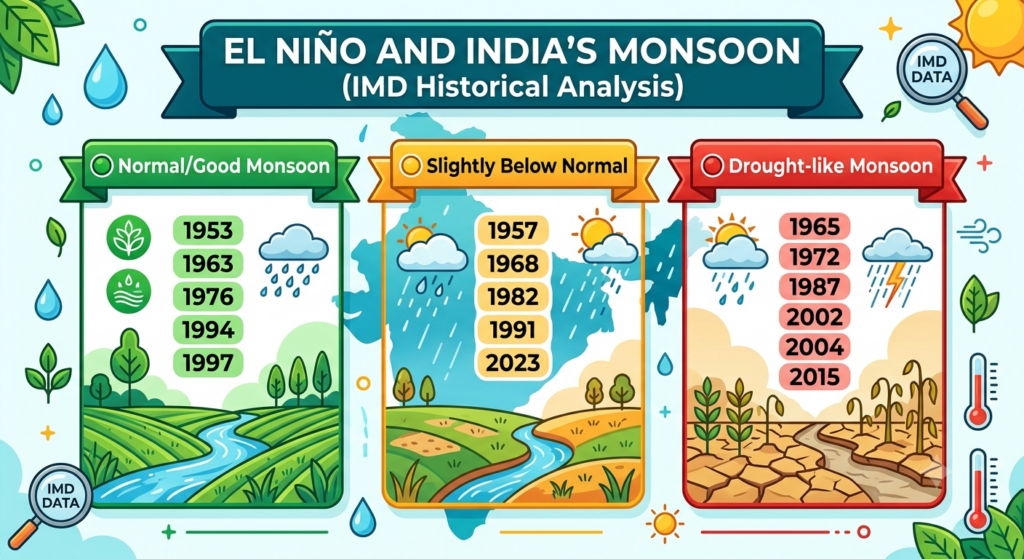
Furthermore, the data illustrates the volatility of individual months within a single season. For example, in 2002, July experienced a drastic decline of over 50%, despite the seasonal average being ‘only’ -20.9%. A similar fluctuation was noted in 2023, where a severe -36.1% in August was partially offset by a +13.1% in September.
These intra-seasonal variations are of greater concern to farmers than the overall seasonal figure, as the timing of sowing and harvesting can be severely impacted by a single poor month, even in an otherwise average year.
Though the IMD data indicates that El Niño continues to be the most significant risk factor for monsoon in India, it is no longer the only factor influencing monsoon performance—its impact has become less predictable as other climatic influences have gained prominence.
Sreevalsan M

Most Popular

49 minutes ago
L&T Q2 cons net profit rises 33% to at ₹5,202 crore
The group’s consolidated revenue rose 16% to ₹78,750 crore, driven by progress in its…

4 days ago
Infosys Q2 net profit rises 6% to ₹7,823 crore
India's second-largest IT services company trims FY27 revenue guidance

1 day ago
India’s Mumbai records 3,145 luxury property transactions in H1 FY27
The city registered 3,145 luxury residential property transactions worth ₹32,623 crore between April and…

3 days ago
Tech Mahindra partners with SpaceXSI to bring Grok AI coding tools into enterprise workflows
The collaboration will target legacy application modernisation, software development and developer productivity, with a…
