
Analysis
17 - 06 - 2026
India Tests ‘Tomahawk-Class’ Cruise Missile: LRLACM Flight-Test Marks Strategic Shift
This is India’s equivalent of the US Tomahawk—built entirely domestically
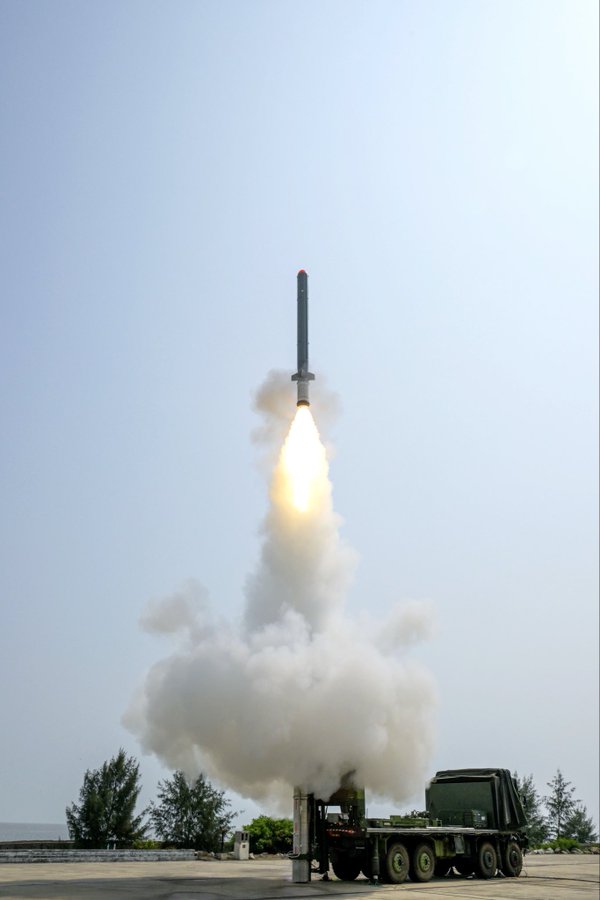
India’s Defence Research and Development Organisation (DRDO) conducted a successful flight-test of the Long Range Land Attack Cruise Missile (LRLACM) from Dr APJ Abdul Kalam Island off the coast of Odisha on June 15, 2026. All test objectives were fully met, as confirmed by tracking instruments deployed by the Integrated Test Range, Chandipur. India’s defense ministry said in a statement.
The launch was witnessed by senior officials from DRDO and user representatives from the Indian Navy and the Indian Air Force. The LRLACM is an indigenously developed missile with all sub-systems developed by DRDO laboratories and Indian industry partners. Aeronautical Development Establishment, Bengaluru, is the nodal laboratory.
Defense minister Rajnath Singh congratulated the DRDO team and industry partners on the successful flight-test. Defence Secretary and DRDO Chairman Rajesh Kumar Singh monitored all activities during the launch, the government said.
What the LRLACM Is
The LRLACM is a subsonic cruise missile with an estimated range of 1,000 to 1,500 km, placing it in the category of long-range land-attack cruise missiles fielded by major military powers. It carries a 450 kg warhead, weighs approximately 1 tonne, measures 6 metres in length with a diameter of 0.52 metres, and can be launched from air, land, or sea platforms.
The missile is an advanced, indigenous cruise missile designed to strike targets at long ranges with pinpoint precision, maneuvering across multiple altitudes and speeds. Its closest equivalent is the US Tomahawk cruise missile.
From Nirbhay to LRLACM
The LRLACM is an upgraded successor to the Nirbhay missile programme, which has been under development since the late 2010s.
The first test of Nirbhay occurred in 2019, with a 1,000km range subsonic cruise missile. In 2020, the LRLACM project was officially approved as “Super Nirbhay.” By 2024, Nirbhay specifications were confirmed at 800–1,000 km range with a 450 kg payload. In 2025, an air-launched variant with 1,000km range was approved for the Indian Air Force. And in June 2026, the LRLACM achieved its successful flight-test.
The LRLACM could involve a three-stage power system: the Nirbhay booster to put the missile in the air, the NPO Saturn 36MT/Manik turbofan to power the cruise phase through its 1,000-km range, and a ramjet engine for supersonic endgame towards the target.
Strategic Depth Against China and Pakistan
For the Indian Air Force, which faces multifaceted threats along its borders with China and Pakistan, the induction of an indigenous air-launched LRLACM with 1,000km range promises to redefine its operational doctrine. The missile will enable deep precision strikes without entering enemy airspace—a critical capability for Su-30MKI fighter jets integrated with the LRLACM using the same heavy-duty pylon developed for BrahMos-A.
Unlike traditional missiles, the air-launched LRLACM uses a gravity drop launch mechanism, eliminating the need for a booster and improving efficiency. This could enable saturation attacks and overwhelm enemy defences.
Tri-Services Capability and Indigenous Supply Chain
The LRLACM will be a tri-services missile system. The effort, detailed first by Livefist in 2018, makes a so-far exploratory effort official: the Nirbhay (and its derivatives) will be one of the most crucial missiles in India’s arsenal. The addition of LRLACM with a firing range of 1,000 km to the existing arsenal will bolster the attack capabilities of the Navy and the Air Force.
Both the subsonic LRLACM and hypersonic LRAShM will complement the supersonic BrahMos, currently the primary strike weapon of the Indian Navy. The cruise missile was developed entirely with indigenous technologies. All its sub-systems were developed by DRDO-backed laboratories and domestic industry partners. The Aeronautical Development Establishment in Bengaluru functioned as the Nodal Laboratory of the project.
India used the BrahMos supersonic cruise missiles last year to strike targets inside Pakistan during a brief clash following a terrorist attack in Kashmir. BrahMos Aerospace, a joint venture between DRDO and Russia’s NPO Mashinostroyeniya rocket design bureau, makes the BrahMos cruise missiles in land, air, and sea variants.
India’s effort to develop a Tomahawk-class land-attack cruise missile moved a step closer to fruition. The successful LRLACM test puts India in the same league as the US, Russia, and China in long-range cruise missile capability. With 1,000–1,500km range, it can strike deep into adversary territory while the launching platform remains outside enemy air defence coverage.
This is not just a missile test. It’s a strategic capability milestone that redefines India’s strike doctrine on both eastern and western fronts.
Venkatesh G
Most Popular
4 days ago
DCGI Approves Toripalimab Combination Therapy for Advanced Oesophageal Cancer in India
Dr Reddy’s Laboratories’ Zytorvi, combined with cisplatin and paclitaxel, gains a first-line indication for…

3 days ago
Kotak Mahindra Bank’s profits soar, but margins refuse to join the party
Management expects the full-quarter impact of FCNR(B) deposits to weigh on margins in the…

3 days ago
Tech Mahindra partners with SpaceXSI to bring Grok AI coding tools into enterprise workflows
The collaboration will target legacy application modernisation, software development and developer productivity, with a…

4 days ago
Infosys Q2 net profit rises 6% to ₹7,823 crore
India's second-largest IT services company trims FY27 revenue guidance
