
Analysis
17 - 06 - 2026
US-Iran deal could open Hormuz earlier than expected: Fitch
The rating agency expects the global oil market to return to oversupply in about a month after the strait is fully opened
A deal between the United States and Iran to extend the ceasefire and open the Strait of Hormuz in June would see the strait open slightly earlier than expected, Fitch Ratings said, adding it anticipated the global oil market to return to oversupply in about a month after the strait is fully opened.
“We still see a high risk that the strait will not be opened immediately or that the situation remains unstable, but even a temporary opening of Hormuz would significantly reduce the more extreme credit risks that the conflict has posed,” it said in a note.
The signing of the peace deal is slated for June 19.
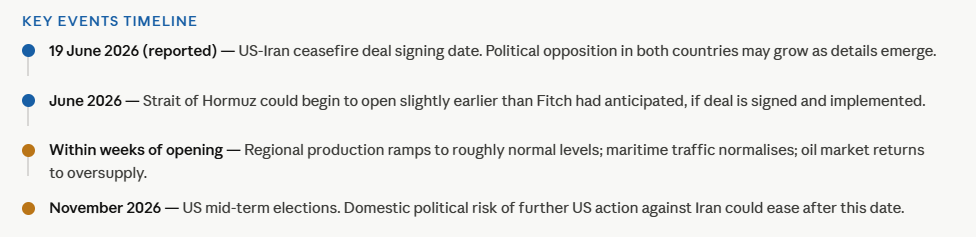
“There will now be heightened pressure on both sides to conclude it, but political opposition in both the US and Iran may increase as details of the planned agreement become clearer. It is unclear what expectations there will be around Israel, but these could become an obstacle to signing if the Israeli authorities are unwilling to adhere to any commitments in the deal that involve them,” it added.
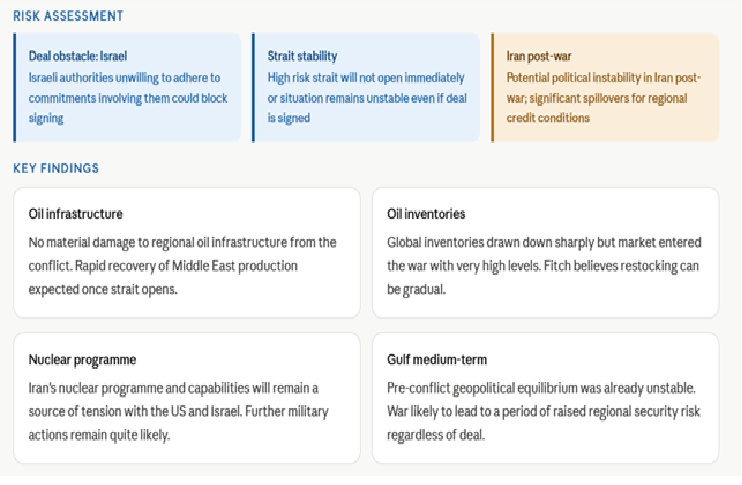
Medium-term prospects for the Gulf remain uncertain, even assuming that the agreement is signed. The pre-conflict geopolitical equilibrium was already unstable and the war is likely to lead to a period of raised regional security risk. It is not yet clear what the longer-term effects on business environments and demographic trends in countries affected by the war will be. There is also potential for further political instability in Iran post-war, which would have significant spillovers for regional credit conditions, the report said.
Israel’s role could also prove an obstacle. “It is unclear what expectations there will be around Israel, but these could become an obstacle to signing if the Israeli authorities are unwilling to adhere to any commitments in the deal that involve them.”
Iran’s nuclear programme and capabilities will remain a source of tension in its relations with the US and Israel, and that further US or Israeli military actions against Iran remain quite likely, though it is less clear whether these would lead to an escalated regional conflict including the closure of Hormuz.
Oversupply in oil market
On oil markets, Fitch expects the global oil market to return to oversupply in about a month if the strait is fully opened, as regional production ramps back up to roughly normal levels within several weeks and maritime traffic through the strait normalises. It added there appears to have been no material damage to regional oil infrastructure from the conflict.
A rapid recovery of Middle East production, strong non-Organisation of the Petroleum Exporting Countries supply growth, and potential OPEC output increases up to maximum production capacity will put downward pressure on oil prices, despite a residual geopolitical risk premium.
Brent crude is expected to average $70 a barrel in the fourth quarter of 2026 and $87 a barrel over 2026, with risks to the $87 projection skewing to the downside given the earlier-than-anticipated Hormuz reopening.

Even a temporary opening of the strait would allow restocking of hydrocarbons and other products produced in the region that are important for global supply chains, pushing back the date at which inventories could fall to levels sufficient to cause severe stress to the global economy, Fitch added.
Earlier this month, Fitch Ratings said it expects Brent oil price to hover about $87 a barrel (bbl), assuming the Strait of Hormuz reopens by the end of July, which would also lead to an oversupply. Read the story
Most Popular

4 days ago
DCGI Approves Toripalimab Combination Therapy for Advanced Oesophageal Cancer in India
Dr Reddy’s Laboratories’ Zytorvi, combined with cisplatin and paclitaxel, gains a first-line indication for…

1 hour ago
L&T Q2 cons net profit rises 33% to at ₹5,202 crore
The group’s consolidated revenue rose 16% to ₹78,750 crore, driven by progress in its…

3 days ago
Tech Mahindra partners with SpaceXSI to bring Grok AI coding tools into enterprise workflows
The collaboration will target legacy application modernisation, software development and developer productivity, with a…

4 days ago
CG Power’s consolidated Q2 net profit rises 44% to ₹409 crore
A sharp rise in Power Systems margins, swelling order book underpin the engineering conglomerate's…
