
Features
12 - 09 - 2026
India’s private wealth is going global faster than ever — but the exit routes may not be keeping pace
As GIFT City deepens as a gateway for outbound private capital, due diligence on exit mechanics — not just headline IRRs — may matter as much as manager selection itself
Recently, investor and the eternal ‘Big Bear’, Shankar Sharma, in an interview with NDTV Profit, was seen arguing that India’s record retail SIP inflows were effectively giving big FIIs and promoters a clean, liquid exit — absorbing their selling without denting share prices.
A similar inference crossed my mind as I read through the Morgan Stanley Investment Management’s study titled — “The Next Phase of Private Markets Growth.” Sharma’s logic, when applied to private markets, seems to cut even sharper: Indian family offices and HNIs routing money through GIFT City AIFs may be buying into aging global PE funds – just as the institutional Limited Partners get first claim on the liquidity being engineered to help everyone else exit.
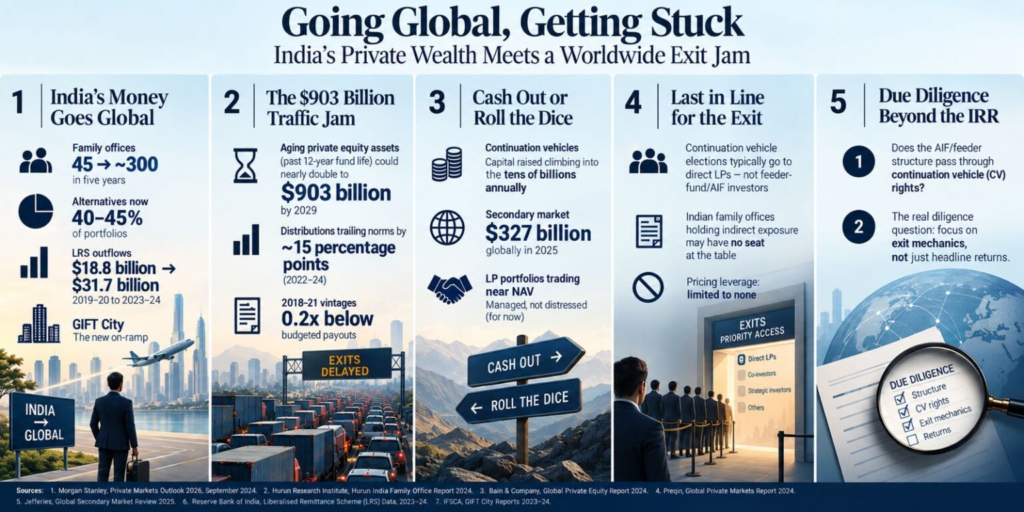
In other words, Indian investors, boxed in behind the layered feeder structures, could be the last in line for an exit fix, built originally for someone else. The report has much relevance at a time when Indian family offices continue to grow both in numbers and asset size – from roughly 45 to almost 300 and investing in alternative assets; private equity, venture capital, private credit – AIFs now account for 40-45% of their portfolios, according to a Julius Baer-EY report.
Liberalised Remittance Scheme (LRS) outflows, the conduit for much of this outbound capital, rose from $18.8 billion in 2019-20 to $31.7 billion in 2023-24. The GIFT City has become the preferred on-ramp, with HNIs and family offices routing a growing share of AIF allocations offshore as domestic equities have lagged.

The study highlights a section – Aging PE assets drive financing demand; here, Morgan Stanley Investment Management notes that the net value of unsold PE assets – sitting past their theoretical 12-year fund life – could nearly double to $903 billion by 2029. It seems the global private equity machine -these investors are buying into – is itself struggling to give reasonable returns.
Distributions as a share of NAV have trailed the historical norms by roughly 15 percentage points between 2022 and 2024 while the vintages – from 2018-2021 – are running about 0.2x below the budgeted payouts, as per industry researchers.
As such, for an Indian family office – that committed capital to a 2019 or 2020 vintage global buyout fund expecting a decade-long horizon – the practical outcome may be a longer wait than the fine print implied.
General Partners have responded by leaning harder on continuation vehicles (CVs) — new funds a sponsor sets up to buy assets out of an aging fund, giving Limited Partners a choice: cash out now, often at a discount, or roll over and stay exposed for another cycle.
Continuation-fund closings have grown sharply worldwide over the past several years, with capital raised climbing into the tens of billions annually, and Continuation Vehicles now account for a meaningfully larger share of direct private-equity fundraising than they did five years ago, according to data from Preqin, a specialized financial market intelligence database.
Dedicated secondary capital reached $327 billion globally in 2025 – which means that many are buying an existing LP’s position in a fund or assets out of an aging fund via a continuation vehicle – rather than committing fresh capital to new funds. Now, that’s a record pool of dry powder chasing these deals.
The report uses smart sentences like: “We are increasingly focused on the potential catalysts that could improve sentiment and reduce the perceived risks that have already received widespread attention. As that occurs, private credit assets have the potential to be re-valued upwards.” Investors need to read deeply to gauge these potential catalysts.
The only comforting factor is the fact most LP portfolios are transacting at close to the NAV, for now – a benign reading that could flip – if the situation turns.
The catch for Indian investors is structural. Continuation vehicles are typically offered to existing LPs of record — institutional pension funds, sovereign funds, endowments — not to feeder-fund investors routed through GIFT City AIFs or offshore PMS wrappers.
An Indian family office holding indirect exposure through a feeder structure may have little say in whether it gets the roll-or-cash option at all, and even less negotiating leverage on pricing if it does.
For India’s growing wealth-advisory industry, this raises a set of practical questions that go beyond returns: are feeder and AIF structures built to pass through CV elections and secondary liquidity to underlying Indian investors, or do they leave decisions entirely with the GP and the fund-of-funds manager?
As GIFT City deepens as a gateway for outbound private capital, due diligence on exit mechanics — not just headline IRRs — may matter as much as manager selection itself.
By Sreevalsan M
Most Popular

4 days ago
DCGI Approves Toripalimab Combination Therapy for Advanced Oesophageal Cancer in India
Dr Reddy’s Laboratories’ Zytorvi, combined with cisplatin and paclitaxel, gains a first-line indication for…

3 days ago
Tech Mahindra partners with SpaceXSI to bring Grok AI coding tools into enterprise workflows
The collaboration will target legacy application modernisation, software development and developer productivity, with a…

1 day ago
India’s Mumbai records 3,145 luxury property transactions in H1 FY27
The city registered 3,145 luxury residential property transactions worth ₹32,623 crore between April and…

3 days ago
Kotak Mahindra Bank’s profits soar, but margins refuse to join the party
Management expects the full-quarter impact of FCNR(B) deposits to weigh on margins in the…
