
Analysis
08 - 06 - 2026
Fitch expects Brent oil average at $87/bbl on late July Hormuz reopening
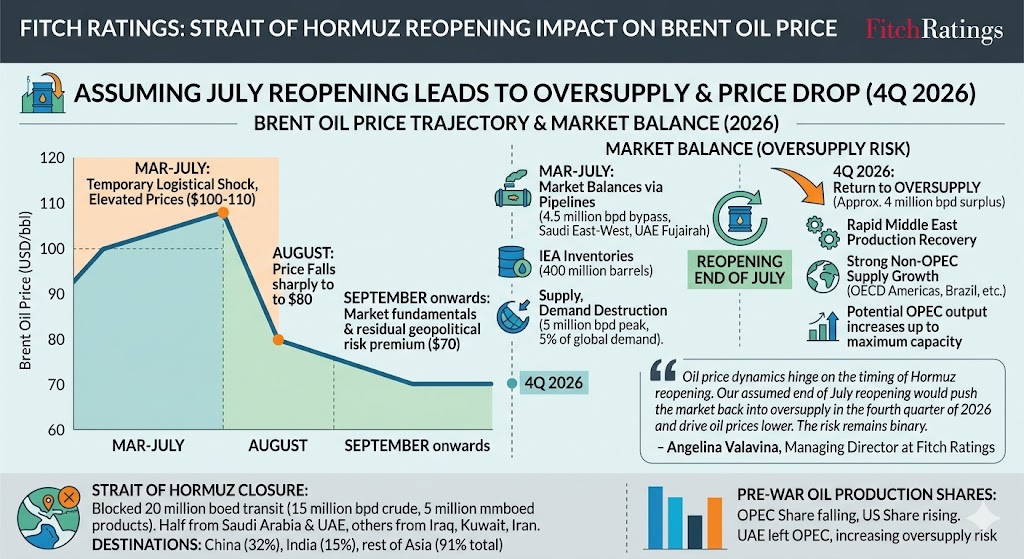
Assuming the strait reopens by July-end, the Brent is expected to fall sharply from the elevated March-July levels. The market would return to oversupply levels from September 2026
Fitch Ratings expects Brent oil price to hover about $87 a barrel (bbl), assuming the Strait of Hormuz reopens by the end of July, which would also lead to an oversupply.
The current escalation in oil prices reflects a temporary logistical supply shock rather than a lasting loss of production capacity, the rating agency said in a note.
Assuming the strait reopens around the end of July, the Brent is expected to fall sharply from the elevated March-July levels. The market would return to oversupply levels from September 2026 due to a lack of material damage to regional oil infrastructure, rapid recovery in Middle East production, and strong non-Organization of the Petroleum Exporting Countries (OPEC) supply growth.
Further, a potential OPEC output increases up to a maximum production capacity will also help.
Consequently, Brent is assumed to average $100-110 a barrel in May to July, before falling to $80 a barrel in August and to about $70 a barrel from September. The latter level is implied by market fundamentals plus a residual geopolitical risk premium.
“Oil price dynamics hinge on the timing of Hormuz reopening. Our assumed end of July reopening would push the market back into oversupply in the fourth quarter of 2026 and drive oil prices lower. The risk remains binary,” Angelina Valavina, managing director at Fitch Ratings, said.
SUPPLY CHANNELS, INVENTORIES
The effective closure of the Strait of Hormuz by Iran blocked the transit of 20 million barrels of oil equivalent per day (mmboed), which includes 15 million barrels per day (bpd) of crude oil and 5 million mmboed of oil products. This volume accounts for 20 per cent of global oil consumption, it added.
Saudi Arabia and the UAE accounted for half of the oil volumes transported through the strait before the conflict, while the remainder comprised exports from Iraq, Kuwait, and Iran. China and India were the destinations for half of these exported volumes.
The global oil market is expected to balance during the five-month closure through July via alternative pipelines, the release of 400 million barrels of inventories by the International Energy Agency (IEA), additional supply, and demand destruction.
Saudi Arabia’s East-West pipeline provides export capacity, while the UAE operates a pipeline to the Fujairah export terminal. Together, these pipelines provide 4.5 million bpd of spare capacity to bypass Hormuz, compared with the 15 million bpd of crude oil volumes that previously transited the strait.
There was a material demand destruction of 5 million bpd during the closure period, representing about 5 per cent of global oil demand. In March, demand destruction stood at 0.8 million bpd, averaging 1.6 million bpd across March and April.
REGIONAL VOLUMES, SURPLUS RISK
Asia accounted for 91 per cent of the oil sold through the strait before the conflict, with 32 per cent going to China and 15 per cent to India. China’s oil stocks stood at 1.2 billion barrels out of a global total of 8.2 billion barrels in January 2026.
Production in Organisation for Economic Co-operation and Development (OECD) Americas, Kazakhstan, Venezuela, Brazil, and Russia increased by 1.4 million bpd between February and April 2026. Fitch forecasts global oil supply to be about 2.9 million bpd lower on average in 2026 than in 2025, but expects the market to revert to a surplus of about 4 million bpd in the fourth quarter of 2026.
OPEC’s share of global oil production fell to 34 per cent in 2024 from 47 per cent in 1970, while the US share rose to 21 per cent in 2024 from 10 per cent in 2000. The UAE’s recent decision to leave OPEC, where it produced 3.6 million bpd or 12 per cent of OPEC’s output before the war, signals a shift to a volume over value strategy, implying weaker discipline and a higher risk of oversupply.
Most Popular

3 days ago
Kotak Mahindra Bank’s profits soar, but margins refuse to join the party
Management expects the full-quarter impact of FCNR(B) deposits to weigh on margins in the…

1 day ago
India’s Mumbai records 3,145 luxury property transactions in H1 FY27
The city registered 3,145 luxury residential property transactions worth ₹32,623 crore between April and…

4 days ago
Infosys Q2 net profit rises 6% to ₹7,823 crore
India's second-largest IT services company trims FY27 revenue guidance

50 minutes ago
L&T Q2 cons net profit rises 33% to at ₹5,202 crore
The group’s consolidated revenue rose 16% to ₹78,750 crore, driven by progress in its…
