
News
25 - 07 - 2026
Indian’s Education Minister Dharmendra Pradhan resigns
In an X post, Pradhan said the resignation was to prevent anti-national forces from exploiting it, preserving national unity…
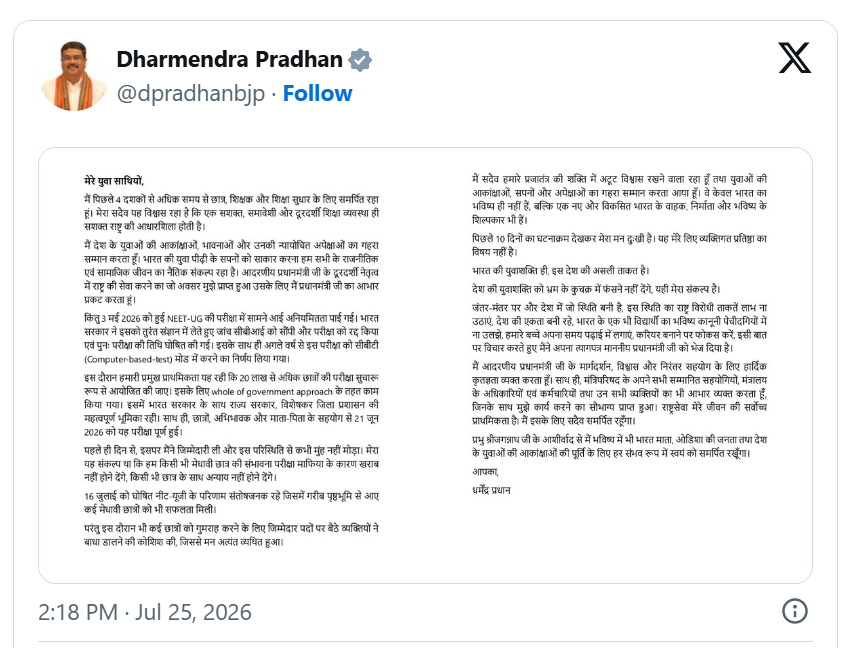
Indian’s Education Minister Dharmendra Pradhan resigned on Saturday, amidst mounting pressure from student protesters, following weeks of unrest across the country. The move comes ahead of the third round of talks between government representatives and the Cockroach Janta Party (CJP).
Pradhan, whose departure was the core demand of the agitating students, made the announcement on social media platform X (formerly Twitter).
“The developments of the past 10 days have saddened me deeply. This is not a matter of personal prestige for me. From the very first day, I took responsibility for the matter (NEET leak) and never turned away from this situation. My resolve was that we would not allow the examination mafia to destroy the prospects of any meritorious student,” Pradhan said on X.
“Considering the situation at Jantar Mantar and across the country—with the aim of preventing anti-national forces from exploiting it, preserving national unity, ensuring that not a single Indian student’s future gets entangled in legal complexities, and allowing our children to devote their time to studies and focus on building their careers—I have submitted my resignation to the Honorable Prime Minister,” the post said, adding, India’s youth are the country’s real strength.
Jantar Mantar erupts
Pradhan’s departure triggered jubilant scenes at Delhi’s Jantar Mantar, where thousands of protesters had turned the public square into their operational base.
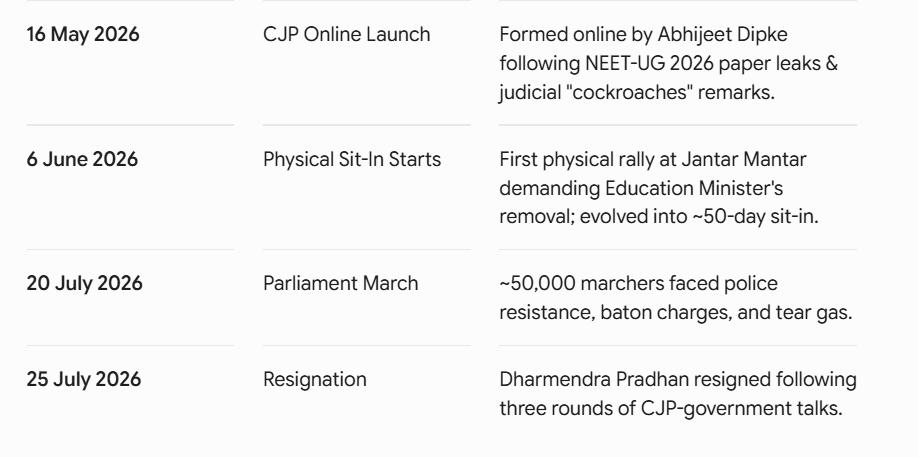
The CJP — a satirical youth political movement — was formed in May 2026 by political communications strategist Abhijeet Dipke. The group adopted its provocative name in response to controversial judicial remarks comparing unemployed youth to “cockroaches” and “parasites”. Though initially launched online, the movement rapidly evolved into a formidable national voice for youth grievances.
The immediate trigger for the massive demonstrations was widespread anger over alleged paper leaks and systemic corruption in the national medical entrance exam, NEET-UG 2026. Protesters accused authorities of jeopardising the futures of millions of young aspirants across the country.
Alongside the demand for Pradhan’s resignation, the CJP laid out several demads such as compensation for families to about ₹1 crore of NEET aspirants who had tragically died by suicide and amnesty for protesters including immediate withdrawal of all criminal charges.
Other demands included comprehensive, fast-tracked structural reforms to restore transparency and credibility to the national examination board.
Weeks of Unrest
The sit-in dharna at Jantar Mantar spanned over a month, commencing in mid-June and gathering momentum through July as solidarity rallies flared up in major cities including Mumbai, Hyderabad, and Chennai.
Tensions reached boiling point on Monday, July 20, when an estimated 50,000 protesters attempted to march from Jantar Mantar towards Parliament. Police forces deployed baton charges and tear gas to disperse the crowds, resulting in clashes that drew intense public and political condemnation.
Activist Sonam Wangchuk’s 25-day hunger strike further amplified the movement’s visibility, eventually concluding on Thursday night after assurances from ministers that student demonstrators would not face legal retaliation.
With Pradhan’s departure now secured, CJP leaders have signaled that whilst a primary objective has been achieved, the movement will continue to monitor government commitments regarding structural exam reforms and legal protections for student activists.
Most Popular

4 days ago
CG Power’s consolidated Q2 net profit rises 44% to ₹409 crore
A sharp rise in Power Systems margins, swelling order book underpin the engineering conglomerate's…

7 minutes ago
L&T Q2 cons net profit rises 33% to at ₹5,202 crore
The group’s consolidated revenue rose 16% to ₹78,750 crore, driven by progress in its…
3 days ago
Kotak Mahindra Bank’s profits soar, but margins refuse to join the party
Management expects the full-quarter impact of FCNR(B) deposits to weigh on margins in the…
4 days ago
DCGI Approves Toripalimab Combination Therapy for Advanced Oesophageal Cancer in India
Dr Reddy’s Laboratories’ Zytorvi, combined with cisplatin and paclitaxel, gains a first-line indication for…
