
News
18 - 07 - 2026
Skyroot Aerospace puts Vikram-1 in orbit, India’s first privately developed rocket
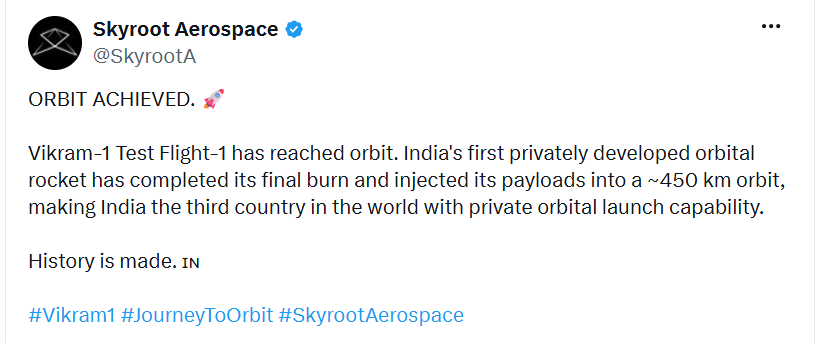
The country has become the third nation — joining the US and China – to possess the capability for private orbital launches.
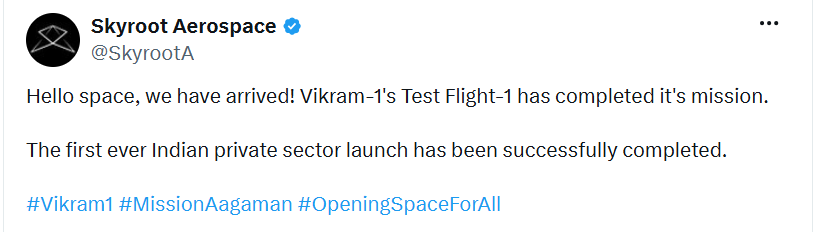
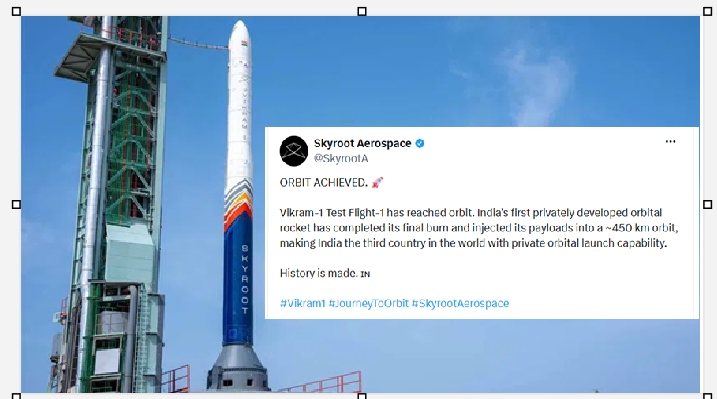
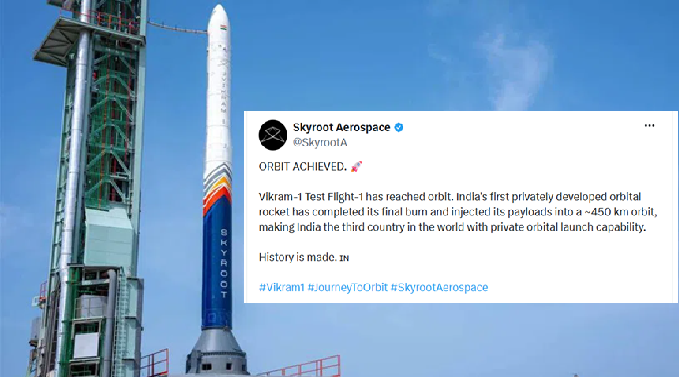
Hyderabad-based Skyroot Aerospace has achieved a historic milestone by successfully launching Vikram-1, India’s first privately developed orbital-class rocket, into space.
In a landmark flight, Skyroot Aerospace successfully executed its maiden orbital mission, “Aagaman” (Sanskrit for “Arrival”), on Saturday, July 18, 2026. The four-stage, all-carbon composite rocket lifted off from the Satish Dhawan Space Centre in Sriharikota, precisely placing its payloads into a 450 km Low Earth Orbit (LEO).
With this achievement, India has become the third nation — joining the US and China – to possess the capability for private orbital launches.
The mission served as a rigorous test for the firm’s in-house, 3D-printed engines and high-thrust solid rocket boosters, confirming the viability of indigenous private space hardware. The Vikram-1 carried several technology demonstration payloads, including Skyroot’s own SCOPE satellite, alongside scientific experiments from Grahaa Space, DCubed, and a robotic arm prototype from Cosmoserve Space.
Designed to carry up to 350 kg into orbit, the Vikram-1 platform is intended to function as an on-demand launch service for small satellites, offering a flexible and cost-effective alternative to traditional, legacy launch options. Industry experts suggest that the success of Aagaman validates the effectiveness of India’s recent space sector reforms, which are increasingly unlocking opportunities for private enterprises to lead in high-stakes aerospace innovation.
Following the successful deployment, Prime Minister Narendra Modi commended the Skyroot team, highlighting the mission as a testament to the prowess and ambition of Indian private sector innovation.
Designed to carry up to 350 kg into orbit, Vikram-1 is intended to function as an on-demand “cab service” for small satellites, offering a flexible and cost-effective alternative to traditional, constrained launch options.
Defining moment
Prime Minister Narendra Modi congratulated the Skyroot team for the successful launch of Vikram-1, describing it as “a defining moment in India’s space journey”.
“Spoke to the team of Skyroot Aerospace and congratulated them on the successful launch of Vikram-1. This is a defining moment in India’s space journey. The growing participation of our private sector is opening new frontiers and accelerating innovation. This achievement will encourage countless youngsters to dream bigger and innovate fearlessly,” Modi said in an X post.
Indian Space Research Organisation, the national space agency of India, Chairman V Narayanan also congratulated Skyroot Aerospace on Vikram-1 orbital success.
“This is the first successful attempt by an Indian private rocket to reach orbit. The space sector reforms announced in 2020 have made this possible. When private participation in the space sector began, we had only one startup. Today, we have more than 400 space startups. This is just the beginning under the leadership of our Prime Minister as we move towards making India a developed nation,” he said.
“Vikram-1 reached its designated orbit and deployed our own SCOPE satellite, Grahaa Space’s Solaras satellite, and other in orbit experiments making Skyroot the first private company to take a rocket to orbit on its very first flight. What the world witnessed today is the result of years of work by our team, our partners and suppliers across the country,” Pawan Goenka, Chairman, IN-SPACe said.
“It proves that India has the talent, the technology and the industrial strength to build launch vehicles that meet the world's standards and to serve the world from here. Our mission has always been to open space for all. Today we opened that door a little wider. This is not the destination. It is the beginning. From here, we leap,” Goenka added.
Most Popular

4 days ago
CG Power’s consolidated Q2 net profit rises 44% to ₹409 crore
A sharp rise in Power Systems margins, swelling order book underpin the engineering conglomerate's…

49 minutes ago
L&T Q2 cons net profit rises 33% to at ₹5,202 crore
The group’s consolidated revenue rose 16% to ₹78,750 crore, driven by progress in its…
4 days ago
DCGI Approves Toripalimab Combination Therapy for Advanced Oesophageal Cancer in India
Dr Reddy’s Laboratories’ Zytorvi, combined with cisplatin and paclitaxel, gains a first-line indication for…

3 days ago
Tech Mahindra partners with SpaceXSI to bring Grok AI coding tools into enterprise workflows
The collaboration will target legacy application modernisation, software development and developer productivity, with a…
