
News
17 - 07 - 2026
Skyroot Aerospace prepares for maiden orbital flight of Vikram-1 rocket
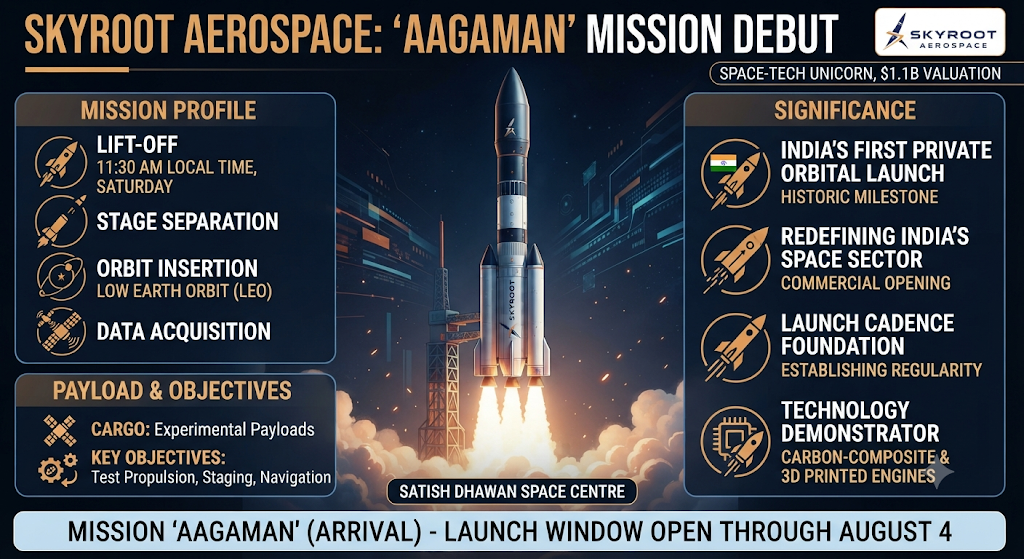
The launch is scheduled for 11:30 am local time on Saturday from the Satish Dhawan Space Centre in Bengaluru.
Hyderabad-based Skyroot Aerospace is preparing for the maiden orbital flight of its Vikram-1 rocket, a landmark mission poised to redefine the trajectory of India’s private space industry.
The importance of the launch stems from the fact that this is the first time a private Indian firm is attempting to place a payload into orbit.
The launch is scheduled for 11:30 am local time on Saturday from the Satish Dhawan Space Centre in Bengaluru.
The company, which earlier become a unicorn with a valuation of $1.1 billion, has dubbed the mission – Aagaman – as a crucial technology demonstrator. The seven-storey, carbon-composite rocket is designed to carry payloads of up to 350 kg into low-earth orbit (LEO).
“This is our first test flight, and we will be getting valuable data from it. This will be foundational to Skyroot’s aspirations of establishing a launch cadence,” Skyroot Aerospace Chief Executive Officer Pawan Kumar Chandana said in a statement.
Commercial Ambitions
The mission’s success would be a validation of India’s policy of opening its state-dominated space sector to private investment. Since the government eased regulations in 2020, startups have been racing to develop low-cost launch vehicles to meet the surging global demand for satellite constellations used in everything from telecommunications to weather monitoring.
Skyroot’s development timeline for the Vikram-1 has spanned several years and involved a network of more than 400 suppliers. The rocket features 3D-printed engine components and advanced guidance systems, technologies the company says will enable a modular and cost-effective approach to space access.
Technical Hurdles
While the flight is intended primarily to test the rocket’s propulsion, stage separation, and navigation, it carries a small manifest of experimental payloads, including technologies from companies such as Grahaa Space and DCubed.
Success is not guaranteed, however. The aerospace industry often faces significant risks during inaugural orbital attempts, and company officials have emphasised that the primary goal is data collection.
“With the in-flight data gathered from this mission, we will return to the shopfloor to learn, improve, and build further,” Chief operating Officer Naga Bharath Daka said.
The launch would also position Skyroot as a key player in a competitive field, challenging established global launch providers by offering a domestic alternative for satellite operators. The company is currently operating under a launch window that remains open through August 4.
Skyroot Aerospace is an Indian private aerospace manufacturer and commercial launch service provider founded by two former Indian Space Research Organisation scientists, Pawan Kumar Chandana, and Naga Bharath Daka.
Earlier in May, Skyroot Aerospace became India’s first space-tech unicorn following its latest round of funding of nearly $60 million, taking its valuation to $1.1 billion. The funding came from Sherpalo Ventures, Singapore’s sovereign wealth fund GIC, the founders of Greenko Group and Arkam Ventures, and others.
Most Popular

3 days ago
Kotak Mahindra Bank’s profits soar, but margins refuse to join the party
Management expects the full-quarter impact of FCNR(B) deposits to weigh on margins in the…

4 days ago
CG Power’s consolidated Q2 net profit rises 44% to ₹409 crore
A sharp rise in Power Systems margins, swelling order book underpin the engineering conglomerate's…

4 days ago
DCGI Approves Toripalimab Combination Therapy for Advanced Oesophageal Cancer in India
Dr Reddy’s Laboratories’ Zytorvi, combined with cisplatin and paclitaxel, gains a first-line indication for…

4 days ago
Infosys Q2 net profit rises 6% to ₹7,823 crore
India's second-largest IT services company trims FY27 revenue guidance
