
Analysis
18 - 07 - 2026
Strategic reforms, private investment enable India to touch the sky
The Indian Space Policy 2023 liberalised FDI norms, and brought in funding for the entire space value chain and fostered a dynamic ecosystem
For decades, the Indian Space Research Organisation (ISRO) was the only architect of the country’s celestial ambitions. Now the landscape being reshaped by reforms, anchored by the ‘Indian Space Policy 2023’, is helping private firms to explore the vast potential of space.
India’s integration of policy support, public-private-partnerships and consistent technological innovations are creating a powerful trajectory for private companies in the space sector.
The evolution from a state-led programme to a thriving, competitive space economy is a testament to the nation’s growing confidence. With continued commitment to these reforms, India is well positioned to secure its place as a leading global space power, driving the future of the international space economy and ensuring that the stars are within reach for India’s private sector.
The Indian Space Policy 2023 liberalised foreign direct investment (FDI) norms, and brought in funding for the entire space value chain, apart from fostering a dynamic ecosystem marked by growing startups, indigenous innovation, and expanding commercial activities.
The biggest beneficiary of the Indian Space Policy 2023 was ISRO’s commercial arm NewSpace India Ltd (NSIL). By focusing on the manufacturing and procurement of space systems, and delivering solutions for both government and non-government entities, NSIL’s revenue rose nearly 10-fold to ₹3,246.09 crore in FY25 from ₹321.77 crore in FY22.
As of July 2026, NSIL has successfully launched 141 satellites, including 138 international or customer satellites, making India a trusted and reliable global launch service provider, according to data released by Press Information Bureau (PIB).
Now, Hyderabad-based Skyroot Aerospace is the new kid on the block. Its successful launch of Vikram-1 on Saturday, India’s first privately-developed orbital rocket, makes India the third nation, after the United States and China, proves the private firms ability to tap the potential of this sector.
Financial empowerment
For the private sector to explore the potential of the space, financial empowerment is the cornerstone.
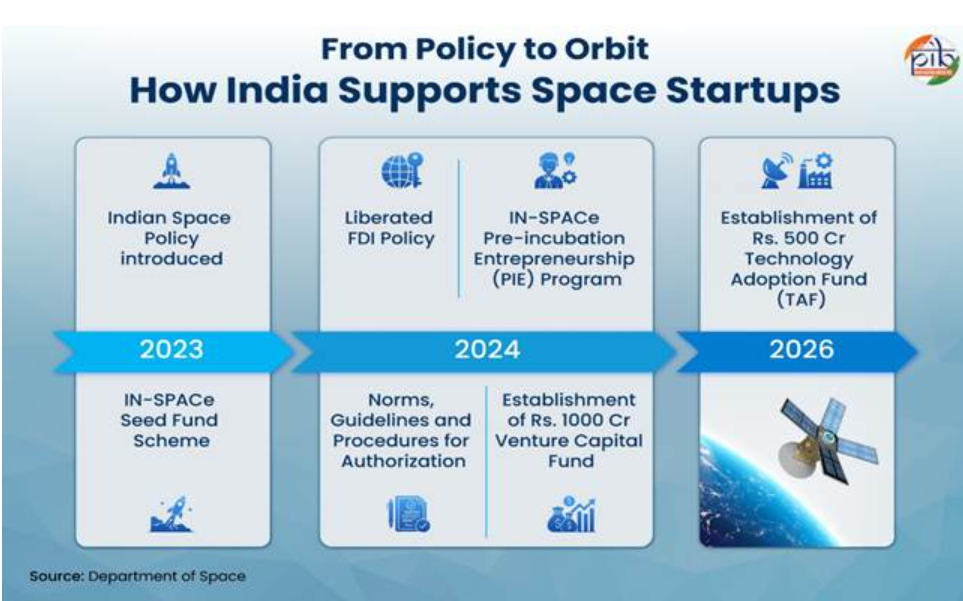
The Indian National Space Promotion and Authorisation Centre (IN-SPACe) Seed Fund Scheme provides essential early-stage financial assistance to space startups and Micro and Small Enterprises (MSMEs). By offering grants of up to ₹1 crore alongside mentorship, training, and networking support, this scheme is nurturing innovation in critical areas such as agriculture-related technologies, disaster management, and urban development.
To scale these efforts further, the government has introduced a ₹1,000-crore Venture Capital Fund to be deployed over five years through FY29-30. With annual investments projected to range between ₹100 crore and ₹250 crore, this initiative aims to expand the nation’s space economy five-fold over the coming decade, attracting private investment and fostering domestic manufacturing.
Additionally, the introduction of the ₹500 crore Technology Adoption Fund (TAF) is addressing the challenge of commercialising indigenous space technologies. By offering funding of up to 60 per cent of project costs for startups and Micro, Small, and Medium Enterprises (MSMEs), and up to 40 per cent for larger industries, this fund ensures that early-stage research is transformed into market-ready products. TAF has a maximum limit of ₹25 crore per project.
These commercialisation initiatives have begun yielding results. In February this year, the Indian National Space Promotion and Authorisation Centre (IN-SPACe) facilitated a ₹511 crore, 10-year transfer of Small Satellite Launch Vehicle (SSLV) technology to Hindustan Aeronautics Limited (HAL), a significant milestone.
Complementing these financial mechanisms is a liberalised FDI policy. By permitting up to 74 per cent automatic foreign investment in satellite manufacturing and operations, 49 per cent in launch vehicles and spaceports, and 100 per cent in the manufacturing of satellite components and subsystems, the government has signalled that India is open for global collaboration. This move will accelerate investments, promote collaborative research, and improve the ease of doing business, making India an increasingly attractive destination for global investors.
The success of these reforms is evident in the field.
From the execution of India’s first dedicated commercial Launch Vehicle Mark-3 mission in October 2022 (36 OneWeb satellites launched into Low Earth Orbit) to the efforts of private firms such as Agnikul Cosmos (the first Non-Government Entity to launch a rocket) and India setting up its first private launch pad (Dhanush) at Sriharikota in May, the sector is gaining momentum.
Whether through the demonstration of the world’s first single-piece 3D-printed semi-cryogenic rocket engine or the historic launch of Vikram-S under Mission Prarambh in November 2022, the private sector has proved its technical prowess.
Moreover, the success of Vikram-1 under mission ‘Aagaman’, is testimony to the growing confidence and capabilities of India’s private space industry. The journey from ISRO-led missions to a thriving space ecosystem demonstrates the success of the government’s reform agenda. With sustained policy support, public-private partnerships, and technological innovation, India is well positioned to emerge as a leading global space power and a key driver of the future space economy.
https://www.pib.gov.in/PressReleasePage.aspx?PRID=2286011®=48&lang=2
Most Popular
4 days ago
DCGI Approves Toripalimab Combination Therapy for Advanced Oesophageal Cancer in India
Dr Reddy’s Laboratories’ Zytorvi, combined with cisplatin and paclitaxel, gains a first-line indication for…

4 days ago
CG Power’s consolidated Q2 net profit rises 44% to ₹409 crore
A sharp rise in Power Systems margins, swelling order book underpin the engineering conglomerate's…

4 days ago
Infosys Q2 net profit rises 6% to ₹7,823 crore
India's second-largest IT services company trims FY27 revenue guidance

1 day ago
India’s Mumbai records 3,145 luxury property transactions in H1 FY27
The city registered 3,145 luxury residential property transactions worth ₹32,623 crore between April and…
