
Analysis
10 - 07 - 2026
Jefferies raises five-year China AI capex forecast to $1 trillion
The revision is based on long-term projections for AI investment in China, growth in chips, rise in power consumption requirements for data centres
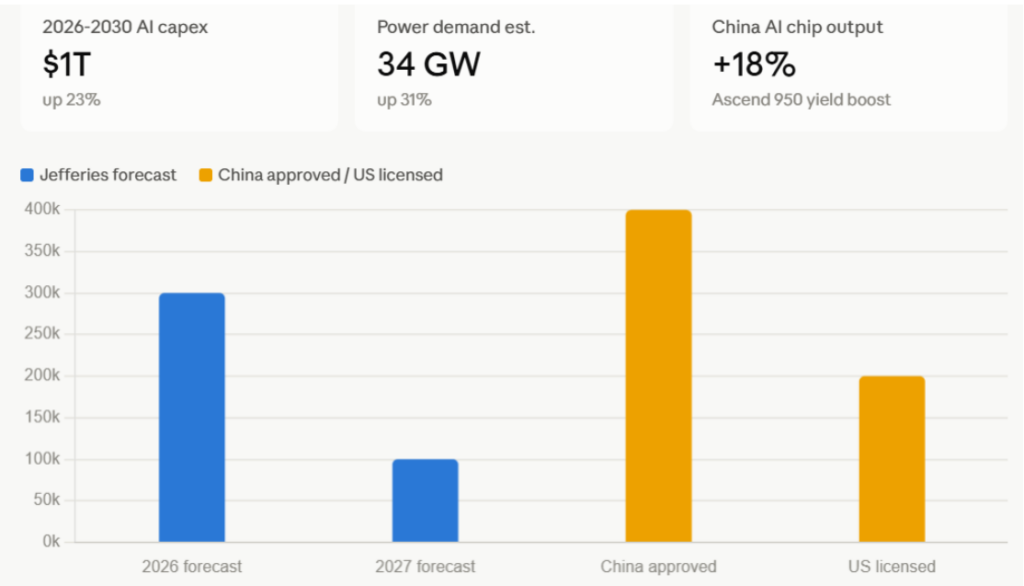
Jefferies has raised its 2026-2030 cumulative artificial intelligence (AI) capital expenditure forecast for the People’s Republic of China by 23 per cent to $1 trillion. The firm also increased its estimate for power demand by 31 per cent to 34 gigawatts (GW).
The investment bank states that China will buy 300,000 units of H200 (NVIDIA Corporation’s AI chip) in 2026 and 100,000 in 2027 as a stop-gap solution, given skyrocketing inference.
Furthermore, the firm expects China’s AI chip output to rise 18 per cent as Huawei Technologies has “cut die size but raised the clock rate (use more power) on Ascend 950 to boost yield but keep performance. The bank also forecasts “slightly higher unofficial imports beyond 2027”.
The report highlights a “serious” chip shortage that could hamper AI growth.
Jefferies notes that while The Information reported China would likely allow key AI players to buy more H200 chips to support AI growth, there remain significant obstacles.
“We believe that makes sense, at least as a short-term solution to support skyrocketing inference growth in China,” according to the report.
Severe chip shortage
Current industry checks indicate a “severe chip shortage and rapidly rising GPU rental in China, hampering AI players’ inference growth,” the document stated. Jefferies estimates China has approved 400,000 units, but the United States has licensed only 200,000.
Analysts have “cautiously” set projections at 300,000 for 2026 and 100,000 for 2027, citing “high” US resistance and the focus on localisation by Huawei and China. The analysis of these trends is detailed in the Jefferies report.
“Our understanding is that Huawei’s next-gen GPU Ascend 950 is one-third smaller than its predecessor (910) at 400 sqmm die size, which would likely boost foundry yield.”
While this design change is intended to increase chip output, it also affects power consumption.
“Ascend 950’s est power draw of 600W together with higher chip output means it would drive higher electrical power demand,” the report stated.
Looking at the broader market, the brokerage identified Advanced Micro-Fabrication Equipment Inc. China (AMEC), Semiconductor Manufacturing International Corporation (SMIC), and VNET Group (VNET) as its top picks.
The firm expects “semi capex to be consistently high and local WFE market share to steadily rise,” as China continues its efforts to localise AI technology components.
Most Popular

3 days ago
Tech Mahindra partners with SpaceXSI to bring Grok AI coding tools into enterprise workflows
The collaboration will target legacy application modernisation, software development and developer productivity, with a…
49 minutes ago
L&T Q2 cons net profit rises 33% to at ₹5,202 crore
The group’s consolidated revenue rose 16% to ₹78,750 crore, driven by progress in its…

4 days ago
CG Power’s consolidated Q2 net profit rises 44% to ₹409 crore
A sharp rise in Power Systems margins, swelling order book underpin the engineering conglomerate's…
4 days ago
DCGI Approves Toripalimab Combination Therapy for Advanced Oesophageal Cancer in India
Dr Reddy’s Laboratories’ Zytorvi, combined with cisplatin and paclitaxel, gains a first-line indication for…
