
Features
10 - 09 - 2026
Sunita Williams on the Human Future in Space: ‘We’re All on One Little Spacecraft’
At Bengaluru Space Expo, the NASA astronaut reflects on the changing role of astronauts, the promise of microgravity research and why humans, robots and AI must explore together
For Captain Sunita Williams, human spaceflight is not defined by a single mission, spacecraft or profession. It is a continuing process of construction, experimentation, problem-solving and international cooperation—one in which astronauts must increasingly function as engineers, scientists, operators and, at times, subjects of their own research.
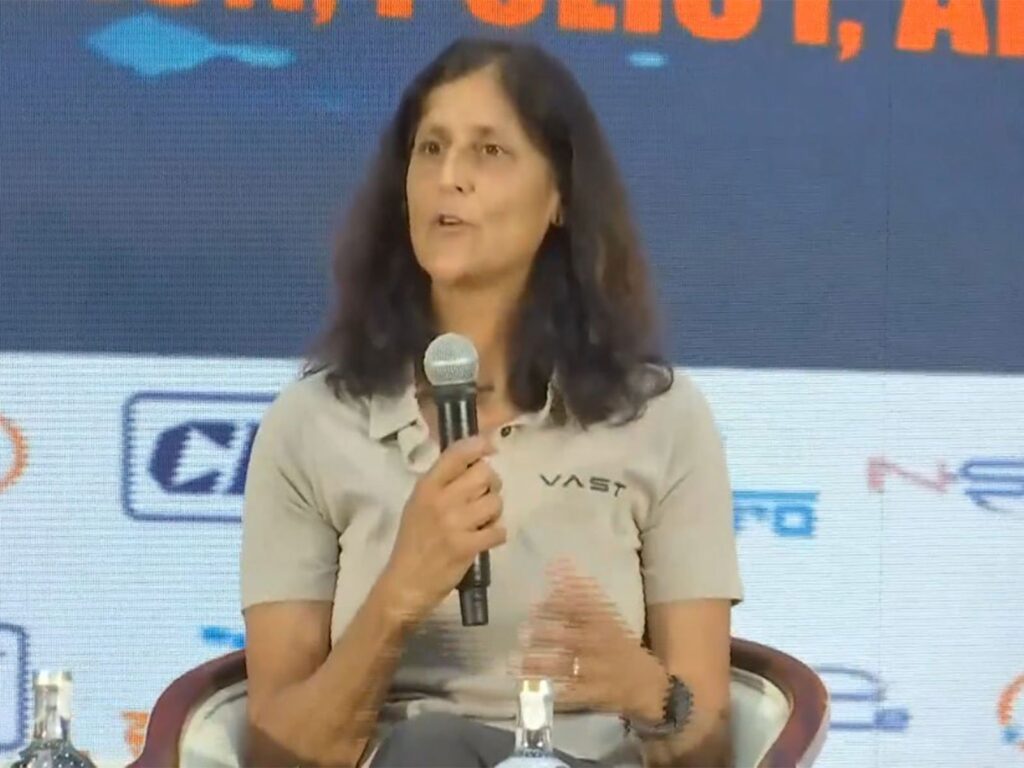
Speaking at the ninth Bengaluru Space Expo, Williams reflected on her experiences across three space missions and offered a view of how human exploration could evolve as countries move beyond the International Space Station towards commercial orbital platforms, lunar bases and eventually deeper destinations.
Williams was speaking during a panel titled “The Next Chapter of Space: A Conversation on Exploration, Science and Innovation,” moderated by Anand Rajagopalan, Executive Vice President, TakeMe2Space. She appeared alongside Group Captain Angad Pratap, Indian astronaut, and Tom Shelley, Vice President, Crew Partnerships, Vast Space.
For Williams, the evolution of human spaceflight is already visible in the changing nature of astronaut work.
Her first mission involved helping assemble the International Space Station (ISS) and coordinating with astronauts and engineers from multiple countries. Her second included working with Russian colleagues and conducting a wide range of experiments. Her most recent mission involved operating a new spacecraft, offering firsthand experience of the complexity and uncertainty involved in developing human-rated transportation systems.
The experiences reinforced a central reality of spaceflight: astronauts rarely perform just one role. They operate spacecraft, conduct scientific experiments, assemble and repair infrastructure, manage emergencies and participate directly in research into how the human body responds to space.
Microgravity Research
Williams said the scientific value of human spaceflight is not always immediately obvious.
She cited capillary-flow experiments conducted during an earlier mission as an example. Mathematical models and fluid experiments performed in microgravity later contributed to research into how nutrients can be delivered to plants in hydroponic systems.
Such research could become increasingly important as astronauts begin spending longer periods aboard space stations and eventually establish facilities on the Moon. Other areas of research conducted in orbit include DNA sequencing, materials science, biology and the effects of long-duration spaceflight on the human body and mind.
The significance of these experiments, Williams noted, may emerge years or even decades after the original research is conducted. An experiment begun during one mission can ultimately become relevant when scientists and engineers start designing a new generation of spacecraft, orbital stations or planetary habitats.
That long-term perspective is particularly important as human missions become longer and increasingly distant from Earth. Future space stations will need to think more independently
Williams said future orbital platforms will need to be considerably more autonomous than the ISS.
Astronauts aboard the station cannot simply access a comprehensive online database whenever they encounter an unfamiliar technical problem. They often depend on teams on Earth for instructions, troubleshooting and operational guidance.
That model becomes more challenging as human missions move farther from Earth. Communication delays between Earth and the Moon are manageable, but missions to more distant destinations could make immediate assistance impossible.
Future stations, Williams said, should therefore provide astronauts with extensive onboard databases and computing capabilities, allowing crews to find information and solve problems without constantly relying on ground teams. The same principle should apply to medical and scientific operations.
Astronauts should increasingly be able to analyse medical information and scientific results in orbit rather than sending every sample or dataset back to Earth for interpretation.
Manufacturing In Space
Microgravity also challenges technologies that are taken for granted on Earth. Williams pointed out that many machines designed for terrestrial environments rely on gravity in ways that are not always obvious.
Even conventional printing can become difficult in orbit because printers and other manufacturing equipment are often designed around gravity-dependent assumptions. Future manufacturing systems will therefore need to be developed specifically for microgravity.
Three-dimensional printing could become particularly important, allowing crews to manufacture tools, replacement parts and other equipment when transporting every component from Earth becomes impractical. Williams suggested that building such capabilities into new orbital platforms from the outset would be considerably easier than attempting to retrofit them onto the ISS.
The ISS has been operating for more than two decades and contains infrastructure designed around the requirements and technological assumptions of an earlier generation. New commercial and government stations, she said, provide an opportunity to integrate autonomous computing, manufacturing and scientific analysis directly into the architecture.
Humans, robots and AI must work together
Williams also rejected the idea that future exploration will require a choice between robotic and human missions. Robots can act as scouts on the Moon or Mars, examining potential landing sites, assessing environmental conditions and preparing the way for human crews.
But robotic systems are ultimately constrained by the knowledge and programming available when they are deployed. “I think humans, technology and robotics all need to work together,” Williams said.
Robots and artificial intelligence can gather information and perform routine or dangerous tasks, but humans remain essential when unexpected circumstances emerge. People can interpret new information, make judgments and alter the course of a mission in real time.
Williams compared robotic explorers to a first line of exploration—systems capable of investigating an environment before astronauts arrive. Once humans reach the site, however, they can respond to discoveries that were not anticipated when the mission was designed.
“AI can help us, but you need to get a human on site to actually make the decision and to take those next steps,” she said. The relationship between humans and machines, therefore, is not necessarily competitive.
Robots and AI can extend human capabilities, while human judgment remains crucial in environments where conditions are uncertain and the consequences of failure can be significant. Williams also highlighted the International Space Station as one of the strongest examples of international cooperation in human spaceflight.
Working alongside astronauts and engineers from different countries has allowed teams to compare approaches to spacecraft design, spacesuits, scientific experiments, safety procedures and problem-solving. “I love the International Space Station just because we get to contrast and compare—not only modules, but also the spacesuits and experiments, and how people think and how they solve problems,” she said.
Those differences, Williams argued, will become even more valuable as human exploration moves beyond low Earth orbit.
Crews travelling to the Moon and eventually farther destinations will encounter problems that cannot always be anticipated from Earth.
“We need to carry all those different thought processes with us,” Williams said, referring to the different ways countries and cultures approach complex problems.
International cooperation will consequently become increasingly important in developing lunar bases and other deep-space infrastructure, where no single country is likely to possess every capability required.
The view of Earth that changed her perspective
For Williams, the most powerful lesson of spaceflight has also been one of the simplest: Earth is a shared home.
She recalled the first time she saw the planet from space.
During a space-shuttle mission, she was working on the mid-deck when she was called to the flight deck to receive her space wings.
Looking through the window, she saw Earth below.
“There it is,” she recalled thinking. “The teachers are right—the planet is round.”
The scientific observation quickly became something much more profound.
Every person, plant and animal she knew existed on that single planet.
“It was just like, that’s where people are,” Williams said. “We’re all home and we’re all on one little spacecraft.”
The experience, she said, temporarily displaced the national and personal identities that normally define people’s lives.
She was not thinking primarily about being American or about her individual background. Instead, she was looking at Earth as a single shared home.
That perspective connected the emotional experience of spaceflight with a practical responsibility: protecting the planet and strengthening cooperation among the people who inhabit it.
The next chapter is bigger than any one mission
Williams’ message from Bengaluru was ultimately about changing the way humanity thinks about exploration.
The future will not be defined solely by faster spacecraft or more powerful rockets. It will depend on the ability to combine human judgment, scientific research, robotics, artificial intelligence, autonomous systems and international cooperation.
Astronauts will become increasingly multidisciplinary. Space stations will need to become more autonomous. Microgravity research will create new possibilities for science and manufacturing, while robots and AI will increasingly prepare environments for human exploration.
And as humans venture farther from Earth, cooperation will become less a matter of choice and more a practical necessity.
The image Williams carried back from orbit—Earth as one small spacecraft carrying everyone we know—may ultimately be as important to the future of human spaceflight as any new propulsion system or spacecraft.
“Humans, technology and robotics all need to work together,” she said.
It is a principle that could define not just the next generation of spacecraft, but humanity’s longer journey from low Earth orbit to the Moon, Mars and beyond.
By Subramanya Joshi
Most Popular

3 days ago
Kotak Mahindra Bank’s profits soar, but margins refuse to join the party
Management expects the full-quarter impact of FCNR(B) deposits to weigh on margins in the…

1 day ago
India’s Mumbai records 3,145 luxury property transactions in H1 FY27
The city registered 3,145 luxury residential property transactions worth ₹32,623 crore between April and…

4 days ago
Infosys Q2 net profit rises 6% to ₹7,823 crore
India's second-largest IT services company trims FY27 revenue guidance
3 days ago
Tech Mahindra partners with SpaceXSI to bring Grok AI coding tools into enterprise workflows
The collaboration will target legacy application modernisation, software development and developer productivity, with a…
