
Analysis
13 - 08 - 2026
Indian payments firms raised about $5.8 billion across 371 equity rounds
A Tracxn report shows cross-border UPI transactions grew more than 20-fold in FY25 to over 7.5 lakh
Indian payments companies have raised about $5.8 billion across 371 disclosed equity rounds since January 2021, launched eight Initial Public Offerings (IPOs) and did 25 acquisitions.
Five companies – CRED and PhonePe (about $1 billion each), Pine Labs ($641 million), Razorpay ($535 million) and BharatPe ($440 million) – bagged about two-thirds of the total disclosed funding. This is a signal that investors are backing scaled category leaders over the long tail, according to a report by market intelligence platform Tracxn.
According to the report, consumer-facing payments drew 53 per cent of capital ($3.1 billion), ahead of business payments at 38 per cent ($2.2 billion) and the enabler layer (the APIs, switches and infrastructure others build on) at 9 per cent ($526 million).
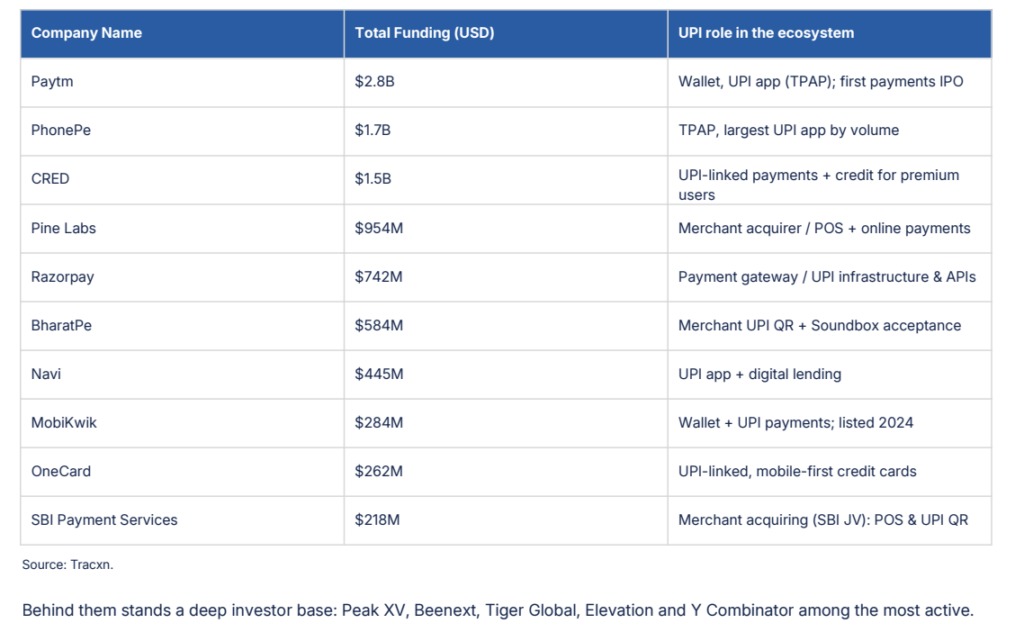
Across their lifetimes, the 10 best-funded companies have raised $9.4 billion, led by Paytm ($2.8 billion), PhonePe ($1.7 billion) and CRED ($1.5 billion). In every case the capital flowed to the UPI ecosystem: PSPs and TPAPs, merchant acquirers, UPI-linked credit, and the plumbing beneath them. In every case the capital flowed to the UPI ecosystem such as Payment Service Providers (PSPs) and Third-Party Application Providers (TPAPs), merchant acquirers, UPI-linked credit, and the plumbing beneath them.
Returning Capital
The industry is now returning capital, and an industry that can return capital is a maturing one, and UPI’s ecosystem now clears that bar, Tracxn report said.
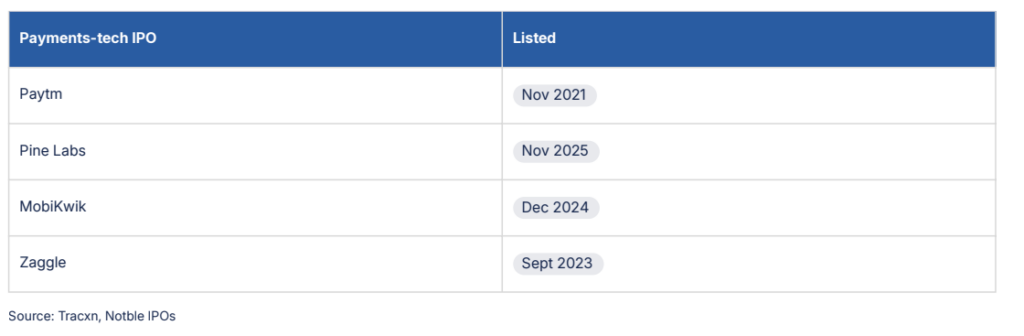
The set records eight payments-sector IPOs since 2021, headlined by Paytm (listed November 2021) and Pine Labs (November 2025), alongside MobiKwik and Zaggle. Public markets are absorbing home-grown payments companies at scale, a marked shift from an ecosystem that until recently could only raise private rounds.
Consolidation is the second exit route and the funded companies are the ones buying. Razorpay absorbed Ezetap ($200 million) and IZealiant; Pine Labs took Setu ($75 million) and Mosambee; and M2P, Juspay, PayU and Perfios all bought capability. The companies UPI enabled are now internalising the ecosystem around them, turning a fragmented field into a smaller set of full-stack platforms.
UPI now runs close to half the world’s real-time payments (about 49 per cent). It cleared about ₹314 lakh crore in FY26 at roughly 66 crore transactions a day, the demand base that made this private industry investable. Cross-border UPI transactions grew more than 20-fold in a single year, from 37,060 in financial year 2024 (FY24) to over 7.5 lakh in FY25, and the rail is now live in 12 countries.
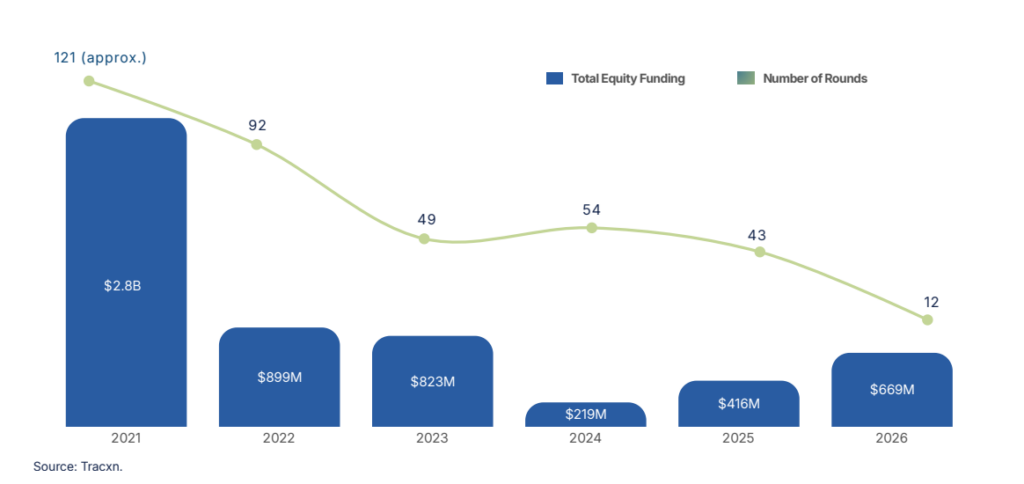
Funding peaked in the 2021 boom, corrected through 2022-2024 winter and showed a tentative recovery in 2026, concentrated in CRED’s $540 million round.
The process cost of a UPI transaction is about 0.25 per cent, and government incentives covers only 10-11 per cent of that, while the new MDR enabling provision is an to close the gap.
Expansion (credit-on-UPI, cross-border corridors, offline and feature-phone rails, and fraud defence) has historically been financed by private capital, not the subsidy line.

Most Popular

4 days ago
DCGI Approves Toripalimab Combination Therapy for Advanced Oesophageal Cancer in India
Dr Reddy’s Laboratories’ Zytorvi, combined with cisplatin and paclitaxel, gains a first-line indication for…

1 day ago
India’s Mumbai records 3,145 luxury property transactions in H1 FY27
The city registered 3,145 luxury residential property transactions worth ₹32,623 crore between April and…

4 days ago
CG Power’s consolidated Q2 net profit rises 44% to ₹409 crore
A sharp rise in Power Systems margins, swelling order book underpin the engineering conglomerate's…
50 minutes ago
L&T Q2 cons net profit rises 33% to at ₹5,202 crore
The group’s consolidated revenue rose 16% to ₹78,750 crore, driven by progress in its…
