
Analysis
28 - 05 - 2026
India toll collection growth to slow to 5-7% on West Asia friction
Geopolitical disruptions are set to temporarily dampen near-term commercial freight traffic, but long-term asset credit profiles remain insulated
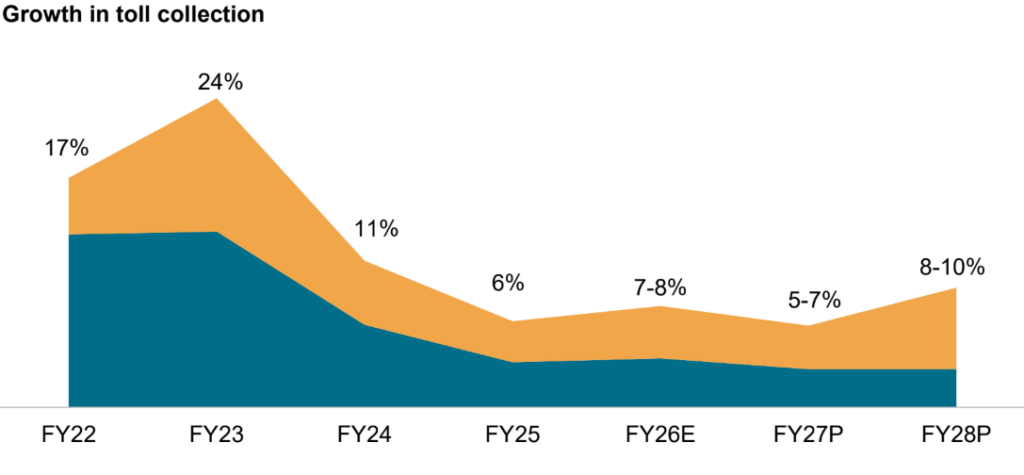
The growth in toll collection in India is seen moderating to 5-7 per cent amidst the West Asia conflict, according to a Crisil report.
The percolating economic impact of the West Asia conflict and a consequent deceleration in commercial traffic is likely to moderate growth in toll collection by 150-200 basis points on-year this fiscal, it said.
The marginal underperformance is temporary and is likely to be recouped next fiscal, due to relatively higher toll rate hikes compelled by inflationary pressures.
The toll rate hike in a fiscal year is based on the Wholesale Price Index (WPI) inflation of the previous year.
This underscores the resilience of toll road assets through economic cycles. Healthy operating performance and controlled leverage should keep credit profiles of toll road operators stable.
TRAFFIC MOMENTUM
“Traffic growth, a function of economic expansion, is estimated at 2-4 per cent in the near term. A modest WPI inflation of last year will limit toll rate hikes this fiscal and consequently, toll collection will grow 5-7 per cent. However, next fiscal toll rates may see a steeper increase due to higher WPI inflation, expected this fiscal amid the West Asia conflict. This will drive toll collection growth to 8-10% next fiscal,” says Manish Gupta, Deputy Chief Ratings Officer, Crisil Ratings.
There are unique drivers for commercial and passenger traffic. Commercial traffic remains the backbone of toll collection, typically contributing about 75 per cent. Freight movement is closely linked to industrial output, construction activity and mining, which may be impacted amid the West Asia conflict – as reflected in sequential degrowth in fastag toll collections in March and April.
Passenger traffic, on its part, continues to benefit from rising vehicle ownership, better connectivity and time savings enabled by improved road infrastructure. While the contribution of passenger traffic to overall toll collection is lower, it has outpaced commercial traffic in growth over the past few years. Improved road quality and expressway connectivity are likely to support this trend going forward as well. Moreover, this segment is less affected by geopolitical events.
While the overall road traffic growth remains steady, around one-fourth of the assets from Crisil Ratings sample saw a decline in traffic over the last two fiscals. Diversion to new highways and expressways was a key reason for the decline, affecting about 12per cent of the assets. Other factors such as heavy monsoons, sand mining ban, normalisation following a temporary traffic surge, and feeder route issues impacted another about 12 per cent of the assets.
“Notably, more than 80 per cent of the assets from Crisil Ratings sample are a part of infrastructure investment trusts (InvITs) or pooled portfolios. Consequently, diversity of assets helps cushion the impact. Controlled leverage maintained under the InvIT structure, along with resilient operating performance, will keep the debt service coverage ratio of toll road assets strong at 1.5 times this fiscal and the next. Consequently, credit profiles will remain stable,” says Anand Kulkarni, Director, Crisil Ratings.
POLICY INTERVENTIONS
While policy interventions have occasionally influenced toll collection, their overall impact has been manageable. For instance, the introduction of an annual pass for non-commercial passenger vehicles (effective August 15, 2025) resulted in a 5-7 per cent impact on overall toll collection in the last quarter of fiscal 2026. However, the impact is being compensated by the authority to concessionaires, thereby preserving credit stability.
Significant weakening in the macroeconomic environment amid the West Asia conflict, particularly affecting commercial traffic, will warrant close monitoring, it said.
Most Popular

1 day ago
India’s Mumbai records 3,145 luxury property transactions in H1 FY27
The city registered 3,145 luxury residential property transactions worth ₹32,623 crore between April and…

4 days ago
Infosys Q2 net profit rises 6% to ₹7,823 crore
India's second-largest IT services company trims FY27 revenue guidance
3 days ago
Kotak Mahindra Bank’s profits soar, but margins refuse to join the party
Management expects the full-quarter impact of FCNR(B) deposits to weigh on margins in the…
51 minutes ago
L&T Q2 cons net profit rises 33% to at ₹5,202 crore
The group’s consolidated revenue rose 16% to ₹78,750 crore, driven by progress in its…
