
Analysis
26 - 08 - 2026
India permits duty-free raw sugar imports to curb rising prices: Crisil
Dealers can hold upto 4,000 quintal of sugar for not more than 30 days, bulk consumers can maintain inventories of 15 days from Sept 1 to Nov 30, 2026.
The Indian government has permitted duty-free imports of 1 million metric tonne (MMT) of raw sugar under a Tariff Rate Quota (TRQ) scheme until October 31, 2026, to contain rising prices of the commodity.
This comes amidst falling inventory with closing Stock for Sugar Season 2026 (SS26) estimated at 3.9 MMT, down 25 per cent from SS25 and 40 per cent below the five-year average of 6.5 MMT. The country is gearing up to celebrate the festive season, beginning with festivals such as Onam, Raksha Bandhan, and Varalakshmi Vrat this month.

Through a notification dated August 20, 2026, the government has imposed stock limits on dealers, wholesalers and bulk consumers to prevent hoarding and support market availability.
Dealers and wholesalers can hold a maximum of 4,000 quintal of sugar for not more than 30 days, while bulk consumers using more than 10 metric tonne per month can maintain inventories equivalent to only 15 days of consumption from September 1 to November 30, 2026, according to a report by Crisil Intelligence.
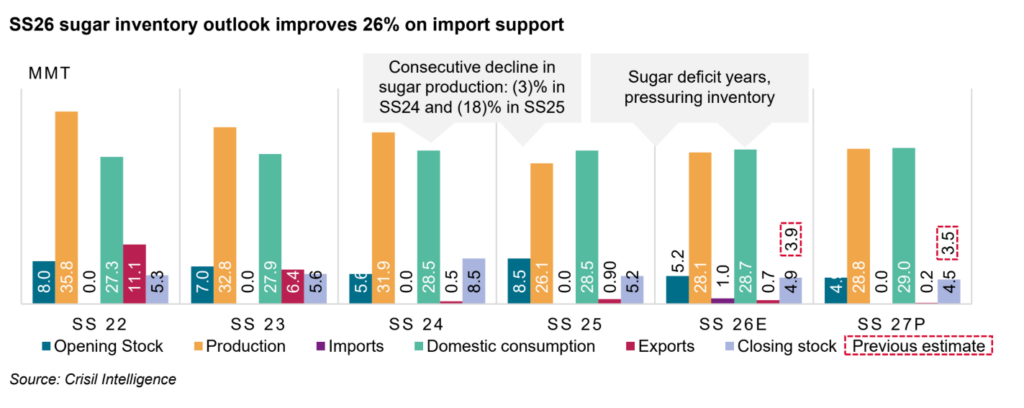
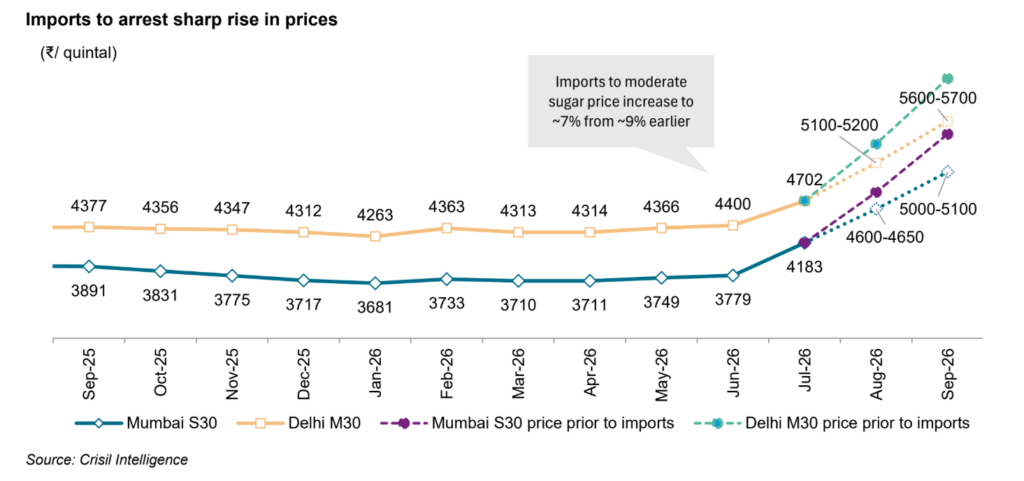
Duty-free imports of 1 MMT are expected to raise SS26 closing inventories to 4.9 MMT, improving the stock cover from about 1.5 months to nearly two months of domestic consumption. The additional supply is expected to moderate the increase in sugar prices, with average SS26 prices now projected to rise about 7 per cent, compared with the earlier estimate of 9 per cent.
In July 2026, Mumbai S-30 and Delhi M-30 prices were about 11 per cent higher on-year, with on-month increases of 11 per cent and 7 per cent, respectively. While prices are expected to continue rising in August-September despite the approval of imports, the magnitude of the increase is now likely to be 300-500 basis points (bps) lower than the previously expected about 15-20 per cent rise.
Consecutive declines in sugar production, down 3 per cent in SS24 and 18 per cent in SS25 due to lower yields and reduced acreage, coupled with higher diversion of sugar equivalent towards ethanol, significantly tightened inventories despite steady growth in consumption.
Ethanol diversion rises
Ethanol diversion has increased consistently over the past five years, rising from about 0.8 million tonne in SS20 to more than 3 million tonne in SS26, with further increases expected in SS27. The resultant supply tightness, along with rising cane costs driven by higher Fair and Remunerative Price (FRP) and State Advised Price (SAP), supported a sharp increase in sugar prices.
Although sugar production is estimated to recover by about 8 per cent in SS26, robust domestic demand and low opening stocks are expected to keep inventories under pressure.
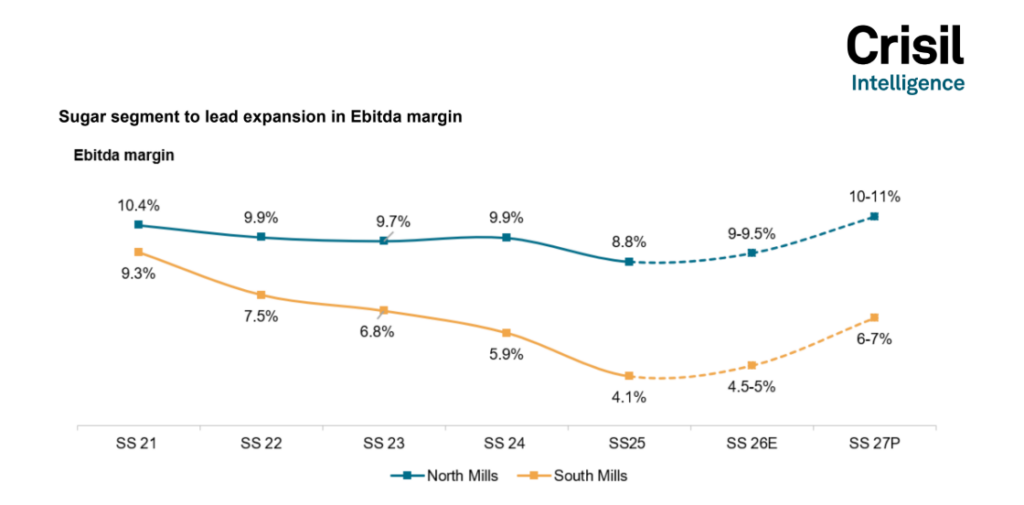
For SS26, integrated sugar mills are expected to record only a modest about 50 bps margin expansion despite a sharp increase in sugar price realisations. The upside from higher sugar prices and moderate volume growth is likely to be largely offset by increased cane costs, with FRP and SAP expected to rise by 4.4 per cent and 8.3 per cent, respectively.
Earnings Before Interest, Tax, Depreciation and Amortisation (EBITDA) margin of integrated sugar mills to rise a modest 50 bps in SS26 and 100-200 bps in SS27. Profitability in the distillery and cogeneration segments is expected to remain broadly stable, supported by steady ethanol prices despite softer distillery volumes.
For SS27, lower closing inventories are expected to support sugar price realisation, while improved performance in the distillery and cogeneration segments should strengthen overall profitability. Industry margins could expand 100-200 basis points during the season.
If you spotted a mistake or have feedback on this story, write to us at editor@newsassociate.com. Email us your press releases on the same ID.
Most Popular

1 day ago
India’s Mumbai records 3,145 luxury property transactions in H1 FY27
The city registered 3,145 luxury residential property transactions worth ₹32,623 crore between April and…

4 days ago
CG Power’s consolidated Q2 net profit rises 44% to ₹409 crore
A sharp rise in Power Systems margins, swelling order book underpin the engineering conglomerate's…

4 days ago
DCGI Approves Toripalimab Combination Therapy for Advanced Oesophageal Cancer in India
Dr Reddy’s Laboratories’ Zytorvi, combined with cisplatin and paclitaxel, gains a first-line indication for…

3 days ago
Kotak Mahindra Bank’s profits soar, but margins refuse to join the party
Management expects the full-quarter impact of FCNR(B) deposits to weigh on margins in the…
