
Analysis
25 - 06 - 2026
West Asia truce limits Indian corporate margin hit to 100 bps
Previously, assuming a prolonged conflict, analysts had pencilled in a much steeper impact of 200 bps
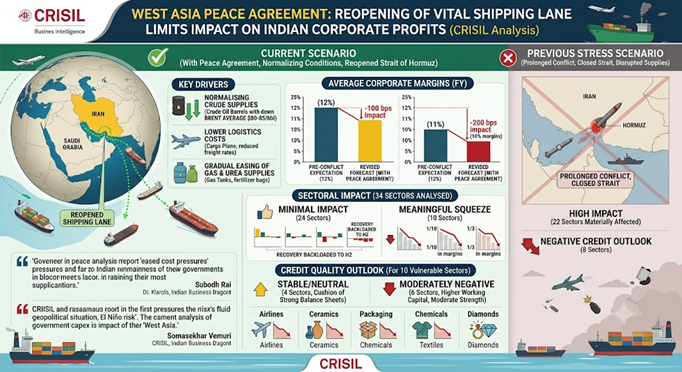
A peace agreement in West Asia will limit the impact on Indian corporate profits to 100 basis points (bps) as the reopening of a vital shipping lane eases pressure on margins.
This follows an analysis of 34 sectors exposed to the conflict by Crisil.
This will bring average margins to around 11 per cent this financial year, down from the 12 per cent expected before the hostilities broke out. Previously, assuming a prolonged conflict and the closure of the Strait, analysts had pencilled in a much steeper impact of 200 basis points, it said.
“The recent sharp correction in crude oil prices and likely normalisation of gas supplies are beneficial for India Inc as that would ease cost pressures meaningfully. If the armistice sustains, two-thirds of the 34 sectors will see minimal disruption, with margin recovery in the second half mostly offsetting pressures of the first half,” Subodh Rai, Managing Director, Crisil Ratings, said.
“But the risk of conflict escalation persists, so we foresee corporate India staying cautious and continuing to focus on supply-chain diversification,” Rai added.
The impact on both revenue and margins will be minimal for 24 of the analysed sectors, with their recovery largely backloaded to the second half of the financial year. The remaining 10 sectors face a meaningful squeeze, with operating margins declining by one-tenth to one-third compared with pre-conflict estimates.
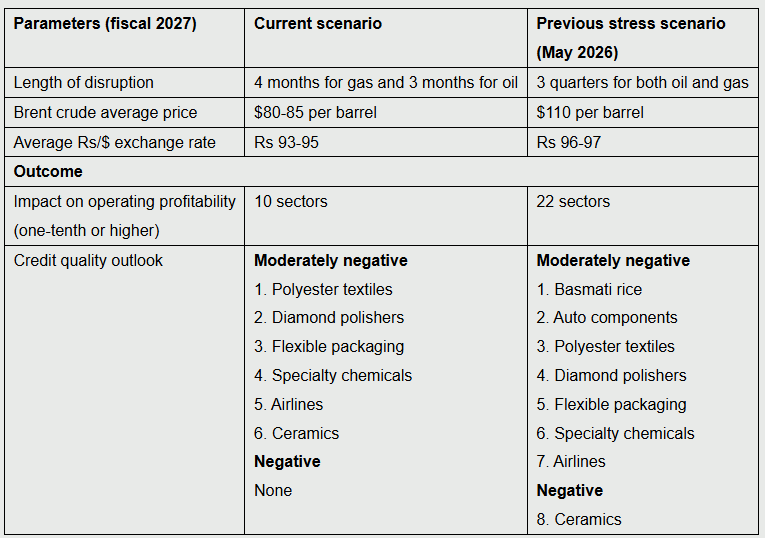
The sectoral analysis, which represents 65 per cent of rated corporate debt, assumes that crude oil supplies will normalise quickly and that the price of Brent crude will average $80-85 per barrel in this financial year. Gas supplies are expected to lag slightly, with total disruptions assumed to last four months this financial year. The reopening of the Strait is also projected to gradually reduce India’s reliance on expensive spot gas.
For four of these 10 vulnerable sectors, the credit quality outlook remains stable or neutral, as strong balance sheets are expected to cushion the impact of lower profitability. For the remaining six sectors, the credit quality outlook is moderately negative due to a profitability hit of one-tenth or more, higher working capital requirements, and moderate balance-sheet strength.
The reopening of the Strait of Hormuz following a tenuous United States-Iran memorandum of understanding (MoU), if enduring, is expected to materially ease profitability pressures on Indian companies for the remainder of the financial year compared to earlier, harsher forecasts.
Energy markets have reacted quickly to the diplomatic breakthrough, causing crude oil prices to soften. However, the availability of critical inputs such as gas and urea is projected to improve only gradually while structural supply-side disruptions caused by the conflict are resolved. Currently, the number of vessels transiting the Strait remains well below levels seen before the conflict.
Domestic demand conditions in India remain supported by government-led infrastructure spending and expectations of steady consumer consumption. Furthermore, calibrated price increases introduced by companies to offset rising input costs are expected to support overall realisations.
“The correction in crude oil prices and the gradual easing of both shipping-related costs and gas supplies provide timely relief to India Inc. While supply-side pressures are expected to abate, the geopolitical situation in West Asia remains fluid and escalation risks persist. Nevertheless, softer crude prices would support the government’s ability to sustain its capital expenditure push and respond to any demand-side impact. This becomes particularly relevant as El Niño poses risks to the monsoon and, in turn, domestic rural demand,” Somasekhar Vemuri, Senior Director at Crisil Ratings said.
Oil supplies normalise
In the airline sector, margin compression in the first half of the year is unlikely to fully reverse due to currency pressures, capacity rationalisation, and constrained pricing power, which will continue to strain profitability.
Meanwhile, elevated fuel costs, limited gas availability, and a consequent decline in capacity utilisation will compress ceramics margins in the first quarter, with only a partial and gradual recovery expected over the rest of the financial year as supply conditions improve.
For commodity-linked sectors, including flexible packaging, specialty chemicals, and polyester textiles, high input costs and a moderate ability to fully pass these costs on to consumers will weigh on margins. Persistent disruptions to demand will also weigh on both volume and profitability for diamond polishing, delaying a sector-wide recovery.
Crucially, no single sector is expected to witness a high impact on either revenue or profitability at this stage.
The relatively mild impact stands in sharp relief to the previously assessed stress scenario, which assumed a disruption lasting up to three quarters. Under that prolonged scenario, as many as 22 sectors would have experienced material margin pressure, defined as a decline of one-tenth or more in operating profitability, and about eight sectors would have faced a moderately negative or negative credit quality outlook due to limited financial buffers.
Most Popular

3 days ago
Tech Mahindra partners with SpaceXSI to bring Grok AI coding tools into enterprise workflows
The collaboration will target legacy application modernisation, software development and developer productivity, with a…

4 days ago
DCGI Approves Toripalimab Combination Therapy for Advanced Oesophageal Cancer in India
Dr Reddy’s Laboratories’ Zytorvi, combined with cisplatin and paclitaxel, gains a first-line indication for…

4 days ago
CG Power’s consolidated Q2 net profit rises 44% to ₹409 crore
A sharp rise in Power Systems margins, swelling order book underpin the engineering conglomerate's…

4 days ago
Infosys Q2 net profit rises 6% to ₹7,823 crore
India's second-largest IT services company trims FY27 revenue guidance
