
Analysis
12 - 06 - 2026
Strong leisure demand to anchor Indian hotel sector growth in FY27
An increase in leisure travel, social events is expected to counter rising cost pressures from geopolitical tensions, helping sector to maintain stable cash flows and low financial leverage: Ind-Ra
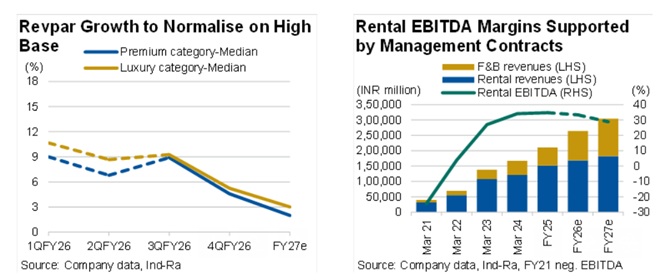
India’s hotel sector is expected to sustain its structural upcycle in financial year 2027 according to India Ratings and Research (Ind-Ra). (FY27), with revenue per available room (RevPAR) remaining resilient across its rated portfolio despite moderating growth and geopolitical headwinds.
Occupancy is expected to remain around FY26 levels at nearly 74 per cent, supported by a strong leisure demand, social events and a shift in consumer spending towards experiences over goods, although corporate travel may soften due to oil-led cost pressures,
“Our baseline estimates on the hotel sector demand and supply growth range from 10%-15% yoy in FY27, leading to sustained robust operating cashflows even as RevPAR growth normalises. Key industry players have focused on brownfield investments and leasing models to swiftly add capacity and capitalise on strong spending trends. We further expect major hotel operators to continue outperforming the industry in FY27, on back of continued industry consolidation,” says Mahaveer Shankarlal, Director, Corporates, Ind-Ra.
“Within segments, leisure and luxury are likely to remain more resilient than the premium and business. Despite strong supply additions, the balance sheet leverage is likely to remain low, with the capacity to absorb the risk of a near-term oil shock,” Shankarlal added.
Demand-supply growth of 10–15 per cent year on year (yoy) is likely to support healthy cash flows across rated entities, even as average room rate (ARR) growth approaches its cyclical peak, signalling pricing stabilisation.
Operating cash flows are expected to remain stable, supported by an improved revenue mix. Overall, Ind-Ra expects its rated portfolio to maintain strong credit profiles, with balance sheets adequately positioned to absorb near-term macroeconomic shocks.
Leisure travel, weddings, and social events will continue to anchor demand, supported by a structural consumer shift towards experience-led spending, although wedding days are marginally lower YoY. However, geopolitical tensions, particularly the Middle East conflict and the resulting oil shock, could weigh on corporate travel demand across rated entities due to rising cost pressures, leading to a divergence between strong leisure demand and relatively softer business segment performance.
ARR growth near peak
Ind-Ra believes ARR growth across its rated portfolio is nearing its peak, following a 5 per cent–8 per cent increase in FY26 and broader growth of 2 per cent–13 per cent across the peer set. Consequently, RevPAR growth is expected to normalise in FY27, although absolute levels will remain healthy. The agency continues to assume a lower through-the-cycle ARR in its rating case relative to prevailing elevated levels, indicating limited further upside from pricing. Nevertheless, strong underlying demand and scale benefits are expected to sustain robust operating cash flows across rated companies, even amid moderating RevPAR growth.
Ind-Ra expects earnings before interest, taxes, depreciation, and amortisation (EBITDA) margins across its rated portfolio to remain stable to marginally lower at 39–40 per cent in FY27 (FY25: 39 per cent), supported by a favourable revenue mix including banquet, food & beverage, and management contract income. The ongoing upcycle has accelerated capacity additions across rated entities through brownfield expansions, asset upgrades, leasing models, and international expansion in gateway cities.
Additionally, rising mergers and acquisitions (M&A) activity and increasing institutional ownership are driving industry consolidation, with larger players likely to outperform the broader market. While these expansion strategies may lead to a marginal uptick in leverage, balance sheets across the rated portfolio remain comfortable and retain sufficient cushion to absorb near-term macroeconomic risks, including oil price volatility.
Most Popular
4 days ago
DCGI Approves Toripalimab Combination Therapy for Advanced Oesophageal Cancer in India
Dr Reddy’s Laboratories’ Zytorvi, combined with cisplatin and paclitaxel, gains a first-line indication for…
2 hours ago
L&T Q2 cons net profit rises 33% to at ₹5,202 crore
The group’s consolidated revenue rose 16% to ₹78,750 crore, driven by progress in its…

1 day ago
India’s Mumbai records 3,145 luxury property transactions in H1 FY27
The city registered 3,145 luxury residential property transactions worth ₹32,623 crore between April and…
3 days ago
Kotak Mahindra Bank’s profits soar, but margins refuse to join the party
Management expects the full-quarter impact of FCNR(B) deposits to weigh on margins in the…
