
Analysis
17 - 05 - 2026
Rajasthan’s Bhiwadi push shows India’s chip ambitions widening beyond the South
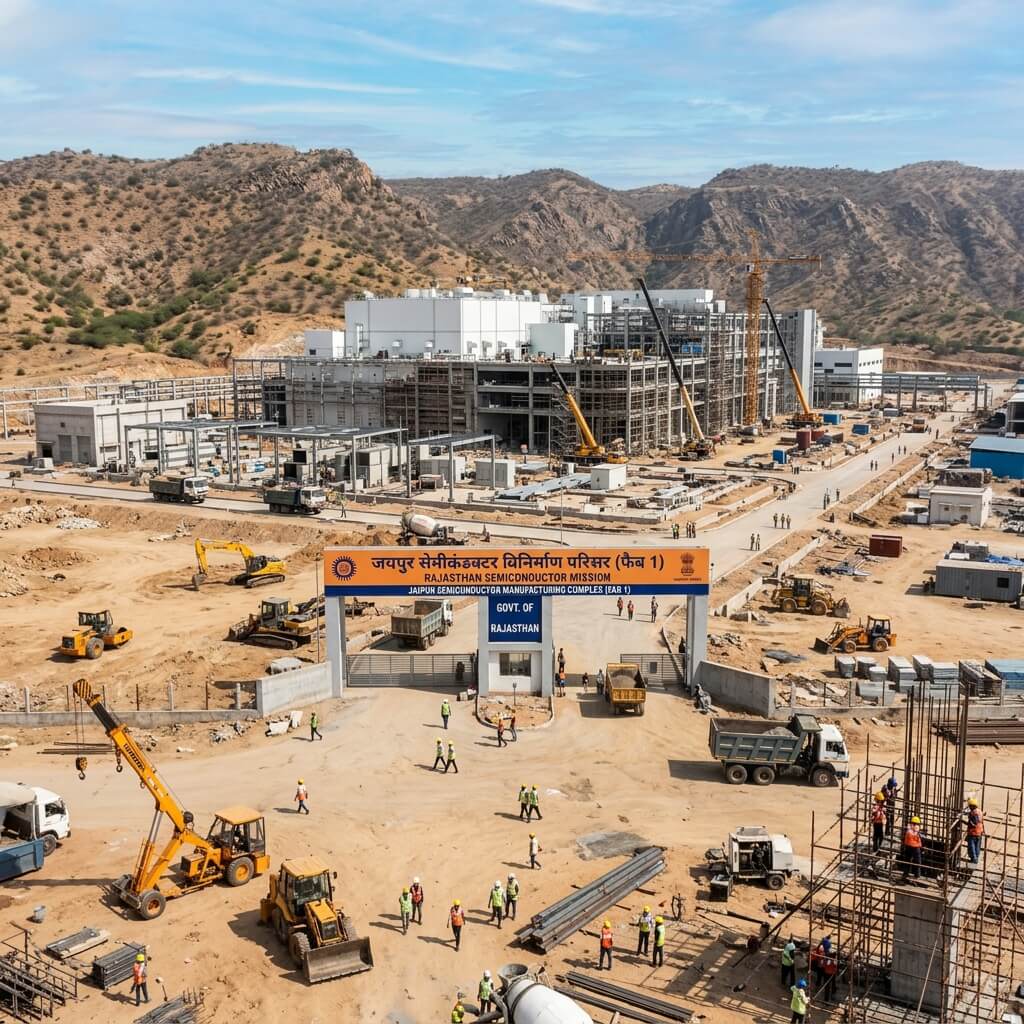
Rajasthan’s new semiconductor plant and electronics cluster in Bhiwadi mark a small but significant step in India’s effort to expand chipmaking and electronics manufacturing beyond its southern hubs.
The inauguration of Sahasra Semiconductors’ packaging facility and a new electronics manufacturing cluster in Bhiwadi adds a northern foothold to a sector that has so far been concentrated largely in the south and west, where states such as Tamil Nadu, Karnataka, Telangana and Gujarat have moved faster on fabs, assembly and component manufacturing.
Calling it a “historic day” for Rajasthan, Vaishnaw said the state’s entry into the semiconductor sector marks a significant step in India’s efforts to become a global hub for electronics and chip manufacturing under the Make in India and Digital India initiatives.
Moving up the value chain?
For India, the timing matters. The country is trying to move up the electronics value chain at a moment when supply-chain resilience, geopolitics and import dependence have become central policy concerns.
Chip packaging, assembly and testing may not carry the glamour of a wafer fab, but they are among the most practical places for India to build scale quickly. That is why an SME-led unit in Rajasthan matters: it broadens the industrial base, diversifies geography and shows that semiconductor manufacturing is no longer being framed only as a large-corporate or metro-centric play.
Sahasra Semiconductors’ facility is positioned as India’s first SME-led commercial semiconductor chip production unit, with an investment of more than Rs. 150 crore. It is also relatively small by global standards, with an annual packaging capacity of 60 million units today.
But its stated plan to expand output to 400 million to 600 million units over the next two to three years is the more important number. If that expansion happens, it would signal that India’s semiconductor ecosystem is beginning to develop not just policy intent but industrial momentum.
The company’s focus on memory chips used in micro SD cards, flash storage devices, LED driver ICs, eSIMs and RFID products also reflects a sensible entry point: these are commercially useful products with existing demand, not cutting-edge logic chips that require vastly more capital and technical depth.
The economics of the broader ecosystem still favor a step-by-step approach. India has spent years discussing the ambition of becoming a semiconductor hub, but the reality is that the country’s strongest near-term advantage lies in assembly, testing, packaging and downstream electronics manufacturing rather than front-end fabrication. That is where policy incentives, industrial parks and export-oriented manufacturing can make the fastest difference. The government’s electronics strategy has already helped India scale mobile-phone assembly and broader electronics production, and officials now want semiconductors to become the next layer of that story.
Vaishnaw’s comments at the Bhiwadi inauguration underline that shift. Electronics production in India, he said, has risen sixfold over the past 12 years to nearly Rs. 13 lakh crore, while exports have climbed to about Rs. 4.24 lakh crore. Mobile phones are now India’s top export category, a striking marker of how quickly the sector has moved from import dependence to export relevance. That backdrop matters for semiconductors because phone assembly, component sourcing and chip packaging are tightly linked. As more devices are assembled locally, the business case for nearby component ecosystems improves.
Bhiwadi itself illustrates why industrial clustering remains so important. The new Electronics Manufacturing Cluster, developed by ELCINA, spans 50.3 acres and cost Rs. 46.09 crore, with Rs. 20.24 crore in central support under the EMC scheme. Planned investments in the cluster now exceed Rs. 1,200 crore across 20 companies, spanning semiconductor packaging, electronic components, EV parts, RFID technologies and industrial electronics. Eleven companies are already operational, with cumulative investments above Rs. 900 crore and employment for more than 2,700 people. Those are modest numbers relative to India’s manufacturing ambitions, but they matter because industrial ecosystems are built one supplier, one line, and one customer order at a time.
The Rajasthan project also highlights another important theme: India’s semiconductor ecosystem is becoming more geographically distributed. That is strategically useful. A sector that relies only on a handful of states is more vulnerable to policy concentration, logistics bottlenecks and land constraints. By contrast, a wider footprint allows states to compete on infrastructure, land costs, labour availability and industrial policy. Rajasthan’s Semiconductor Policy 2026 is clearly an attempt to position the state as a serious contender, especially for manufacturing linked to the Delhi-NCR corridor.
There is also a market signal here for global and domestic investors. In India, semiconductor policy has moved from headline announcements to implementation. That does not mean the country is close to building a complete chip stack. It does mean the ecosystem is beginning to develop the less glamorous but commercially essential layers that make a chip economy viable: cleanrooms, packaging capacity, testing, cluster infrastructure, skilled labour and export channels. The fact that more than 60% of Sahasra’s output is already exported to the United States, Europe, China and neighboring markets suggests there is demand for Indian-made packaging services if execution remains steady.
The bigger question now is whether Rajasthan’s entry will be an isolated milestone or part of a broader northern manufacturing corridor that can attract follow-on investment. If the cluster fills up and Sahasra scales as planned, Bhiwadi could become a useful proof point for India’s semiconductor industrial policy: not a substitute for fabs, but a practical and bankable step toward a wider electronics base.
For now, the message is clear. India’s semiconductor story is no longer confined to policy papers, incentive packages or a few southern industrial hubs. It is beginning to spread, and Rajasthan’s arrival suggests that the next phase may be less about one grand announcement and more about building many smaller, connected pieces of the ecosystem.
Most Popular
22 hours ago
India’s private space tech firms raise $871 million, Skyroot becomes first unicorn
Skyroot became India's first SpaceTech unicorn following a $50 million Series C round in…

1 day ago
Infosys fined in France over employee work-hour tracking failures
The action reflects the strict oversight of workplace practices in France, where companies are…
1 day ago
Power systems performance remains strong for CG Power
Key risks for the company include a slowdown in T&D capex, an increase in…

3 days ago
Indian’s Education Minister Dharmendra Pradhan resigns
In an X post, Pradhan said the resignation was to prevent anti-national forces from…
