
News
07 - 10 - 2026
Real estate sector to feel the brunt of repo rate hike
Rise in borrowing costs to affect buyer sentiment, and for developers the rate hike would lead of rise in cost of capital
The Reserve Bank of India’s (RBI) 25 basis point repo rate hike is set to squeeze Equated Monthly Instalments (EMIs) and stretch buyer affordability across the real estate sector, particularly in price-sensitive segments. However, an upward revision in Gross Domestic Product (GDP) growth projections is expected to counter these immediate borrowing pressures by reinforcing overall confidence in sustained housing demand.
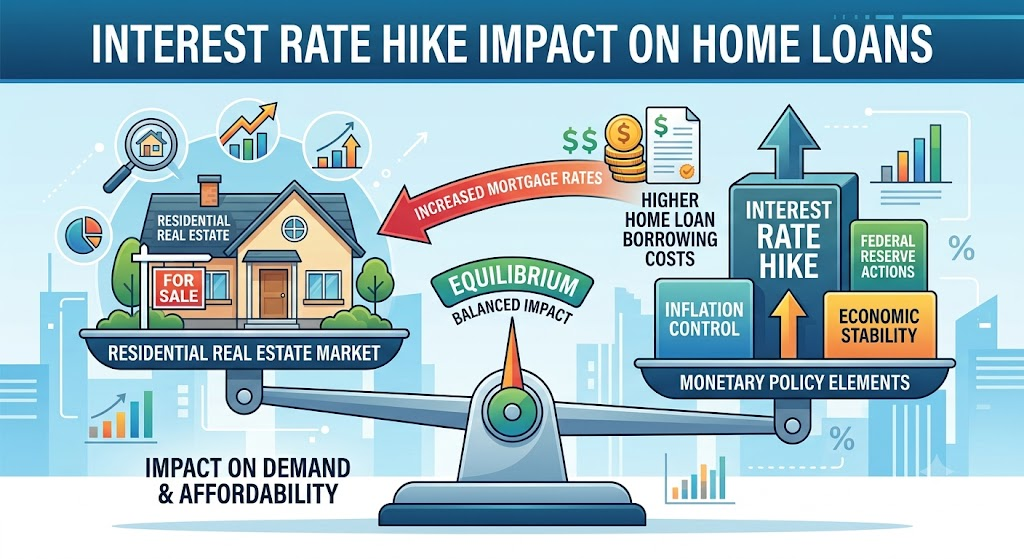
On Wednesday (October 7, 2026), RBI raised repo rate by 25 basis points to 5.50%, the first time since February 2023, following a unanimous vote by the Monetary Policy Committee (MPC). Alongside the rate hike, the RBI shifted its monetary policy stance to ‘calibrated tightening’ to mitigate persistent inflationary pressures driven by El Niño concerns, a weak monsoon, and elevated international crude oil prices hovering above $100 per barrel. Concurrently, the central bank revised its national Gross Domestic Product (GDP) growth projections upwards, signalling strong underlying momentum in broader economic activity.
“The rate hike will put pressure on consumer sentiment and discretionary spending – this has a direct correlation to housing demand. The festive season is a key period for housing demand, and an increase in borrowing costs will affect buyer sentiment. It is worth noting that residential prices in the top seven cities have already risen significantly, stretching affordability,” Anuj Puri, chairman at Anarock Group said.
Unlikely to impact commercial real estate
However, the rate hike is unlikely to have a direct impact on commercial real estate, which continues to be driven by structural demand from global capability centres (GCCs), technology, banking, financial services and insurance and other occupier segments.
“However, retail real estate may see some near-term impact. Higher financing costs coupled with the possibility of softer festive consumption could make developers and investors more cautious. Some new mall projects could potentially be deferred until there is greater clarity on demand, Puri added.
With the rate hike, dearer home loans will make buyers more selective and cause decision timelines to extend, particularly in the price-sensitive segments.
As per Anarock data, Q3 2026 recorded about 1,00,220 housing sales across the top seven cities, up 3 per cent YoY and 10 per cent QoQ. Affordable housing comprised a 16 per cent share of these sales. This momentum will now be tested because even a modest increase in EMIs will result in deferred purchase decisions or budget recalculations among affordable housing buyers.
“Although, despite the current environment, the homebuying market remains bullish, strengthened by the demand of the festive season. Buyers who have been waiting on the sidelines are returning, driven by auspicious timing and a strong desire to own a home. A modest rise in EMIs may lead some buyers to compare options more carefully, but it is unlikely to dampen end-user demand, especially for ready and near-completion homes. If anything, many buyers may move faster to lock-in prices before further cost pressures build,” Ravi Agarwal, Managing Director and Chairman at Lloyds Realty said.
“For developers, the rate hike raises the cost of capital, so disciplined execution and balance sheet strength matter even more. This is particularly true for redevelopment projects, which are a major growth driver in markets like Mumbai. These projects depend on timely approvals, financing and society consensus, and higher borrowing costs can squeeze viability if timelines stretch. At the same time, redevelopment continues to offer residents a clear path to modern, better-planned homes, and that structural need will sustain activity,” he added.
Borrowing cost to rise marginally
“The RBI’s 25 bps repo rate hike will marginally increase the cost of borrowing and could put some pressure on home loan EMIs. However, we believe the impact on housing demand should remain manageable, given the underlying strength of the Indian economy. The upward revision in GDP growth expectations is particularly encouraging and reinforces confidence in the broader economic outlook,” Kamlesh Thakur, President, Naredco Maharashtra & Co-Founder & Managing Director, Srishti Group said.
“For the real estate, the focus now will be on maintaining affordability, ensuring smooth transmission of rates and sustaining consumer confidence, especially during the ongoing festive and peak home-buying season. The situation can still be effectively managed if the reform measures expected from both the Central and State Governments are accelerated—particularly faster and more predictable project approvals, rationalisation of GST, and enabling RBI-regulated lending for legitimate project-related premiums and instalment payments payable by developers,” he said.
“For real estate, the immediate impact will be felt through slightly higher borrowing costs, particularly for leveraged homebuyers and investors. However, with economic growth remaining robust, we do not expect this single rate increase to materially derail housing demand. The premium and luxury segments, which are increasingly driven by income growth and wealth creation rather than purely by financing costs, should remain relatively resilient,” Kaushal Agarwal, Chairman at The Guardians Real Estate Advisory said.
Reassuring GDP outlook
“For residential real estate, a 25 bps increase is unlikely to fundamentally alter the current demand environment, although it could make buyers more sensitive to financing costs. Mumbai market continues to benefit from strong employment, infrastructure-led growth and limited availability of well-located housing. The robust GDP outlook is reassuring for consumer sentiment and purchasing power. We therefore expect the market to remain fundamentally stable, with quality projects in established micro-markets continuing to attract serious buyers,” Shraddha Kedia-Agarwal, Director, Transcon Developers said.
“The repo rate hike to 5.50% is likely to create some near-term pressure on borrowing costs, but we see the impact on real estate as manageable. The sector has built considerable momentum on the back of strong end-user demand, improved infrastructure and rising consumer confidence. Importantly, the RBI’s stronger GDP growth outlook signals that the broader economic fundamentals remain healthy. While buyers may become slightly more cautious on ticket sizes and financing, genuine end-user demand is unlikely to disappear. Developers will need to remain focused on delivering the right product at the right price, with affordability continuing to be a key consideration,” Shilpin Tater, Managing Director, Superb Realty said.
“While higher rates can have a direct bearing on home loan affordability, the increase is relatively modest and should not significantly disrupt the housing market. More importantly, the underlying demand for housing remains structurally strong, supported by India’s young urban population, with the median age in urban centres around 28 years, accelerating urbanisation and rising aspirations for better-quality housing,” Vedanshu Kedia, Director at Prescon Group said.
“These demographic and economic trends continue to create a strong and sustained need for residential real estate. What is encouraging is the RBI’s confidence in the underlying strength of economic activity, reflected in the upward revision to the growth outlook. For developers, this reinforces the need to remain disciplined on pricing and product positioning, while for buyers, the fundamentals of real estate as a long-term asset class remain intact,” Kedia added.
“While the rate hike may have a marginal impact on borrowing costs, the upward revision in GDP growth expectations is encouraging for the real estate sector. In Odisha, particularly Bhubaneswar, sustained economic activity, rising urbanisation and improving buyer confidence should continue to support housing demand. We remain optimistic about the market’s growth trajectory, with the region increasingly emerging as an attractive destination for quality residential and mixed-use development,” Rajesh Agrawal, Director, Oriom Realty said.
If you spotted a mistake or have feedback on this story, write to us at editor@newsassociate.com. Email us your press releases on the same ID.
Most Popular

1 day ago
India’s Mumbai records 3,145 luxury property transactions in H1 FY27
The city registered 3,145 luxury residential property transactions worth ₹32,623 crore between April and…

4 days ago
Infosys Q2 net profit rises 6% to ₹7,823 crore
India's second-largest IT services company trims FY27 revenue guidance

3 days ago
Tech Mahindra partners with SpaceXSI to bring Grok AI coding tools into enterprise workflows
The collaboration will target legacy application modernisation, software development and developer productivity, with a…

3 days ago
Kotak Mahindra Bank’s profits soar, but margins refuse to join the party
Management expects the full-quarter impact of FCNR(B) deposits to weigh on margins in the…
