
News
16 - 10 - 2026
Odisha needs ₹1.1 tn to expand renewable energy, storage, grid infrastructure
A report by IEEFA proposes a three-pronged financing strategy, including a dedicated transition fund, to mobilise capital for clean energy and support a more resilient economy
India’s eastern state of Odisha needs about ₹1.1 lakh crore of investment in renewable energy, storage, and transmission over the next decade to scale up its clean energy initiatives.
Odisha estimates that it will need to add about 10.7 gigawatts (GW) of renewable energy capacity between financial years 2026 and 2036, according to a report by the Institute for Energy Economics and Financial Analysis (IEEFA).
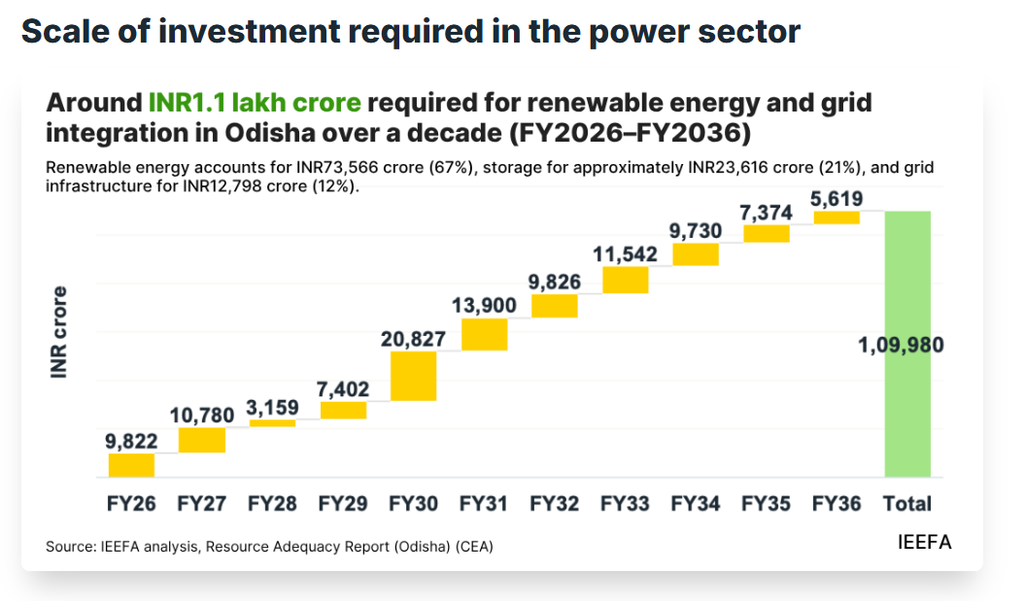
This is alongside 2.7 GW of pumped storage, 0.13 GW of battery storage and intra-state transmission upgrades, it said. Renewable energy accounts for 67 per cent of this requirement, storage for 21 per cent and grid infrastructure for 12 per cent. Annual investment needs vary with the timing of capacity additions, peaking at about ₹20,827 crore by FY30.
“Odisha’s clean energy transition is both an investment challenge and an opportunity to strengthen the state’s long-term economic resilience. A coordinated financing approach can help match projects with appropriate sources of capital, mobilise private investment and support workers and communities affected by the shift away from fossil fuels,” said Gaurav Upadhyay, Lead Energy Specialist, Transition Finance, South Asia at IEEFA.
The state has substantial untapped potential to close this gap. Odisha has an estimated 139.5 GW of solar potential, of which about 0.82 GW, or less than 1 per cent, has been installed. It has 12.13 GW of wind potential and no grid-connected wind capacity yet.
Hydropower has reached about 2.2 GW of an estimated 7.6 GW. With appropriate investment in generation, storage, and grid infrastructure, Odisha could also play a larger role in supplying renewable electricity to other states.
Heavily coal dependent
At present, the state’s power system remains heavily coal dependent. Its finances are similarly linked to fossil fuels. In FY25, Odisha received an estimated ₹14,148 crore from coal and petroleum resources, equal to 13.1 per cent of its own tax and non-tax revenue, down from 16.2 per cent in FY23.
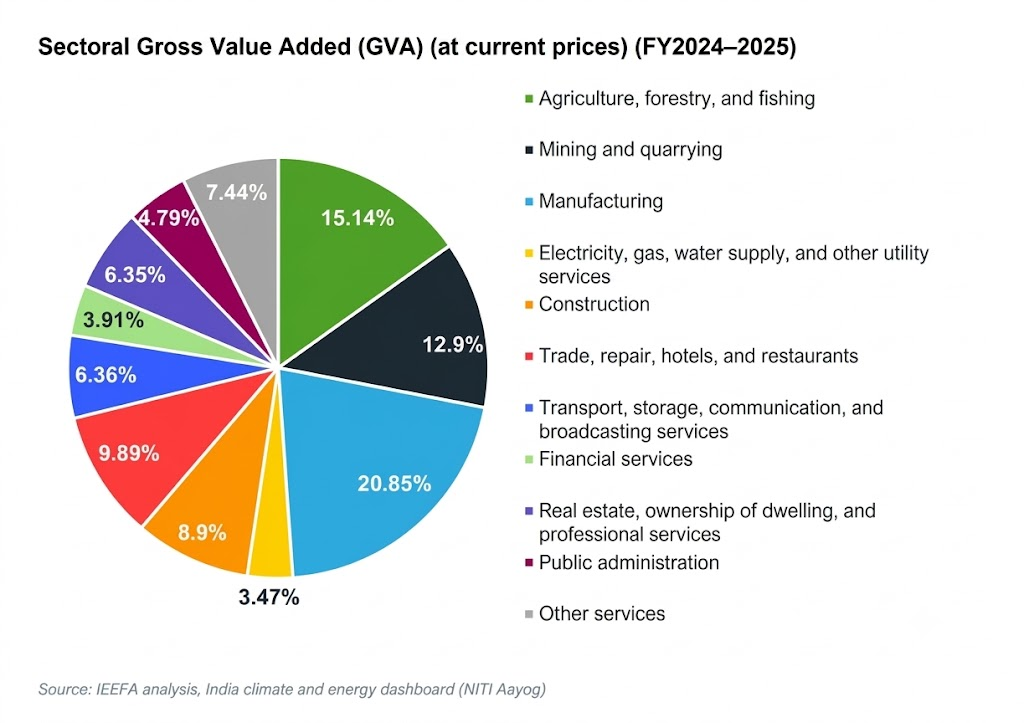
The report states that this decline does not only reflect growth in alternative revenue streams. It also reflects stagnation in overall fossil-fuel revenues and a sharp fall in coal-related receipts. Fossil-fuel-linked sectors also account for about a third of the state’s gross value added.
Financing needs extend well beyond the power sector, to industrial decarbonisation, green hydrogen, electric mobility, energy-efficient buildings, and just transition measures such as worker reskilling, mine closure and land restoration, and economic diversification in coal-dependent districts.
To meet these needs, the report proposes a three-pronged strategy: assess the full cost of transition across sectors; develop a sustainable finance framework that matches projects with suitable sources of capital; and establish a dedicated transition fund that pools government, multilateral, climate, and private finance to de-risk projects and support just transition priorities.
If you spotted a mistake or have feedback on this story, write to us at editor@newsassociate.com. Email us your press releases on the same ID.

Most Popular

1 day ago
India’s Mumbai records 3,145 luxury property transactions in H1 FY27
The city registered 3,145 luxury residential property transactions worth ₹32,623 crore between April and…

3 days ago
Kotak Mahindra Bank’s profits soar, but margins refuse to join the party
Management expects the full-quarter impact of FCNR(B) deposits to weigh on margins in the…
4 days ago
DCGI Approves Toripalimab Combination Therapy for Advanced Oesophageal Cancer in India
Dr Reddy’s Laboratories’ Zytorvi, combined with cisplatin and paclitaxel, gains a first-line indication for…

3 days ago
Tech Mahindra partners with SpaceXSI to bring Grok AI coding tools into enterprise workflows
The collaboration will target legacy application modernisation, software development and developer productivity, with a…
