
News
07 - 05 - 2026
India’s GCCs morph into $98 billion ‘enterprise nerve centers’ as AI pivot accelerates

India’s Global Capability Centers (GCCs) have reached a definitive “inflection point,” evolving from cost-saving back offices into sophisticated “enterprise nerve centers” that are expected to generate $98.4 billion in revenue by the end of fiscal year 2026.
A joint report by Nasscom and Zinnov released Thursday reveals a landscape rapidly decoupling from its “delivery engine” roots to become the primary architect of global enterprise strategy. The sector now employs 2.36 million professionals across 2,117 centers, marking a nearly 32% growth in the number of GCCs since 2021.
From deployer to builder
The most significant shift in the 2026 landscape is India’s emergence as a “global builder” of Artificial Intelligence (AI) rather than a mere consumer. The report notes that over 1,200 GCCs in India now possess AI/ML capabilities, with more than 250 running dedicated AI Centers of Excellence.
“In FY26, the narrative extends beyond scale to innovation and value creation,” said Rajesh Nambiar, President of Nasscom. “GCCs are leveraging AI to move past task automation towards intelligent, self-optimizing business processes”.
India currently hosts approximately 28% of the global GCC AI talent pool—the second largest globally after the United States—and leads worldwide in hiring intensity for Generative AI roles.
Maturity leap
The operational profile of these centers is maturing at an unprecedented rate. According to the data, 46% of Indian GCCs now operate as “Portfolio” or “Transformation” hubs, characterized by end-to-end product ownership and business leadership.
In a sharp departure from historical trends, new entrants are skipping the “Outpost” stage of low-value work. Nearly 96% of centers established after 2021 launched with a product or portfolio mandate, and 49% were “AI-first” from their inception, the report said.
This shift is reflected in leadership structures, with 64% of site leaders now holding “dual mandates” that bridge global business unit ownership with local site leadership, the report added.
Workforce redesign
The rapid adoption of AI has dramatically compressed the “half-life” of technical skills from 10 years to just 2–5 years, forcing a total redesign of the workforce model. The report highlights that 73% of Chief Human Resources Officers (CHROs) believe AI disruption is currently outpacing workforce readiness.
Despite the shift toward leaner, high-expertise teams, the physical footprint of GCCs continues to expand. The GCC real estate runway is projected to grow from 263 million to over 350 million square feet over the next three to four years. This growth is accompanied by a sustainability push, with 85% of GCCs targeting carbon neutrality by 2030.
The orcehstration economy
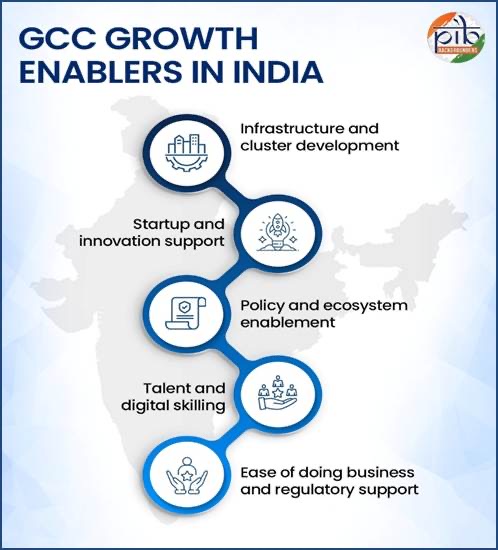
The report identifies a new “ecosystem orchestrator” model where GCCs derive value from what they coordinate rather than just what they own. This includes deep integration with local startups, academia, and service providers.
Currently, 90–95% of leading GCCs partner with universities, and over 50% co-innovate with startups through hackathons, PoCs, and “startup studios”.
Looking ahead, the report predicts that 75% of all Indian GCCs will achieve “Portfolio” or “Transformation” status by 2030, cementing India’s position as the locus of global enterprise architecture, the report said.
Most Popular

4 days ago
CG Power’s consolidated Q2 net profit rises 44% to ₹409 crore
A sharp rise in Power Systems margins, swelling order book underpin the engineering conglomerate's…

3 days ago
Tech Mahindra partners with SpaceXSI to bring Grok AI coding tools into enterprise workflows
The collaboration will target legacy application modernisation, software development and developer productivity, with a…

7 minutes ago
L&T Q2 cons net profit rises 33% to at ₹5,202 crore
The group’s consolidated revenue rose 16% to ₹78,750 crore, driven by progress in its…
4 days ago
DCGI Approves Toripalimab Combination Therapy for Advanced Oesophageal Cancer in India
Dr Reddy’s Laboratories’ Zytorvi, combined with cisplatin and paclitaxel, gains a first-line indication for…
