
News
14 - 10 - 2026
Electric bus share in new registrations to rise 2.5 times next fiscal
Two key challenges – inadequate charging and depot infrastructure – could delay the deployment: Crisil Ratings
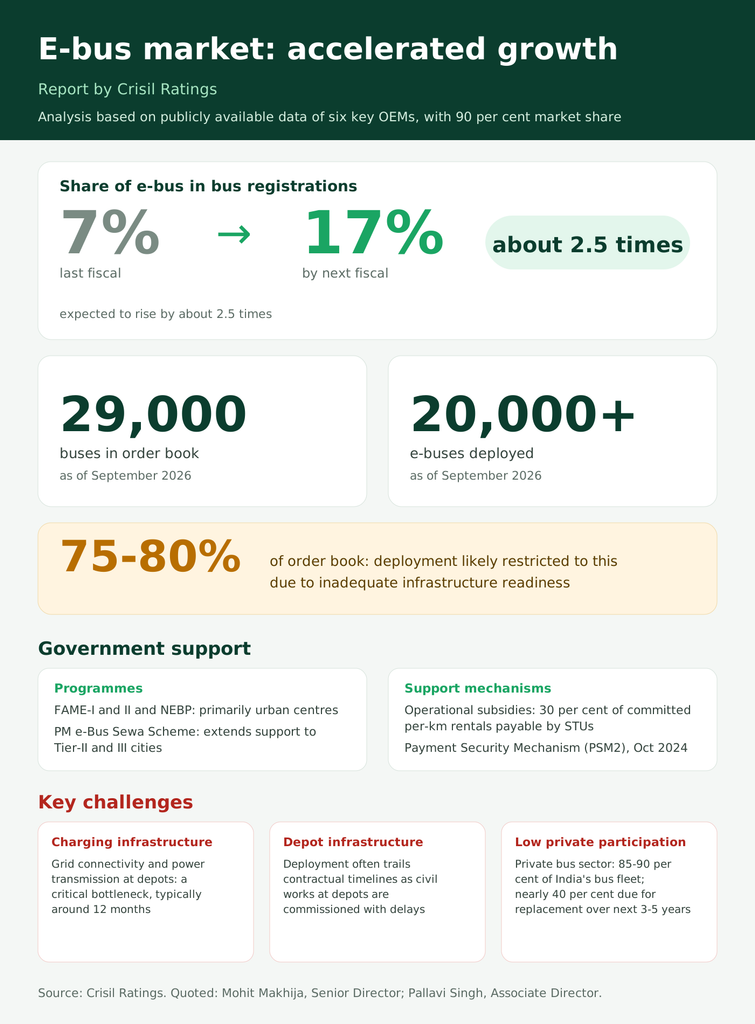
The share of electric bus (e-bus) in under bus registrations in Indian is expected to rise by about 2.5 times to 17 per cent by next fiscal from the 7 per cent recorded in last fiscal.
The e-bus market is entering a phase of accelerated growth, supported by progressive policy support such as procurements through various government programmes, payment security mechanism and operational subsidies, according to a report by Crisil Ratings.
However, two key challenges – inadequate charging and depot infrastructure – can delay the targeted deployment whereas low private sector participation can hamper sustenance of growth in the road ahead.
“Government policies have enabled creation of a strong pipeline for e-bus adoption, with the order book reaching about 29,000 buses as of September 2026. Given adequate manufacturing capacities and funding availability, a vast majority of these orders, shall get ready for deployment within the scheduled timelines. However, inadequate infrastructure readiness is likely to restrict deployment to only 75-80 per cent of order book,” Mohit Makhija, Senior Director, Crisil Ratings, said.
Crisil Ratings said its analysis is based on publicly available data of six key original equipment manufacturers (OEMs), with 90 per cent market share and interactions with industry experts and stakeholders.
Government initiatives have played a pivotal role in driving penetration of electric buses. While earlier programmes like FAME-I and II and National Electric Bus Programme (NEBP) primarily focused on urban centres, the PM e-Bus Sewa Scheme broadened the scope by extending support to Tier-II and III cities. Collectively, these initiatives facilitated the deployment of more than 20,000 e-buses as of September 2026.
Further, policy support has also evolved beyond demand creation. Operational subsidies under the PM e-Bus Sewa Scheme, covering 30 per cent of the committed per-km rentals payable by State Transport Undertakings (STUs), along with Payment Security Mechanism (PSM2), notified in October 2024, aim to mitigate counterparty risks associated with financially weaker STUs.
Given the limited operating track record of buses deployed under the PSM framework, a demonstrated history of timely payments will be key to sustaining demand momentum in the sector.
E-bus deployment often trails contractual timelines as charging infrastructure and associated civil works at depots are commissioned with delays. In particular, obtaining grid connectivity and commissioning power transmission infrastructure at depots continues to be a critical bottleneck, with the process typically taking around 12 months, thereby slowing the operationalisation of deployed buses.
While capital assistance for power infrastructure and depot upgrades under the PM e-Bus Sewa Scheme seeks to address these constraints, execution delays could continue to impede timely deployments and temper the pace of e-bus penetration.
Another key challenge towards meaningful adoption in the road ahead remains low participation from the private sector.
“Improving participation of private bus sector, including staff transportation, school, intercity and tourism segments, which account for 85-90 per cent of India’s bus fleet can provide a meaningful growth opportunity in the road ahead. Further, with nearly 40 per cent of this private fleet getting due for replacement over next 3-5 years, a sizeable electrification opportunity can emanate provided charging infrastructure, financing and operating economics become conducive,” Pallavi Singh, Associate Director, Crisil Ratings, said.
The long-term trajectory for e-bus adoption remains favourable. However, sustaining momentum will require a combination of continued policy support, faster infrastructure build-out and improvements in deployment efficiency.
If you spotted a mistake or have feedback on this story, write to us at editor@newsassociate.com. Email us your press releases on the same ID.
Most Popular

3 days ago
Kotak Mahindra Bank’s profits soar, but margins refuse to join the party
Management expects the full-quarter impact of FCNR(B) deposits to weigh on margins in the…

1 day ago
India’s Mumbai records 3,145 luxury property transactions in H1 FY27
The city registered 3,145 luxury residential property transactions worth ₹32,623 crore between April and…

4 days ago
Infosys Q2 net profit rises 6% to ₹7,823 crore
India's second-largest IT services company trims FY27 revenue guidance

3 days ago
Tech Mahindra partners with SpaceXSI to bring Grok AI coding tools into enterprise workflows
The collaboration will target legacy application modernisation, software development and developer productivity, with a…
