
Features
10 - 10 - 2026
Why Incremental Reforms Will Not Save France
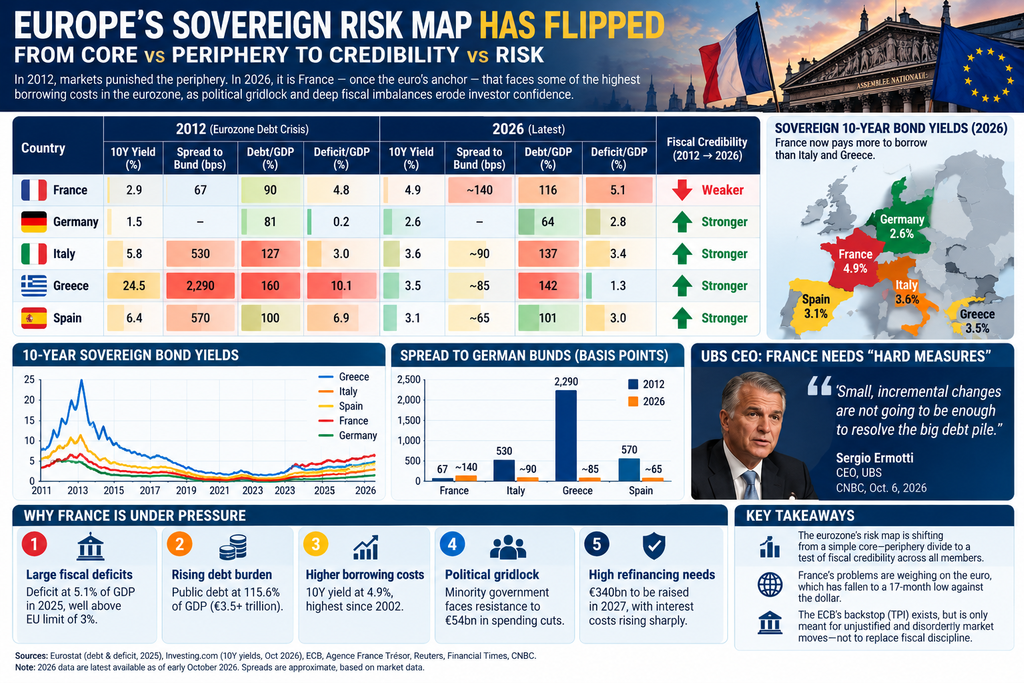
In the grand corridors of European finance, a once-unthinkable inversion is underway. France—long considered the political and economic co-anchor of the Eurozone alongside Germany—has seen its sovereign borrowing costs climb to levels historically reserved for the bloc’s southern periphery.
As French benchmark 10-year OAT yields hit 4.91% and the spread over German Bunds expands past 150 basis points, investors are punishing the single currency, sending the euro tumbling to a 17-month low. What was once a crisis confined to Europe’s outer edges has migrated directly to its center.
Combo of fiscal deterioration and political inertia
The immediate driver of this sell-off is a combination of fiscal deterioration and political inertia in Paris. France’s public deficit hovered at 5.1% of GDP in 2025 and is projected to breach 5.4% this year, pushing total government debt to 115% of GDP. With interest payments on the country’s €3.5 trillion debt pile projected to surpass €74 billion—exceeding the nation’s entire education budget—the French Treasury faces a looming debt loop.
Yet, attempts at consolidation by Prime Minister Sébastien Lecornu’s minority government have met stiff opposition. Proposed spending cuts of €54 billion in the draft budget are colliding with political gridlock and nationwide social unrest.
Neither right-wing figurehead Marine Le Pen, who favors a constitutional referendum on deficit limits, nor left-wing leader Jean-Luc Mélenchon, who has proposed cancelling a fifth of the debt, offer realistic paths to deficit reduction. Meanwhile, Paris recently signed off on an additional €36 billion in defense spending through 2030, compounding the long-term strain.
The market’s reaction reflects a systemic recalibration of French risk. “Incremental small changes are not going to be enough to resolve the big debt pile,” warned Sergio Ermotti, Chief Executive Officer of UBS, speaking to CNBC earlier this week. Drawing a stark comparison to Southern European nations that undertook painful structural reforms after the post-2010 debt crisis, Ermotti noted: “We went through similar situations in the last 10 to 15 years in Spain, in Italy, in Greece, in Portugal. These countries that went into a big crisis are now the best performing countries in Europe.” He emphasized that France must execute comparable structural adjustments to “restore a credible path to growth.”
The situation is further complicated by France’s investor profile. Foreign non-resident institutions hold roughly 50% of outstanding French government debt, making the market vulnerable to sharp capital outflows if international investors lose confidence. Analysts at DWS noted in a client memo that France’s current dilemma is primarily a spending problem without a clear political resolution, pointing out that “the problem does not lie in short-term refinancing, but rather in the credibility of a fiscally sustainable long-term path.”
The widening gap between French and German borrowing costs raises questions about potential intervention by the European Central Bank. While the ECB possesses the Transmission Protection Instrument (TPI)—a tool created to counter market dynamics detached from economic fundamentals—analysts argue the threshold for its deployment has not been met. Because French yields reflect real political and fiscal risk, early central bank intervention could create moral hazard, reducing the pressure on Paris to enact fiscal reforms.
As former IIF Chief Economist Robin Brooks observed on the dynamic, the broader fear remains whether market pressure forces the ECB’s hand before contagion spreads to other high-debt members. For now, European policymakers find themselves watching a tense game of fiscal chicken, as the market forces France to confront its long-deferred economic reckoning.
By Venkatesh G

Most Popular

4 days ago
CG Power’s consolidated Q2 net profit rises 44% to ₹409 crore
A sharp rise in Power Systems margins, swelling order book underpin the engineering conglomerate's…

3 days ago
Tech Mahindra partners with SpaceXSI to bring Grok AI coding tools into enterprise workflows
The collaboration will target legacy application modernisation, software development and developer productivity, with a…

3 days ago
Kotak Mahindra Bank’s profits soar, but margins refuse to join the party
Management expects the full-quarter impact of FCNR(B) deposits to weigh on margins in the…

1 day ago
India’s Mumbai records 3,145 luxury property transactions in H1 FY27
The city registered 3,145 luxury residential property transactions worth ₹32,623 crore between April and…
