
Analysis
13 - 07 - 2026
Thali prices surge on rising input costs: Crisil
Tomato prices surged 31 per cent YoY owing to delayed and lower summer crop planting
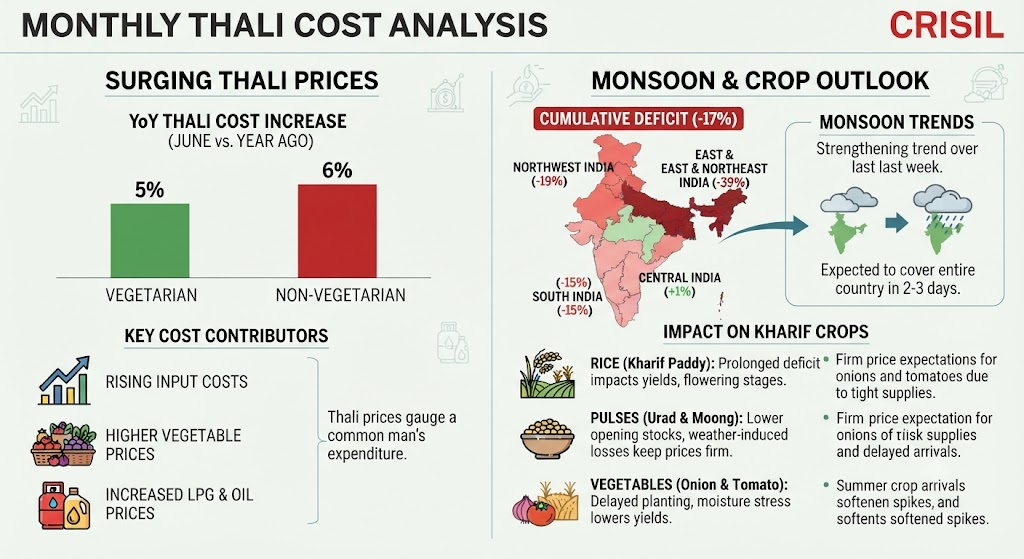
Rising input costs drove up home-cooked thali prices in June, with vegetarian meals rising 5 per cent and non-vegetarian options by 6 per cent from a year ago.
The thali – traditional Indian set meal served on a single platter – prices were up impacted by the higher prices of tomatoes, onions, vegetable oils and liquefied petroleum gas (LPG) cylinders. While potato prices declined, it was offset up price rise of other vegetables, Crisil said in a report.
Thali prices are an important measure to gauge a common man’s expenditure.
Tomato prices surged 31 per cent year-on-year (YoY) owing to delayed and lower summer crop planting, while vegetable oil and LPG prices remained elevated amid global supply disruptions caused by the West Asia conflict.
Subdued southwest monsoon
The southwest monsoon has remained subdued so far, with cumulative rainfall between June 1 and July 7 by around 17 per cent below the long period average. By region, the rainfall deficit is around 15 per cent in South India, 19 per cent in Northwest India, and 39 per cent in East and Northeast India; while Central India is 1 per cent above normal.
However, monsoon activity has strengthened over the past one week, advancing into additional parts of Gujarat, and more parts of Haryana and Punjab and is expected to cover the entire country within the next 2-3 days.
The recent rainfall is expected to improve soil moisture levels and support ongoing kharif sowing. Nevertheless, since monsoon rainfall is expected to stay below normal, the temporal and spatial distribution of rainfall for the rest of the season will be a key monitorable.
Impact on kharif paddy
A prolonged rainfall deficit during critical crop growth stages could impact kharif paddy yields, particularly during flowering. This could tighten supplies from key producing states such as Bihar, West Bengal, Odisha, Chhattisgarh and Maharashtra, thereby supporting market prices.
For pulses, lower opening stocks of urad and moong, coupled with weather-induced yield losses across Karnataka, Madhya Pradesh and Maharashtra, are expected to keep prices firm.
Across key vegetables, a sustained rainfall deficit could lower kharif onion and tomato yields through delayed planting and moisture stress.
For onions, lower rabi stocks have already supported prices in recent months, and any adverse impact on kharif yields could further tighten supplies and keep prices firm. Onion prices are expected to remain firm over the medium term due to tight rabi supplies and delayed kharif arrivals.
Potato prices are likely to edge up as cold-storage stocks are gradually released into the market.
Tomato prices are expected to stay firm through July and August, supported by delayed kharif planting and seasonally lean supplies. However, staggered summer crop arrivals, particularly from southern states where farmers replanted following heat stress, should help soften the seasonal price spike.
Most Popular

1 day ago
India’s Mumbai records 3,145 luxury property transactions in H1 FY27
The city registered 3,145 luxury residential property transactions worth ₹32,623 crore between April and…

3 days ago
Kotak Mahindra Bank’s profits soar, but margins refuse to join the party
Management expects the full-quarter impact of FCNR(B) deposits to weigh on margins in the…

4 days ago
DCGI Approves Toripalimab Combination Therapy for Advanced Oesophageal Cancer in India
Dr Reddy’s Laboratories’ Zytorvi, combined with cisplatin and paclitaxel, gains a first-line indication for…

4 days ago
Infosys Q2 net profit rises 6% to ₹7,823 crore
India's second-largest IT services company trims FY27 revenue guidance
