
Analysis
18 - 09 - 2026
Tata Sons’ board judgment poor, remains unclear: IiAS
The board’s mutiny against the controlling shareholder is possibly a first, and not the right precedent for corporate India: proxy advisory firm
Tata Sons’ board has shown poor judgment in choices at its September 17 board meeting, with its decisions appearing to be “rushed” and undermining the principle of thoughtful deliberations, according to a report by Institutional Investor Advisory Services India Limited (IiAS).
Both decisions were made without Noel Tata’s support, who is the chairperson of Tata Trusts that control 66 per cent of Tata Sons’ equity and voting rights, the proxy advisory firm said.
Tata Trusts have board nomination rights, quorum rights, and veto rights that have been embedded into Tata Sons’ Articles of Association (AoA). Therefore, any decision made without the support of Tata Trusts would not work, independent of its merits and legality, it added.
Both decisions taken by the board will eventually need shareholder approval to go through. With Noel Tata clearly opposing both these decisions, they are unlikely to get shareholder support, irrespective of whether the decisions have merit or not. That being the case, the decisions are a limited “win” for the board.
At its board meeting on Thursday, September 17, Tata Sons’ board made two critical decisions, one to reappoint N Chandrasekharan (Chandra) for a third term, and second, to initiate steps to comply with the applicable RBI Guidelines. The second decision means Tata Sons, the holding-investment arm of all Tata Group firms, is open to listing on the bourses.
IiAS, in its report said that the rationale for Chandra’s re-election to a third term remains unclear, particularly after his public announcement that he would not seek it. In about two years, he will reach the Tata Group’s mandatory retirement age of 65 years for executive directors.
By reappointing him for a third term, the board of the Group’s apex company has effectively disregarded its own policies, sending a troubling signal across the organisation: that policies can be conveniently ignored.
Unclear Rationale
The rationale for rushing this move remains unclear, it said.
A more pragmatic course would have been to extend Chandra’s term only until the Trusts resolved their issues with the Charity Commissioner and established a Selection Committee, as required under Tata Sons’ AoA, to identify his successor.
That would have implied an extension of six months to a year, rather than a full five-year term. Equally puzzling is Chandra’s acceptance of the extended tenure, given his earlier voluntary and unsolicited public announcement that he would not continue for a third consecutive term.
The board’s second move was to initiate steps toward complying with RBI guidelines. RBI had rejected Tata Sons’ attempt to surrender its Core Investment Company (CIC) registration. This means the company may eventually be compelled to list on stock exchanges — despite its long-standing position against listing.
Notably, both Venu Srinivasan (Chairman Emeritus of TVS Motor Company) and Chandra have served on RBI’s Central Board of Directors, yet their past association does not appear to have advanced Tata Sons’ concerns with the regulator.
Noel Tata highlighted yesterday in his statement, “The very same RBI Scale Based Regulations that require an upper layer-NBFC to mandatorily list also expressly provide that an upper layer-NBFC can move out of the enhanced regulatory framework if the movement is on account of voluntary strategic move to readjust operations as per a board approved policy.”
Against this backdrop, it remains unclear whether the board fully explored all possible alternatives during its brief deliberations.
Venu Srinivasan and Noel Tata are nominees of Tata Sons. Various media reports suggest that Venu Srinivasan supported Chandra’s reappointment while Noel Tata opposed it, IiAS said.
Certain media reports also suggested that Sir Dorabji Tata Trust (SDTT) had barred Venu Srinivasan from voting in the September 17 board meeting, and therefore, the validity of his vote is called into question.
No Consensus
Despite both Tata Trust nominees not forming consensus, the board took decisions that may not carry if voted on, rather than having them deferred till consensus between the two Tata Trust nominees was reached, it said.
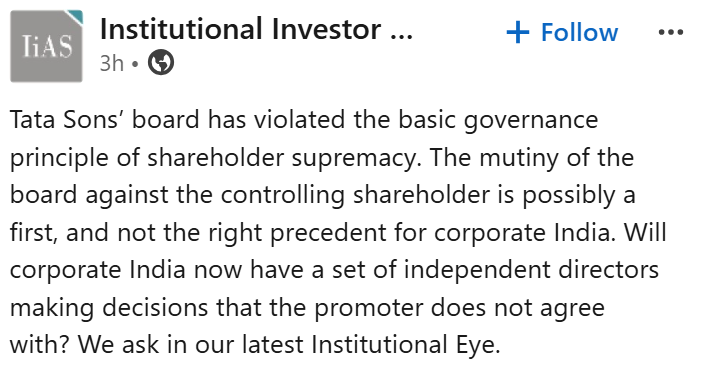
IiAS alleged that Tata Sons’ board has violated the basic governance principle of shareholder supremacy. The mutiny of the board against the controlling shareholder is possibly a first, and not the right precedent for corporate India, it opined.
For an institution that has long prided itself on doing what is right, even at a cost, this marks a troubling lapse and a dismal performance by its leadership, it added.
If you spotted a mistake or have feedback on this story, write to us at editor@newsassociate.com. Email us your press releases on the same ID.
Most Popular

4 days ago
Infosys Q2 net profit rises 6% to ₹7,823 crore
India's second-largest IT services company trims FY27 revenue guidance

1 day ago
India’s Mumbai records 3,145 luxury property transactions in H1 FY27
The city registered 3,145 luxury residential property transactions worth ₹32,623 crore between April and…

3 days ago
Kotak Mahindra Bank’s profits soar, but margins refuse to join the party
Management expects the full-quarter impact of FCNR(B) deposits to weigh on margins in the…

4 days ago
DCGI Approves Toripalimab Combination Therapy for Advanced Oesophageal Cancer in India
Dr Reddy’s Laboratories’ Zytorvi, combined with cisplatin and paclitaxel, gains a first-line indication for…
