
Analysis
09 - 10 - 2026
SEBI’s Accreditation Push Could Broaden Access to Alternative Investments—and Shift More Risk to Investors
Proposed changes could lower entry barriers for accredited investors, but the framework makes financial capacity—not investment safety—the dividing line
India’s investor-accreditation framework is moving towards a potentially significant expansion—not by promising investors greater protection, but by giving financially capable investors access to products that have traditionally carried high minimum investment thresholds.
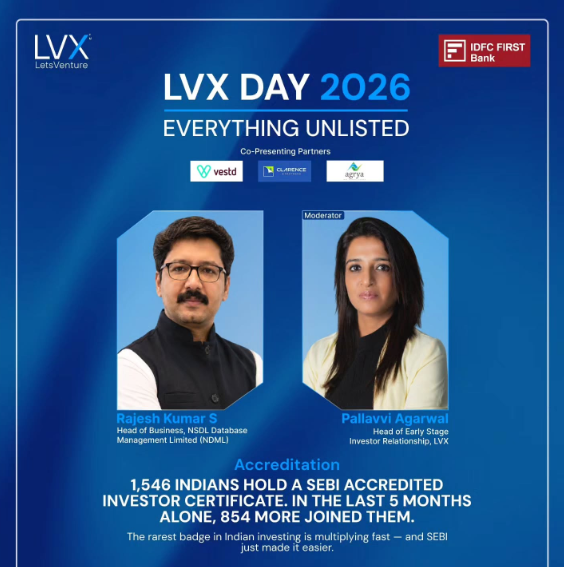
That distinction was central to a discussion at LVX Day 2026 in Bengaluru, where Rajesh Kumar S, Head of Business at NSDL Database Management Limited (NDML), discussed the proposed changes with Pallavi Aggarwal, Head of Investor Relations at LVX.
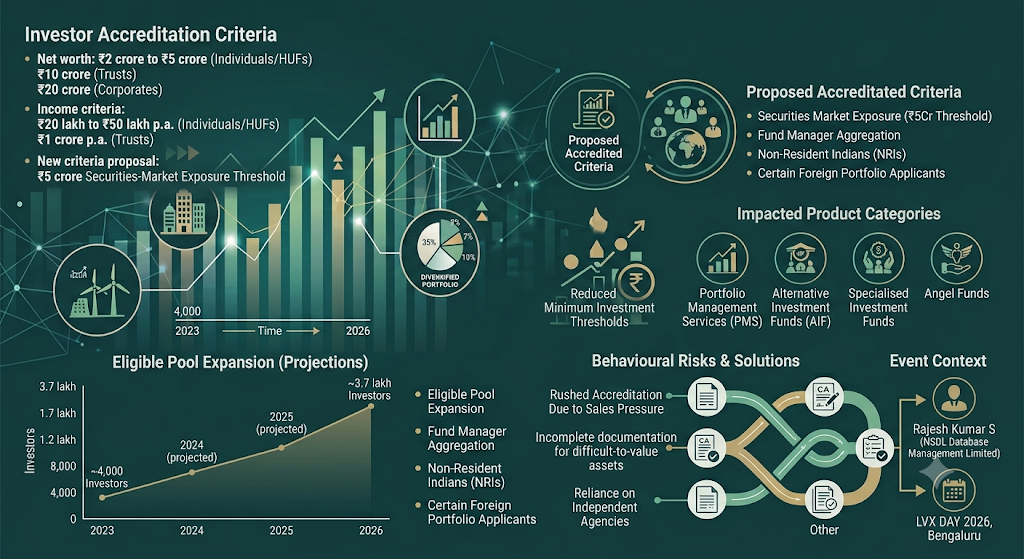
The opportunity is straightforward. Investors who qualify as accredited could potentially invest below the standard minimum ticket sizes associated with products such as portfolio management services, specialised investment funds and other alternative investment vehicles.
The trade-off is less obvious—and potentially more important. Accreditation establishes an investor’s financial capacity to take risk. It does not establish that the investor understands a particular product, that the product is suitable, or that the investment is safe.
“Accreditation is nothing but saying that you have the capacity to take a risk,” Kumar said.
That distinction could become increasingly important if the proposed expansion significantly increases the number of investors eligible for the framework.
From a high-ticket club to a broader investor pool
Investor accreditation was introduced in 2021 to create a regulatory category for investors with demonstrated financial capacity. The underlying idea is that investors capable of absorbing substantial losses may not require the same restrictions that apply to investors for whom large minimum investment requirements provide an additional layer of protection.
Kumar argued that conventional ticket sizes can themselves become a barrier. An investor may have the financial capacity and experience to participate in a particular strategy but remain excluded because the minimum investment is beyond the amount they are willing or able to commit to a single product.
The proposed changes discussed at LVX Day could therefore alter the practical significance of accreditation.
| Feature | United States | European Union | United Kingdom |
|---|---|---|---|
| Main concept | Accredited investor | Retail / professional / eligible counterparty classification | Retail / professional classification plus financial-promotion exemptions |
| Core basis | Income, net worth, licences and entity status | Knowledge, experience, transaction activity, portfolio size and institutional status | Income, net assets, investment sophistication and professional-client criteria |
| Typical individual wealth threshold | $1mn net worth excluding primary residence | €500,000 portfolio is one criterion for elective-professional status—not an automatic qualification | £250,000 net assets excluding home, pension and specified insurance rights |
| Main purpose | Access to certain private offerings exempt from SEC registration | Determines investor protections and product/service treatment | Controls who may receive certain financial promotions and, in some cases, access high-risk investments |
| Default for individuals | Non-accredited | Retail client | Retail consumer |
Among the proposals discussed were mechanisms for fund managers to aggregate accreditation, recognition of securities-market exposure alongside income or net-worth criteria, and treatment of non-resident Indians and certain foreign portfolio applicants as deemed accredited investors. A securities-market exposure threshold of ₹5 crore was also discussed during the session.
Kumar cautioned, however, against equating wealth with sophistication. A wealthy investor may have limited market experience, while an investor with substantially less wealth could have spent years understanding financial markets. Yet financial capacity remains easier for the regulatory system to verify consistently.
“Financial capacity is one parameter which can be verified and scrutinised on scale,” he said.
That creates an unavoidable tension at the heart of accreditation: the framework needs an objective test that can be administered at scale, but financial wealth is not necessarily a perfect proxy for financial sophistication.
A bigger market comes with bigger responsibility
The potential change in scale is substantial. Kumar cited estimates that the eligible investor pool could expand from around 4,000 to roughly 3.7 lakh under the proposed changes. He also said the number of accredited investors had increased from approximately 600 to around 3,000.
If the larger estimate materialises, accreditation would move from being a relatively narrow mechanism into a much more significant piece of India’s investment infrastructure. That could have implications across several product categories, including PMS, alternative investment funds, specialised investment funds and angel funds.
For asset managers, a larger accredited-investor universe could mean access to a broader pool of capital without necessarily changing the underlying structure of their products. For investors, however, lower entry thresholds should not be mistaken for lower risk.
The regulatory logic is effectively the opposite: greater access can come with greater responsibility. Kumar stressed that accreditation is not an endorsement by SEBI of an investor’s sophistication, nor does it eliminate the need for due diligence.
If accreditation expands rapidly, the practical challenge may shift from eligibility to verification.
Kumar identified investor acceptance and documentation as major implementation concerns. Investors accustomed to evaluating investment opportunities through deal notes or fund presentations may be reluctant to provide income-tax returns, chartered-accountant certificates and other financial documents—particularly when similar information is requested by both an accreditation agency and an investment manager.
Duplication is therefore more than an administrative inconvenience. It can increase costs and slow the process precisely when the policy objective is to make access easier. Standardised documentation and verification procedures could become increasingly important if accreditation moves towards hundreds of thousands of investors.
There is also a question of portability.
An accreditation certificate issued by an independent accreditation agency can potentially be used across products. A manager-led accreditation process, by contrast, could be linked to a particular fund or scheme. Investors and fund managers would consequently need to establish exactly what a certificate covers before relying on it.
That distinction could become particularly relevant if multiple investment platforms begin incorporating accreditation into their onboarding processes.
The risks
The expansion also creates a behavioural risk.
If accreditation becomes a gateway to lower minimum investments, there could be pressure on investors to complete the process quickly simply to gain access to a particular opportunity. Kumar highlighted the possibility of sales pressure encouraging rushed accreditation, while incomplete or complicated financial documentation could make verification difficult.
The problem becomes more pronounced when an investor’s wealth is spread across assets that are harder to value or verify, including foreign assets, unlisted securities and property. In such cases, the central question is not merely whether an investor appears wealthy enough.
It is whether the evidence submitted is sufficiently reliable for the accreditation decision being made.
Larger regulatory balancing act
SEBI’s challenge is to widen access without allowing accreditation to become a mechanism through which investors are simply exposed to greater risk without adequate understanding. That balance will become harder—not easier—as the eligible pool expands.
The proposed framework discussed at LVX Day was still awaiting the implementing circular at the time of the session, meaning the practical details of how the changes would operate remained important. For investors, the safest interpretation is consequently a simple one: accreditation may open doors that were previously closed because of minimum-ticket restrictions, but it does not make what lies behind those doors safer.
For the investment industry, the opportunity is to build a more efficient accreditation infrastructure. For regulators, the test will be whether that infrastructure can scale without weakening verification.
And for investors, the ultimate question remains unchanged regardless of the size of the cheque: Can you afford to take the risk—and, more importantly, do you understand the risk you are taking?

Most Popular

1 day ago
India’s Mumbai records 3,145 luxury property transactions in H1 FY27
The city registered 3,145 luxury residential property transactions worth ₹32,623 crore between April and…

3 days ago
Kotak Mahindra Bank’s profits soar, but margins refuse to join the party
Management expects the full-quarter impact of FCNR(B) deposits to weigh on margins in the…

4 days ago
DCGI Approves Toripalimab Combination Therapy for Advanced Oesophageal Cancer in India
Dr Reddy’s Laboratories’ Zytorvi, combined with cisplatin and paclitaxel, gains a first-line indication for…

4 days ago
Infosys Q2 net profit rises 6% to ₹7,823 crore
India's second-largest IT services company trims FY27 revenue guidance
