
Analysis
16 - 07 - 2026
India’s office leasing hits all-time high of 23.9 million sq ft in Q2
Managed Offices, Coworking and Flexible Spaces remained the second-largest occupier: Vestian
India’s office space absorption rate has hit a record 23.9 million square feet in the second quarter (Q2) of 2026 as construction activities rebounded after a Q1.
This led to an improvement in vacancy levels by 105 basis points and rentals 3-9 per cent over the previous year. The new completions rose by 53 per cent quarter-on-quarter to 14.9 million sq ft, according to a report by Vestian Research.
Chicago-headquartered Vestian is an occupier-focused workplace solutions firm specialising in commercial, residential, industrial, retail and hospitality sectors.
Global Capability Centres (GCCs) remained the major demand driver of office demand, leasing 12.5 million sq ft and accounting for 52 per cent of the total absorption in Q2. Information Technology (IT) and Information Technology Enabled Services (ITeS) continued to dominate office demand with 41 per cent share of the total absorption during the quarter, it added.
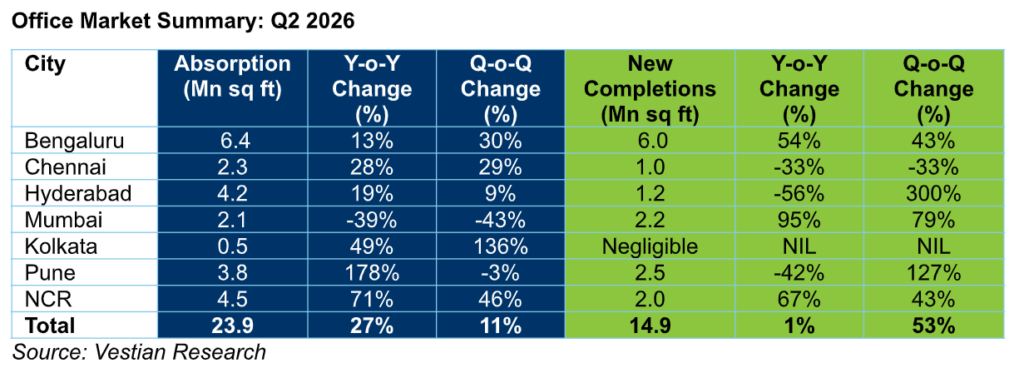
Managed Offices, Coworking and Flexible Spaces remained the second-largest occupier category with 22 per cent share, a sign of growing preference for agile workplace solutions. Flex Space operators ranked among the top two occupier segments across all major cities and even emerged as the largest occupier in National Capital Region (NCR).
Meanwhile, Banking, Financial Services and Insurance (BFSI) accounted for 8 per cent of the total leasing, supported by the continued expansion of financial institutions.
On the demand side, leasing activity remained concentrated in India’s key business hubs, with Bengaluru, NCR, and Hyderabad accounting for around 63 per cent of the pan-India absorption in Q2. The southern cities – Bengaluru, Chennai and Hyderabad – contributed 54 per cent to the total leasing, up from 49 per cent in the previous quarter.
The recovery in construction activity was primarily led by Bengaluru, Pune, Mumbai, and National Capital Region (NCR), which together accounted for nearly 85 per cent of the total new completions during the quarter. Bengaluru alone contributed 40 per cent to the pan-India supply, reflecting developers’ continued focus on established office markets. In contrast, the share of Western cities declined to 25 per cent from 35 per cent during the same period, largely due to a temporary moderation in leasing activity in Mumbai.
“India’s office market continued its growth momentum in Q2 on the back of strong occupier demand. To cater to the rising demand, developers ramped up construction activities across the major cities, resulting in significant supply additions and new project launches during the quarter,” Vestian Chief Executive Officer (CEO) Shrinivas Rao said.
“The continued expansion of GCCs, along with sustained demand from technology companies and managed office and flexible workspace operators, is expected to keep the office market buoyant in the future as well,” he added.
Demand supply gap widens
The demand-supply gap has widened to 9 million sq ft, boosting office rentals, the report said.
The gradual widening of the demand supply gap is expected to further reduce vacancy levels and drive rental appreciation across major commercial hubs, indicating a gradual shift towards a developer-driven market.
Vacancy may further improve, and rentals are expected to rise in the future due to the rising demand-supply gap in the market. Consequently, vacancy levels improved across all seven major cities, with NCR and Kolkata recording the sharpest decline of 189 basis points each over the previous quarter, while rentals witnessed marginal appreciation across major office markets.
The sustained expansion of GCCs, coupled with occupiers’ growing preference for sustainable workplaces, resulted in green-certified office buildings accounting for 87 per cent of the total leasing during the quarter, up from 85 per cent in Q1.
Bengaluru, Hyderabad, and Pune together accounted for 72% of the overall absorption by GCCs, reaffirming India’s position as the preferred destination for multinational corporations establishing GCCs.
Bengaluru retained its leadership position, accounting for 27 per cent of the pan-India absorption, with Outer Ring Road contributing to 76 per cent of the city’s leasing activity. NCR emerged as the second-largest office market during the quarter, with Gurugram contributing 67 per cent to the city’s absorption, driven by robust demand from Flex Space operators.
Kolkata leasing activity more than doubled over the previous quarter, with Peripheral Business District accounting for 96 per cent of the city’s total absorption. Pune recorded the highest year-on-year growth (178 per cent) in absorption among the top seven cities, supported by strong demand from Technology companies and GCCs.

Most Popular

3 days ago
Kotak Mahindra Bank’s profits soar, but margins refuse to join the party
Management expects the full-quarter impact of FCNR(B) deposits to weigh on margins in the…
1 hour ago
L&T Q2 cons net profit rises 33% to at ₹5,202 crore
The group’s consolidated revenue rose 16% to ₹78,750 crore, driven by progress in its…

4 days ago
DCGI Approves Toripalimab Combination Therapy for Advanced Oesophageal Cancer in India
Dr Reddy’s Laboratories’ Zytorvi, combined with cisplatin and paclitaxel, gains a first-line indication for…

3 days ago
Tech Mahindra partners with SpaceXSI to bring Grok AI coding tools into enterprise workflows
The collaboration will target legacy application modernisation, software development and developer productivity, with a…
