
Analysis
29 - 09 - 2026
India’s BESS capacity set for 50-fold surge to 45–50 GWh, but cost pressures loom
About 8-9 GWh of awarded capacity faces a higher risk of delay, moderating the overall deployment outlook: Crisil Ratings
India’s renewable energy (RE) sector is poised for a significant surge in battery energy storage system (BESS) deployment, with 45-50 GWh of capacity expected to be commissioned over this and next fiscals. This contrasts with the just 1 GWh capacity commissioned in the last fiscal.
The growth is underpinned by a strong pipeline of projects under implementation and continued policy support. Capacity additions could have been even higher; however, nearly 8-9 GWh of awarded capacity faces a higher risk of delay, somewhat moderating the overall deployment outlook, according to an analysis by Crisil Ratings.
The analysis covers bids awarded between fiscals 2024 and 2026 across nearly 100 RE developers.
Rising share of RE
The growing need for storage is a direct consequence of the rising share of RE to about 39 per cent of India’s installed power generation capacity and 15 per cent of energy generated last fiscal. However, by nature, the RE generation is intermittent which has increased the need for firm and peak-hour power supply.
This has elevated the importance of energy storage solutions, particularly BESS. The requirement is especially acute for solar projects because electricity demand typically peaks in the evening, when solar generation is negligible.
BESS can address this mismatch by storing surplus solar power during periods of high generation and supplying it during periods of elevated demand.
In line with its objective of integrating a larger share of RE into the national power grid in a sustainable manner, the government has accelerated storage-linked auctions. Projects incorporating BESS accounted for nearly 40 per cent of total auctioned capacity in fiscal 2026, up sharply from about 5 per cent in fiscals 2024 and 2025.
As a result, 50-55 GWh of BESS capacity is scheduled for commissioning across fiscals 2027 and 2028. Of this, about 40 GWh has been awarded through government-led auctions, where distribution utilities are the off-takers, while the remaining 10-15 GWh is expected to serve commercial and industrial consumers directly or be deployed in the merchant market.
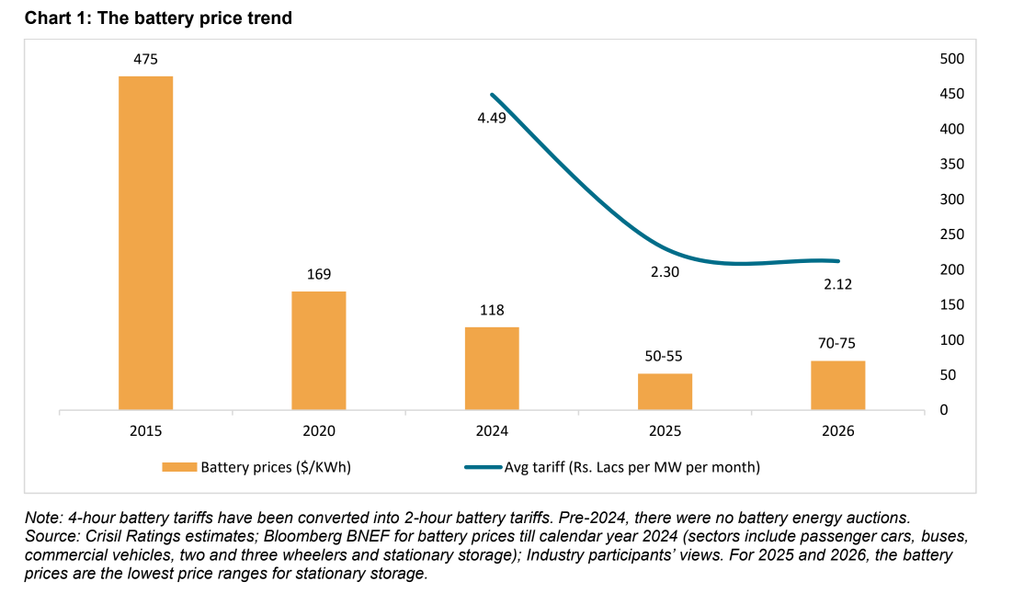
“Nearly 21 per cent of the under-construction BESS capacity, equivalent to about 12 GWh, faces weak return potential which may lead to some delays in commissioning. The risk has emerged because battery prices have hardened in 2026, while tariffs bid out for these projects were relatively low (chart 1). Developers typically procure batteries about a year after securing project bids,” Manish Gupta, Senior Director and Deputy Chief Ratings Officer, said.
“Consequently, most projects awarded in 2025 are now exposed to higher battery prices, which have rebounded from the lows witnessed in 2025. As the battery prices were consistently coming down till 2025, developers appeared to have bid aggressively on the assumption that prices would continue their downward trajectory,” Gupta added.
Developers may defer implementation
However, in reality, battery prices have increased and at these prevailing levels, project returns may be insufficient to achieve a typical target internal rate of return (IRR) of 12-14 per cent. Consequently, developers may defer implementation in anticipation of more favourable battery pricing.
“Further, about 8-9 GWh out of this 12 GWh of the planned capacity is exposed to an additional challenge: limited implementation experience among project sponsors. While BESS projects typically face relatively lower land acquisition and connectivity-related challenges compared to conventional renewable energy projects, equipment procurement remains a key risk given the sector’s continued dependence on overseas suppliers for batteries and other critical components. Developers with limited scale or procurement track records may face challenges in securing equipment on competitive terms, which could adversely impact IRRs,” Ankit Hakhu, Director at Crisil Ratings said.
“Consequently, any increase in procurement costs, coupled with execution-related challenges, could moderate IRRs or result in delays in project commissioning. Early signs of these pressures are already evident across parts of the under-construction pipeline with projects getting stranded,” Hakhu added.
Consequently, the remaining 45-50 GWh of capacity has a higher likelihood of being commissioned during fiscals 2027 and 2028.
If you spotted a mistake or have feedback on this story, write to us at editor@newsassociate.com. Email us your press releases on the same ID.
Most Popular

4 days ago
DCGI Approves Toripalimab Combination Therapy for Advanced Oesophageal Cancer in India
Dr Reddy’s Laboratories’ Zytorvi, combined with cisplatin and paclitaxel, gains a first-line indication for…

1 day ago
India’s Mumbai records 3,145 luxury property transactions in H1 FY27
The city registered 3,145 luxury residential property transactions worth ₹32,623 crore between April and…

3 days ago
Tech Mahindra partners with SpaceXSI to bring Grok AI coding tools into enterprise workflows
The collaboration will target legacy application modernisation, software development and developer productivity, with a…

4 days ago
Infosys Q2 net profit rises 6% to ₹7,823 crore
India's second-largest IT services company trims FY27 revenue guidance
