
Analysis
17 - 09 - 2026
Indian home buyers prefer 3BHK homes as premiumisation trend grows
Housing demand shifts to larger homes and higher budget brackets in H1 2026: Anarock survey
Larger homes continue to dominate buyer demand, with 48 per cent of respondents preferring 3BHK units, while the ₹90 lakh–1.5 crore budget bracket emerged as the most preferred price segment in the first half of this year.
The buyers are increasingly prioritising space and larger configurations, according to the Anarock Consumer Sentiment Survey – H1 2026.
While 3BHKs account for nearly half of overall preferences, 2BHKs remain the second-most preferred configuration at 38 per cent. The preference for 4BHKs and larger homes has risen to nearly 5 per cent, up from about 3 per cent in H1 2024, it said.
“The preference for larger homes is visible across most major markets, although the intensity varies by city,” Anarock Group Chairman Anuj Puri said.
“Ahmedabad recorded the highest preference for 3BHK homes at 57 per cent, followed by Chennai and Delhi-NCR at 53 per cent each, and Hyderabad at 52 per cent. Bengaluru records a 46 per cent preference for 3BHKs, while Kolkata stands at 46 per cent. Pune records 47 per cent – and at 39 per cent, MMR has the lowest 3BHK preference among the surveyed cities,” Puri added.
The shift towards larger homes is accompanied by a move towards higher budget brackets. The ₹90 lakh-1.5 crore segment is now the most preferred budget range, reflecting buyers’ willingness to allocate higher amounts towards better space, configuration, and overall housing quality. The survey notes that preference for homes priced below ₹45 lakh has declined significantly over the years, while the share of buyers opting for higher-value homes has strengthened.
Rising Prices
Despite the enthusiasm for bigger homes, the rising housing prices are still a major source of worry, with 65 per cent of respondents are at least moderately concerned about the current price surge, and 40 per cent view it as a long-term trend. Yet, 44 per cent intend to proceed with their planned purchase, so higher prices have not significantly weakened overall buying intent.
While 38 per cent may delay their purchase slightly, only 18 per cent may postpone indefinitely or cancel their purchase.
Affordability is the biggest constraint and is cited by 44 per cent of those delaying or cancelling their purchases, followed by reduced property options within budget (32 per cent). Among those affected, buyers are opting for peripheral locations, adjusting purchase timelines, or even temporary renting – suggesting that price growth is changing buyer behaviour more than the underlying aspiration for home ownership.
Overall, the survey finds that price appreciation is changing what, where and when buyers purchase, rather than fundamentally weakening housing demand.
Rising housing demand
Despite the growing investment orientation around residential real estate, end-use remains the dominant purchase motive. About 68 per cent respondents are buying homes for self-use, compared with 32 per cent for investment. This indicates that the demand for larger homes is being driven substantially by genuine housing requirements rather than speculative buying.
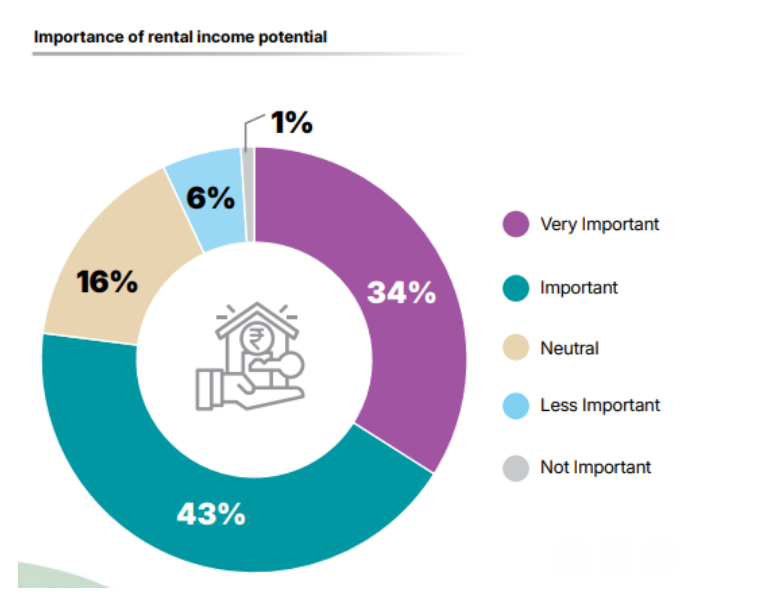
The survey also finds that buyers are increasingly evaluating homes as long-term financial assets. At least 77 per cent consider rental income important or very important when assessing a property’s investment potential, even if they’re buying it for personal occupation. The mere potential of recurring rental income alongside capital appreciation is a strong motivator, as is potential resale value – 67 per cent of respondents rate this factor as important or very important. These finding indicate that buyers increasingly view their home as a long-term financial asset alongside its end-use value.
New Launches Gain Traction
The preference for larger homes is also translating into strong interest in new projects. Around 34 per cent respondents prefer new launches, compared with 18 per cent opting for ready-to-move-in (RTM) homes. As of H1, the ratio of ready homes to new launches stood at 18:34 as against 30:25 back in H1 2022.
Among factors influencing the selection of a new project, developer reputation ranks first at 34 per cent, followed by pricing benefits (early-bird pricing or lower initial financial commitment) at 21 per cent.
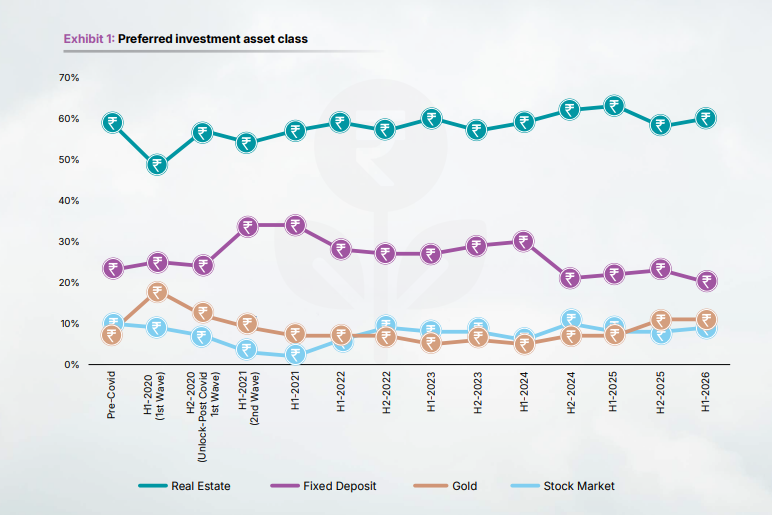
Residential real estate continues to hold a strong position as an investment asset class. About 60 per cent of respondents in this survey preferred real estate, compared with 20 per cent for stocks, 11 per cent for gold and 9 per cent for fixed deposits. The survey also finds that 44 per cent of respondents who invest in non-real-estate assets plan to use their future investment gains towards buying a home.
If you spotted a mistake or have feedback on this story, write to us at editor@newsassociate.com. Email us your press releases on the same ID.

Most Popular
5 minutes ago
L&T Q2 cons net profit rises 33% to at ₹5,202 crore
The group’s consolidated revenue rose 16% to ₹78,750 crore, driven by progress in its…

4 days ago
Infosys Q2 net profit rises 6% to ₹7,823 crore
India's second-largest IT services company trims FY27 revenue guidance

3 days ago
Kotak Mahindra Bank’s profits soar, but margins refuse to join the party
Management expects the full-quarter impact of FCNR(B) deposits to weigh on margins in the…

1 day ago
India’s Mumbai records 3,145 luxury property transactions in H1 FY27
The city registered 3,145 luxury residential property transactions worth ₹32,623 crore between April and…
