
Analysis
09 - 07 - 2026
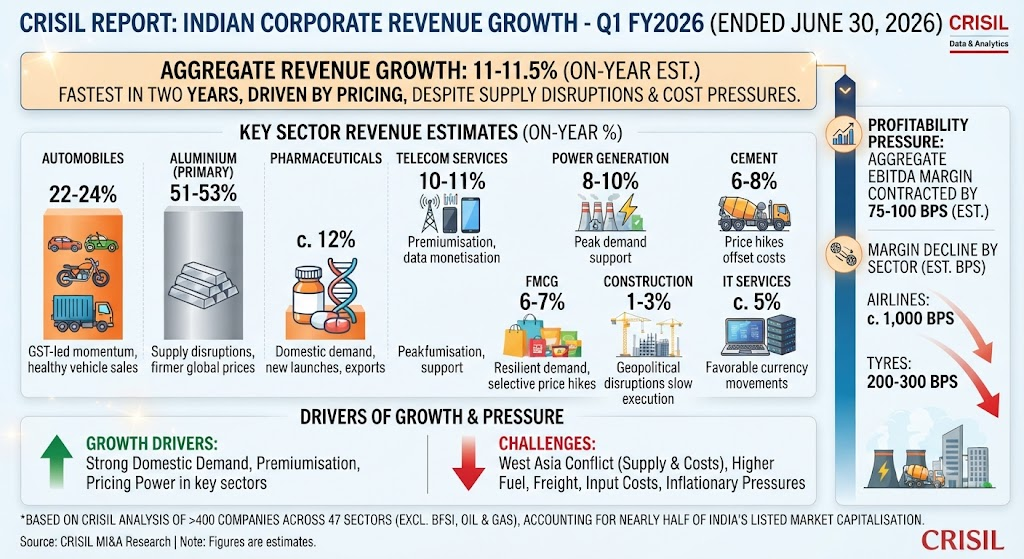
Indian corporates Q1 revenue rose by 11-11.5%, fastest in two years
However, Ebitda margin is estimated to have contracted by 75–100 basis points on-year: Crisil
The revenue of Indian corporates is estimated to have grown by 11-11.5 per cent in the first quarter (Q1) of the financial year ended June 30, 2026, the fastest in two years.
This comes despite the supply disruptions and increase in input costs due to the West Asia conflict. The revenue growth during the preceding quarter stood at 9.6 per cent, according to a Crisil report.
Automobiles, white goods, telecom services, power generation and parts of healthcare continued to draw support from healthy domestic demand. Automobiles and white goods benefited from rationalisation of goods and services tax (GST) rates, while power benefited from peak demand and telecom from premiumisation and data monetisation.
“For much of the past two years, revenue growth was powered largely by volume. But this time around, pricing was the primary driver, contributing more to revenue growth than volume in sectors such as aluminium, steel, cement, airlines, fertilisers and gems and jewellery. To be sure, growth was not uniform, but it was broad-based enough to prop the aggregate number,” Sehul Bhatt, Director, Crisil Intelligence, said.
While growing uncertainties around crude oil and gas—both prices and supply—pushed up fuel, freight, packaging and feedstock costs and tested corporate profitability, domestic demand held up reasonably well, helping companies in many sectors pass on the burden to end-consumers.
Profitability, however, was subdued. Aggregate earnings before interest, taxes, depreciation and amortisation (Ebitda) margin is estimated to have contracted by 75–100 basis points on-year as companies were able to pass on only part of the increase in costs.
Strong atomobile sector
Automobiles remained one of the strongest contributors to growth. The sector revenue is estimated to have risen by 22–24 per cent on-year, supported by GST-led demand momentum, healthy passenger vehicle and two-wheeler sales, commercial vehicle demand, export growth and selective price increases.
Power generation remained relatively insulated from external disruptions and is expected to have clocked 8–10 per cent on-year revenue growth, supported by an estimated 8 per cent increase in peak power demand.
Telecom services revenue is expected to have increased 10–11 per cent, driven by premiumisation, data monetisation, migration to post-paid plans and subscriber upgrades.
In metals, cement, chemicals, tyres, fertilisers, gems and jewellery, and sections of the consumer basket, better realisations accounted for a larger share of revenue growth.
Aluminium producers benefited from supply disruptions and firmer global prices, while steel and cement companies gained from better realisations. Primary aluminium revenue is expected to have surged 51–53 per cent on-year, supported by supply disruptions, lower import availability, higher regional premiums and capacity additions.
Steel companies similarly benefited from stronger prices, stable domestic demand and improved exports.
Construction activity remained subdued despite healthy order books, with sector revenue estimated to have grown only 1–3 per cent on-year as geopolitical disruptions slowed project execution and delayed revenue recognition.
Cement companies, however, were able to offset part of the cost increase through price hikes and are estimated to have logged a 6–8% revenue growth.
Fertiliser revenue is estimated to have grown 8–10 per cent, aided by strong April-May sales, precautionary purchases amid anticipated shortages and higher prices.
Consumer-facing sectors likely remained resilient. FMCG revenue is estimated to have grown 6–7 per cent on-year, supported by selective price increases, though higher packaging, logistics and food-related costs likely weighed on profitability.
In contrast, export-oriented sectors such as textiles, pharmaceuticals and processed food faced disruption from higher freight rates and longer shipping schedules.
Pharmaceuticals held up better than most export-linked sectors, with revenue estimated to have grown around 12 per cent on-year. Domestic demand, new product launches and exports to semi-regulated markets provided support. Even so, higher input, packaging and logistics costs likely weighed on margins.
IT services revenue grew by about 5 per cent, primarily driven by favourable currency movements, as enterprises remained cautious in their spending decisions.
“Margin pressure was most pronounced in sectors where pe-escalation inventory cushions gradually depleted. As replacement costs rose, companies started absorbing higher expenses on industrial diesel, commercial liquefied petroleum gas, freight, packaging and feedstock,” Pushan Sharma, Director, Crisil Intelligence, said.
“The pressure was particularly acute in sectors where pricing power was limited, demand sensitivity was high, or cost escalation was sudden. Sectors with significant exposure to crude oil, natural gas, imported inputs or logistics— such as airlines, chemicals, petrochemicals, pharmaceuticals, tyres, cement, fertilisers and packaging, to name some—faced the most pressure,” he added.
Ebitda margin contracts
Airlines faced aviation turbine fuel-led cost escalation even as passenger traffic softened, resulting in an estimated about 1,000 bps decline in Ebitda margin.
Fertilisers were affected by higher gas, ammonia, sulphur and phosphoric acid prices.
Pharmaceutical companies faced pressure from rising raw material, power and logistics costs, along with pricing pressure in the US market.
Tyres saw a sharp increase in natural rubber, carbon black and synthetic rubber costs, resulting in a 200–300 bps decline in margins.
Sectors with stronger pass-through mechanisms, such as power generation, telecom services, hospitals and parts of the metals sector, were better positioned to protect profitability.
The progress of the southwest monsoon will also bear watching, given its implications for rural demand and food inflation.
For sectors with significant exposure to these cost drivers, margin recovery will depend on both the stability of replacement costs and the ability to pass on higher expenses without impairing demand.
Higher-cost inventory in the system could keep replacement costs elevated and create another round of pressure before margins begin to normalise fully.
The report was based on an analysis of more than 400 companies across 47 sectors (excluding banking, financial services, and oil and gas), accounting for nearly half of India’s listed market capitalisation.
Most Popular

1 day ago
Infosys fined in France over employee work-hour tracking failures
The action reflects the strict oversight of workplace practices in France, where companies are…

1 day ago
After Aadhaar, Nilekani to solve India’s exam trust crisis
The Indian government’s decision to appoint Nilekani to head a high-powered task force on…

3 days ago
Pralhad Joshi given additional charge of Education Ministry
This follows the resignation of Dharmendra Pradhan amidst intense, weeks-long protests over alleged exam…

17 hours ago
Infosys Faces AI-Driven Price War, Loses Three Global Contracts
Infosys is confronting the new realities of the global outsourcing business after reportedly losing…
