
Analysis
22 - 09 - 2026
India Upgrades SST-1 With 82.6 GHz Gyrotron for Advanced Fusion Research
New 400 kW electron-cyclotron heating system strengthens India’s ability to initiate, heat and control ultra-hot plasma in superconducting tokamak experiments
India has strengthened its experimental nuclear-fusion capabilities with the integration of an 82.6 GHz, 400 kW gyrotron-based Electron Cyclotron Resonance Heating (ECRH) system with the Steady-State Superconducting Tokamak-1 (SST-1) at the Institute for Plasma Research (IPR) in Gujarat.
According to IPR, the 82.6 GHz system is integrated with SST-1 and can deliver up to 400 kW of radio-frequency power for pulses of up to 0.5 seconds. The system is used for electron-cyclotron heating at both the fundamental and second harmonic, depending on the tokamak’s magnetic-field conditions.
The development adds another high-power microwave heating capability to SST-1, supporting experiments aimed at understanding how extremely hot plasma can be created, heated and maintained inside a magnetically confined fusion device.
What is India’s ‘Artificial Sun’?
The term “artificial Sun” is often used informally to describe fusion experiments because they seek to reproduce on Earth the physical process that powers stars. It is not an artificial star or a power-generating Sun.
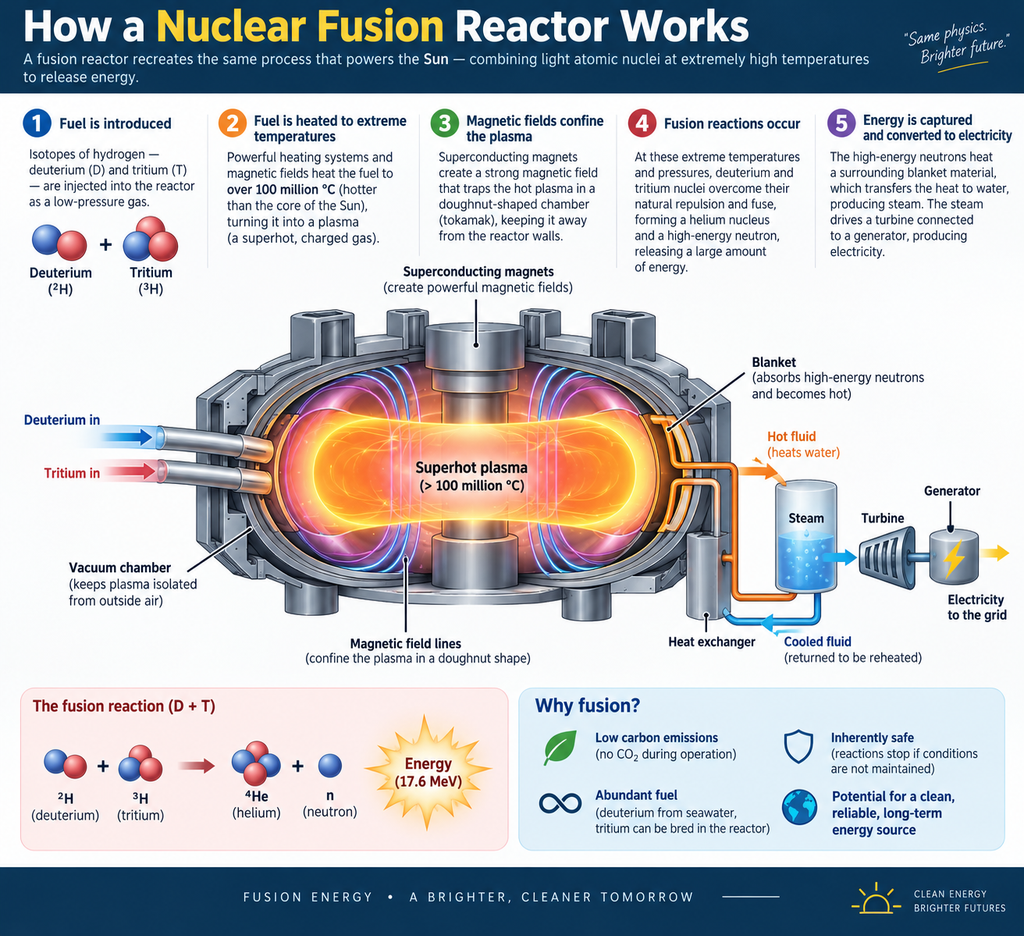
In nuclear fusion, light atomic nuclei are brought together under extreme conditions so that they fuse and release energy. The Sun achieves this through its enormous gravitational pressure and temperatures. On Earth, researchers instead have to create and control the required plasma conditions using engineered systems.
SST-1 is a medium-sized superconducting tokamak designed to study plasma processes under steady-state conditions. It uses powerful magnetic fields to confine the electrically charged plasma within its doughnut-shaped vacuum chamber, keeping the ultra-hot material away from the machine’s walls.
Why the gyrotron matters
A gyrotron is a high-power microwave source used to inject electromagnetic energy into the plasma. In an ECRH system, microwave energy is directed into magnetised plasma at a frequency corresponding to the electron cyclotron resonance. This transfers energy to electrons and heats the plasma.
The new 82.6 GHz, 400 kW system complements the 42 GHz, 500 kW ECRH system already used at IPR. The institute says the 42 GHz system has been operating since 2013 and is used on both SST-1 and the Aditya-U tokamak for applications including plasma breakdown, heating and current drive.
The higher-frequency system is particularly relevant to SST-1’s stronger magnetic-field operating regime. IPR states that the 82.6 GHz system is used for second-harmonic heating at a 1.5-tesla toroidal magnetic field and fundamental-harmonic operation at 3 tesla.
Both systems use liquid-helium-cooled superconducting cryomagnets and are powered and controlled through high-voltage systems developed indigenously at IPR, highlighting the broader engineering capability required beyond the gyrotron itself.
Beyond reaching high temperatures
Fusion research is not simply about producing an extremely hot plasma. The central challenge is keeping the plasma sufficiently hot, dense and stable for long enough to make fusion reactions practical.
SST-1’s design specifically focuses on steady-state plasma physics. IPR’s tokamak programme has reported progressively longer experimental campaigns, with improvements in plasma creation, heating and current-drive capabilities.
The ECRH systems therefore serve several purposes, including assisting plasma breakdown and start-up, heating the plasma and supporting experiments on plasma control. IPR notes that SST-1’s relatively low loop voltage makes ECRH particularly important for reliable plasma initiation.
The institute has also developed an advanced launcher with a steerable mirror that can rapidly steer the radio-frequency beam in both poloidal and toroidal directions, providing additional control over how heating power is delivered to the plasma.
Not yet a fusion power plant
The upgraded SST-1 should not be confused with a commercial fusion reactor. It is an experimental research facility intended to investigate plasma physics and the technologies needed for controlled fusion.
The new gyrotron does not itself generate fusion electricity. Instead, it provides a powerful and precisely controlled source of microwave heating that enables researchers to conduct more sophisticated experiments on plasma initiation, heating, stability and confinement.
India’s fusion programme is also connected to the country’s wider participation in international fusion research, including ITER-related activities. IPR hosts ITER-India as one of its major divisions alongside its domestic tokamak and fusion-technology programmes.
Fusion is attractive as a potential long-term energy source because its fuel resources are widely available and the fusion process does not produce the same long-lived high-level radioactive waste profile associated with conventional fission power.
But turning laboratory fusion into reliable electricity requires solving several difficult problems simultaneously: maintaining stable high-temperature plasma, sustaining fusion conditions, developing materials capable of surviving the reactor environment, efficiently extracting heat and ultimately producing more useful energy than the complete system consumes.
For India, the 82.6 GHz gyrotron is therefore best viewed not as an “artificial Sun” producing power, but as another important piece of the technology stack required to understand and control fusion plasma.
IPR’s current programme lists both the 42 GHz–500 kW and 82.6 GHz–400 kW ECRH systems among its high-power fusion-heating capabilities, reflecting India’s growing expertise in the microwave, superconducting, high-voltage and plasma technologies needed for future fusion machines.
By Subramanya Joshi
If you spotted a mistake or have feedback on this story, write to us at editor@newsassociate.com. Email us your press releases on the same ID.
Most Popular
4 days ago
DCGI Approves Toripalimab Combination Therapy for Advanced Oesophageal Cancer in India
Dr Reddy’s Laboratories’ Zytorvi, combined with cisplatin and paclitaxel, gains a first-line indication for…

3 days ago
Tech Mahindra partners with SpaceXSI to bring Grok AI coding tools into enterprise workflows
The collaboration will target legacy application modernisation, software development and developer productivity, with a…

4 days ago
CG Power’s consolidated Q2 net profit rises 44% to ₹409 crore
A sharp rise in Power Systems margins, swelling order book underpin the engineering conglomerate's…

1 day ago
India’s Mumbai records 3,145 luxury property transactions in H1 FY27
The city registered 3,145 luxury residential property transactions worth ₹32,623 crore between April and…
