
Analysis
02 - 09 - 2026
Accelerating EV adoption could cut India’s import bill by $125 billion by 2050: ICCT
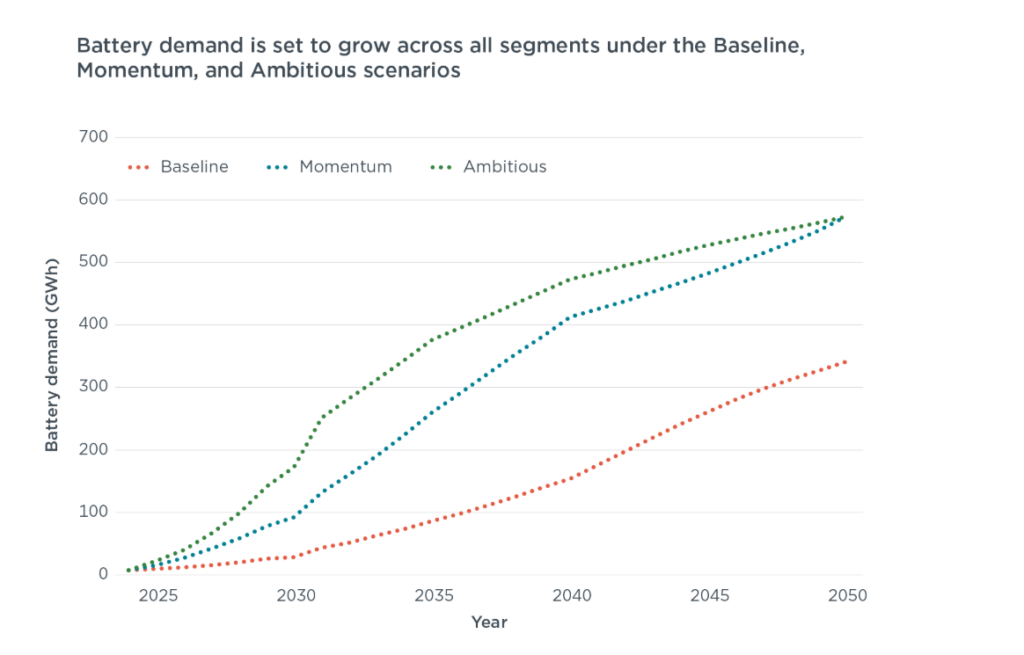
The battery demand will rise sharply after 2030 across all scenarios, reaching 340 GWh under the Baseline scenario
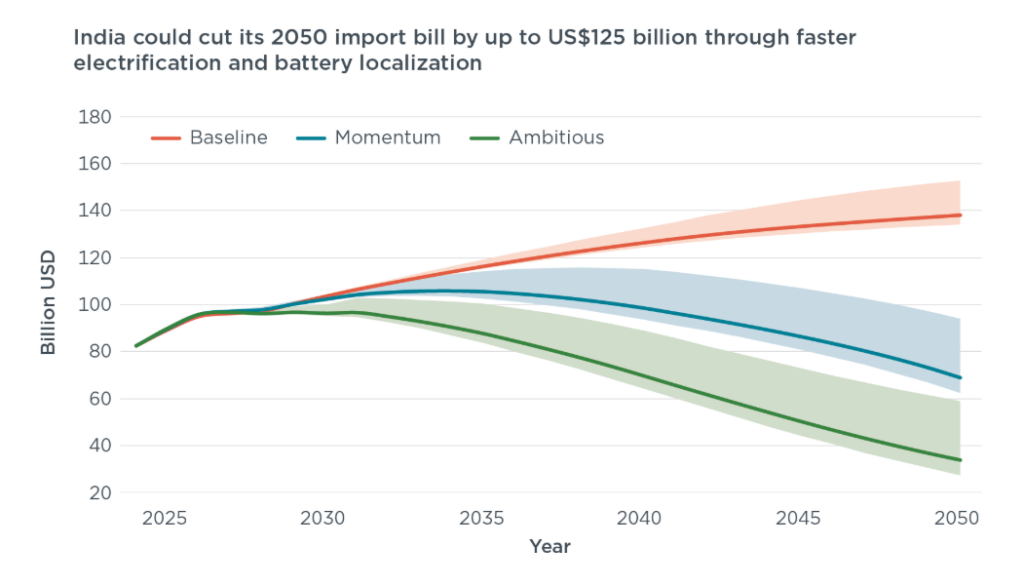
India could reduce its annual combined oil and battery import bill by up to $125 billion by 2050 by accelerating electric vehicle (EV) adoption across all vehicle segments.
Three-quarters of that opportunity, $94 billion, comes from the pace of the transition alone, even if India imports every battery cell it needs, according to a working paper released by the International Council on Clean Transportation (ICCT).
The remaining $31 billion comes from scaling domestic battery manufacturing from full reliance on imports to complete self-sufficiency. The reason: money India saves by importing less petrol and diesel outweighs the cost of importing batteries by an order of magnitude.
The stakes rise sharply if oil prices do. Under the study’s high oil price case, the gap between India’s slowest and fastest electrification pathways widens to $166 billion a year by 2050, against $104 billion (₹9.87 trillion) under the reference price case, a direct measure of the country’s exposure to global crude markets under a slow transition.
“The auto industry has already brought imports down by about 20,000 crore by manufacturing for the India market, and the technology pathway we build from here should progressively take away strategic dependency, which means building not only batteries and motors on Indian soil but the skills and design capability behind them,” Sushant Naik, Chairman, Society of Indian Automotive Manufacturers (SIAM) Electric Mobility Group, and Chief Corporate Affairs Officer, Tata Motors, said.
“That is why localisation is now being assessed across the value chain rather than only at final assembly, and why the shift is from localising a product to a process,” he said during his address at India Clean Transportation Summit (ICTS) 2026.
The study models India’s battery demand across on-road segments including two-wheelers, three-wheelers, passenger cars, light commercial vehicles (LCVs), buses and trucks, from 2024-2050. It tests three EV adoption pathways (Baseline, Momentum and Ambitious) against four scenarios for how much of India’s battery supply is made at home (no localisation, slow, announced and high localisation). Battery demand rises steeply after 2030 in every case, reaching about 340 GWh under the Baseline scenario and 573 GWh under the Momentum and Ambitious scenarios by 2050.
The study – ‘India’s EV transition: Impact of electric vehicle battery demand on import payments from 2024 to 2050’ – finds that the pace of electrification, not the location of battery manufacturing, is what matters most for India’s import bill.
Even under a scenario with no domestic battery manufacturing at all, faster EV adoption could cut India’s 2050 import bill by up to 61 per cent compared to a slower transition. This is because the money saved by importing less petrol and diesel far outweighs the added cost of importing batteries.
“Every electric vehicle India puts on the road reduces its dependence on imported oil, whether the batteries are manufactured domestically or imported. Accelerated EV adoption alone could cut India’s road transport import bill by 61 per cent by 2050. Coupling rapid manufacturing with domestic battery manufacturing could raise those savings to 82 per cent, equivalent to about $125 billion annually,” Namita Singh, Researcher and co-author of the study, said.
The study finds that battery demand will rise sharply after 2030 across all scenarios, reaching about 340 gigawatt-hours (GWh) under the Baseline scenario and 573 GWh under the Momentum and Ambitious scenarios by 2050.
Because domestic cell manufacturing cannot scale quickly enough, imports are expected to meet nearly all of India’s battery demand through 2030 regardless of how aggressively the country pursues localisation.

Most Popular

4 days ago
Adani Airport Holdings to raise $1 billion in lieu of 5.5% stake
The funds would be raised from consortium comprising Alpha Wave Global, Premji Invest, Temasek,…

3 days ago
AAHL fundraise in line with monetisation strategy, strong growth outlook
The fund raising of ₹98 billion values Adani Airport Holdings Ltd at ₹1.7 trillion:…

3 days ago
Vast Bets on Commercial Space Stations to Open a New Era of Orbital Research
Tom Shelley says predictable access to orbit could take human spaceflight beyond government programmes,…

2 days ago
Viasat Targets India for Satellite Manufacturing and Sovereign Space Partnerships
Viasat is in the process of evaluating local production of satellite subsystems and potential…
