
Analysis
23 - 07 - 2026
India cement cos margin to slip ₹50-75/tonne in West Asia fallout
Urban housing demand is expected to improve this fiscal; growing demand to keep capital expenditure elevated
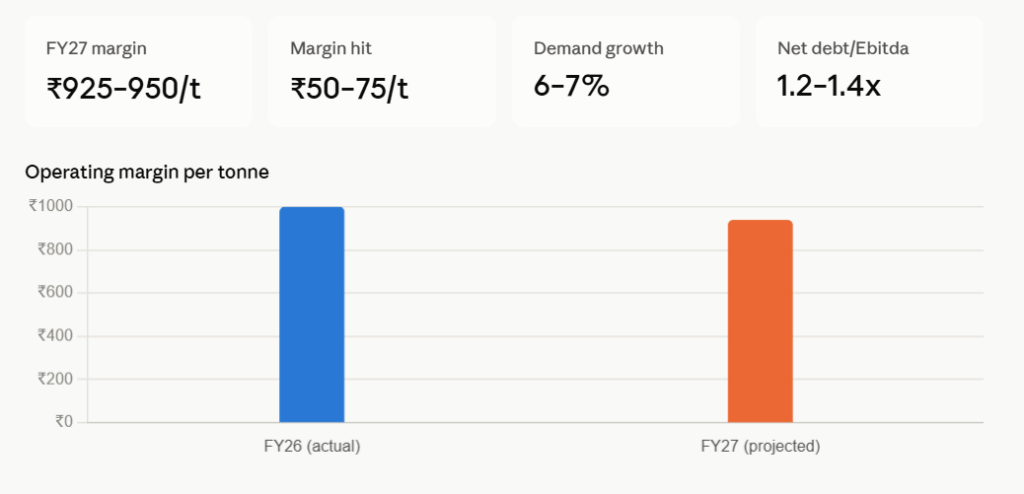
The elevated input costs due to the ongoing West Asia conflict will pare the operating margins of cement makers by ₹50–75 per tonne this fiscal to ₹925–950 per tonne.
Operating cash flows, however, should improve as domestic demand holds steady. This, along with strong balance sheets, will help sustain stable credit profiles across the sector, according to a Crisil analysis of 18 cement companies.
These 18 companies together account for nearly 90% of domestic cement capacity.
In FY26, cement companies’ margins improved sharply to₹1,000 per tonne on higher realisations. The momentum in cement prices continued into the first quarter of this fiscal and adjusted for the reduction in goods and services tax (GST) rates, prices are likely to rise 1-3 per cent during the fiscal, it said.
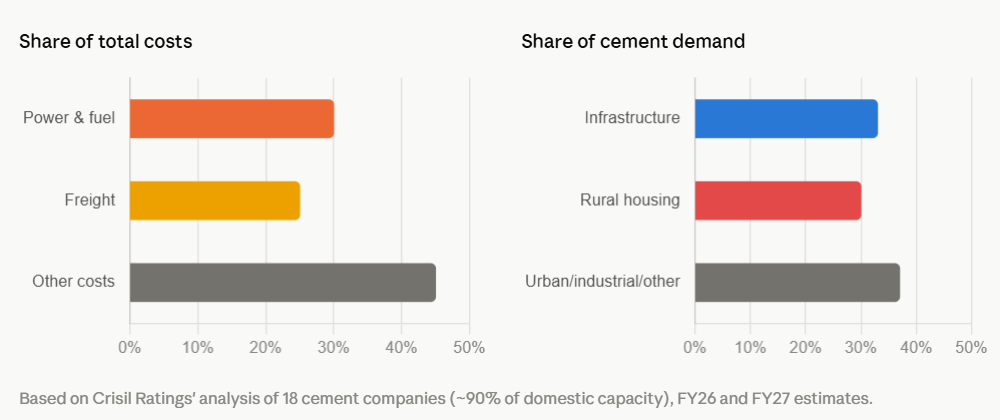
“The West Asia conflict is expected to shave ₹50-75 per tonne off cement makers’ profitability this fiscal. This will be driven mainly by higher power and fuel costs, which account for about 30 per cent of total costs, as petcoke and imported coal prices have surged amid the geopolitical uncertainties,” Anand Kulkarni, director, Crisil Ratings, said.
“Freight costs, accounting for about a quarter of total costs, are also likely to remain elevated because of higher diesel prices. The hit will be harder in the first half, before easing commodity prices help moderate cost pressures later in the year,” he added.
Green energy adoption
Increasing use of green energy by the sector, too, should partly cushion these cost pressures. Green energy now accounts for 35-40 per cent of total electricity consumption. The impact on profitability would have been higher had cement makers not diversified their energy mix.
“Despite softening profitability, operating cash flows of cement makers should remain resilient on the back of steady 6-7 per cent demand growth this fiscal. Infrastructure will be the key driver, aided by nearly 18 per cent higher budgetary allocation for core ministries. Infrastructure accounts for about one-third of total cement consumption, and higher government spending should support project execution and cement demand,” Sehul Bhatt, Director, Crisil Intelligence, said.
“This is expected to offset weaker rural housing demand, which accounts for around 30 per cent of demand, due to pressure on agricultural incomes arising from a likely below-average monsoon,” Bhatt added.
Urban housing demand
Urban housing demand is expected to improve this fiscal, supported by conducive home-loan rates and a strong pipeline of Pradhan Mantri Awas Yojana-Urban projects under construction. Demand from the industrial and commercial segment is also likely to remain healthy.
A steady demand growth is expected to support operating cash flows even as profitability softens this fiscal. Meanwhile, ongoing capacity additions to cater to growing demand will keep capital expenditure elevated. As a result, while leverage, measured as net debt to Ebitda, may increase but will still stay healthy at 1.2-1.4 times this fiscal, an increase from 1 time in last fiscal. Hence, robust balance sheets and resilient cash flows should support stable credit profiles across the sector.
However, lower-than-expected infrastructure spending, including delays in project awarding and execution, could affect cement demand.
Most Popular

4 days ago
DCGI Approves Toripalimab Combination Therapy for Advanced Oesophageal Cancer in India
Dr Reddy’s Laboratories’ Zytorvi, combined with cisplatin and paclitaxel, gains a first-line indication for…

4 days ago
CG Power’s consolidated Q2 net profit rises 44% to ₹409 crore
A sharp rise in Power Systems margins, swelling order book underpin the engineering conglomerate's…

3 days ago
Tech Mahindra partners with SpaceXSI to bring Grok AI coding tools into enterprise workflows
The collaboration will target legacy application modernisation, software development and developer productivity, with a…
2 hours ago
L&T Q2 cons net profit rises 33% to at ₹5,202 crore
The group’s consolidated revenue rose 16% to ₹78,750 crore, driven by progress in its…
