
Analysis
16 - 07 - 2026
IT services growth seen muted at 1-3% on AI disruptions, weak spends
Margins to remain resilient this fiscal, but soften if currency benefits wane: Crisil Ratings
Indian information technology (IT) services sector revenue growth is set to stay muted this fiscal and the next as Artificial Intelligence (AI)-driven disruptions, weak discretionary spending and continuing geopolitical uncertainties deepen a four-year slowdown.
While a 5-7 per cent depreciation in the rupee would support revenue growth and operating profitability this fiscal, that tailwind is likely to fade next year, according to a report by Crisil Ratings.
Mid-tier IT companies could prove to be nimble in this environment. For the broader industry, the key test will be how quickly companies reinvent business models, adapt effectively to the changing industry landscape and expand into newer services. Credit profiles should remain stable, supported by robust balance sheets, low debt and healthy liquidity.
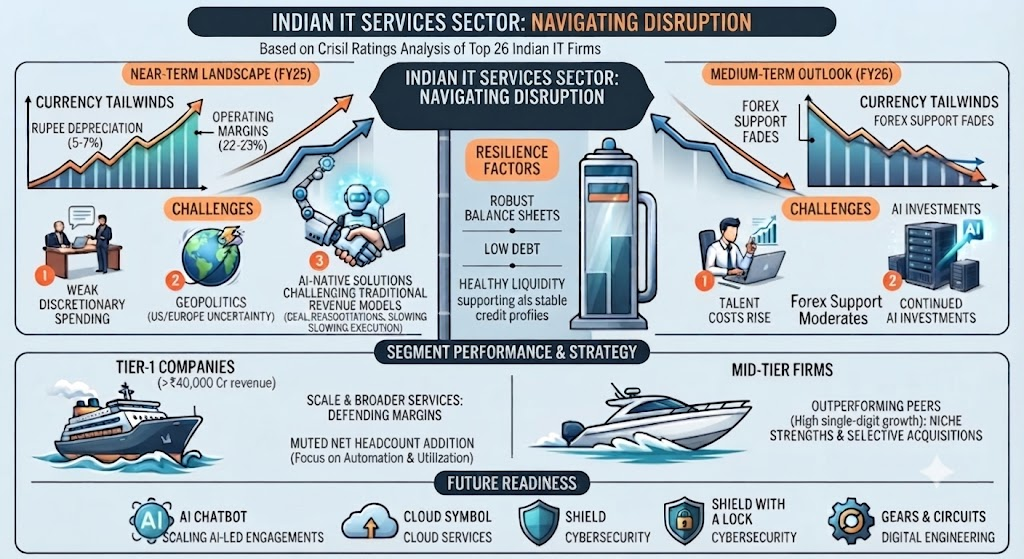
“AI is no longer just a productivity lever for IT services companies; it is beginning to challenge their traditional revenue model. Rising adoption of AI-native solutions is intensifying pricing pressure, triggering deal renegotiations and slowing execution as clients reassess technology spending. At the same time, weak discretionary spending and uncertainty in the US and Europe continue to weigh on demand. This will keep revenue visibility modest over the near term,” Anuj Sethi, Senior Director, Crisil Ratings,said.
Crisil Ratings’ analysis is based on India’s top 26 IT services companies, which together account for about 55 per cent of the industry’s estimated revenue of Rs 16 lakh crore last fiscal.
Tier-1 companies with revenues above Rs 40,000 crore contribute nearly 85 per cent of the sample set, underscoring their scale and breadth of service offerings, while mid-tier firms account for the remainder.
Currency tailwinds
“Prudent resource management and currency tailwinds should help the sector sustain healthy operating margins of 22-23 per cent this fiscal. But that cushion could narrow from next fiscal as revenue pressures persist, talent costs rise, AI investments continue and forex support moderates,” Aditya Jhaver, Director, Crisil Ratings, said.
However, mid-tier IT firms have continued to outperform larger peers sustaining steady double-digit growth over the last few fiscals, supported by their niche strengths, with large-sized acquisitions by select players also strengthening their market position.
Nevertheless, the overall muted industry outlook is expected to temper momentum, with their growth likely to remain at high single-digit levels over this fiscal and the next.
Notwithstanding the mid-tier’s rise, the subdued growth outlook and rising AI-propelled disruptions are also reshaping hiring. Net headcount addition in the sector is expected to remain muted this fiscal and the next as companies focus on defending margins and improving productivity.
Automation, higher employee utilisation and selective hiring for AI-related skills will remain the key levers.
That said, strong balance sheets and healthy cash generation will continue to support investments in technology upgrades and selective acquisitions, particularly in AI, cloud, cybersecurity and digital engineering. Reliance on debt is expected to remain limited given robust liquidity and sizeable cash reserves, thereby supporting stable credit profiles.
AI disruptions
Overall, the sector remains exposed to heightened uncertainties stemming from AI disruptions, even as geopolitical and macroeconomic headwinds continue to constrain demand in key export markets.
Over the next two fiscals, business risk profiles will be a function of the ability of companies to scale their AI-led engagements, shield margins and navigate increasing competition from global capability centres (GCCs), while managing the growing demand for AI-skilled talent.
Most Popular
4 days ago
DCGI Approves Toripalimab Combination Therapy for Advanced Oesophageal Cancer in India
Dr Reddy’s Laboratories’ Zytorvi, combined with cisplatin and paclitaxel, gains a first-line indication for…

3 days ago
Kotak Mahindra Bank’s profits soar, but margins refuse to join the party
Management expects the full-quarter impact of FCNR(B) deposits to weigh on margins in the…

4 days ago
Infosys Q2 net profit rises 6% to ₹7,823 crore
India's second-largest IT services company trims FY27 revenue guidance

1 day ago
India’s Mumbai records 3,145 luxury property transactions in H1 FY27
The city registered 3,145 luxury residential property transactions worth ₹32,623 crore between April and…
