
Analysis
14 - 07 - 2026
El Nino strains hydro-dependent power systems in Asia
India’s rated renewables face a narrower and more temporary risk as wind generation can be affected during El Niño periods.
Hydro-dependent power systems in Asia face the greatest credit risks from a developing El Niño, with Vietnam’s power sector the most exposed among Fitch-rated markets.
Risks elsewhere are more uneven and are generally mitigated by diversification, system integration or reserve capacity, Fitch Ratings said in a report.
Vietnam’s power sector is vulnerable if dry conditions persist because hydropower accounts for roughly 3%-40% of capacity and generation. Lower rainfall could reduce reservoir levels and lead to supply shortages, repeating pressure seen in 2023 when power disruption contributed to lost economic activity. Thermal and renewable additions should reduce this vulnerability over time, but the system remains exposed while that build-out is still incomplete.
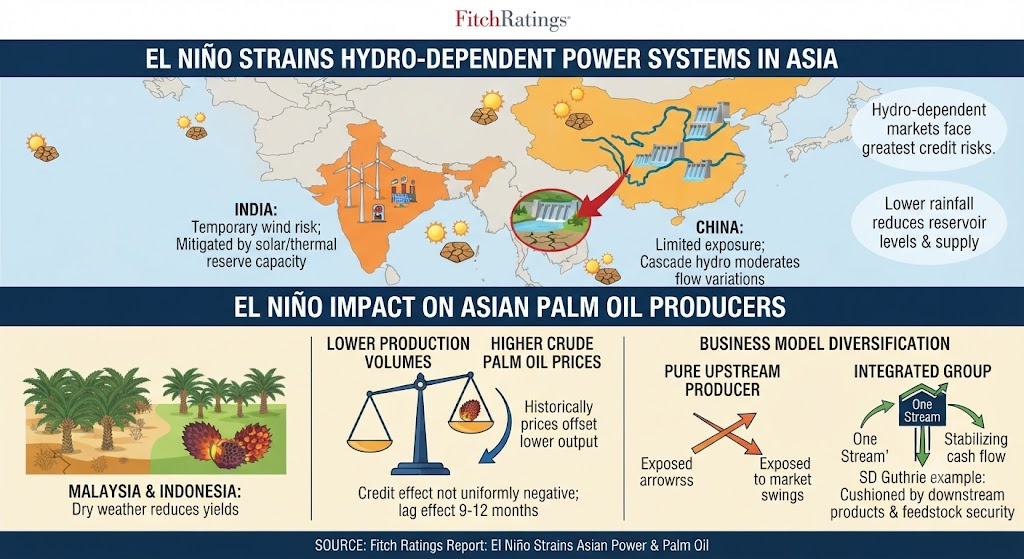
India’s rated renewables face a narrower and more temporary risk. Wind generation typically depends on monsoon wind conditions, which can be affected during El Niño periods. This could lead to lower generation at some wind projects, although the relationship has not been consistent across past episodes.
Broader system risk appears more contained because India has added substantial solar and thermal capacity in recent years, while thermal plant load factors below 70 per cent suggest significant spare capacity that can be deployed if renewable generation weakens.
China’s rated hydropower exposure appears limited. Fitch does not expect El Niño to affect generation significantly at China Yangtze Power’s (A/Stable) major hydropower stations or to change the credit profiles of China Yangtze Power and parent China Three Gorges (A/Stable). The group’s cascade of hydropower stations along the Yangtze River helps to moderate the effect of varying rainfall conditions on generation. Historical patterns suggest water flows could increase after an El Niño peak, but any resulting uplift in generation is unlikely to have meaningful credit implications.
Palm oil producers may experience a tighter market, with dry weather likely to reduce fresh fruit bunch yields and disrupt supply in Malaysia and Indonesia. The credit effect is not uniformly negative, however, because higher crude palm oil prices have historically offset lower production volumes for many producers.
Fitch’s sector view is that price increases have generally outweighed production declines, although the main effect on yields and output typically emerges only after a lag of 9-12 months.
Palm oil credit sensitivity is likely to vary by business model. Pure upstream producers are more exposed to swings in production and prices, while integrated groups are better cushioned by lower cash flow volatility with downstream product diversification that benefits from feedstock security and greater control over sustainability standards from plantation level. SD Guthrie’s (BBB/Stable) integrated “one stream” model is one example of how diversification across the value chain can reduce earnings volatility.
Most Popular

4 days ago
CG Power’s consolidated Q2 net profit rises 44% to ₹409 crore
A sharp rise in Power Systems margins, swelling order book underpin the engineering conglomerate's…

4 days ago
DCGI Approves Toripalimab Combination Therapy for Advanced Oesophageal Cancer in India
Dr Reddy’s Laboratories’ Zytorvi, combined with cisplatin and paclitaxel, gains a first-line indication for…

4 days ago
Infosys Q2 net profit rises 6% to ₹7,823 crore
India's second-largest IT services company trims FY27 revenue guidance
3 days ago
Kotak Mahindra Bank’s profits soar, but margins refuse to join the party
Management expects the full-quarter impact of FCNR(B) deposits to weigh on margins in the…
