
News
15 - 06 - 2026
Spun-off Vedanta units begin trading on BSE, NSE
The restructuring process splits the conglomerate into five corporate entities, unlocking an aggregate valuation that is more than 20 per cent above the pre-demerger closing price.
Vedanta Group’s four demerged entities — Vedanta Aluminium Metal, Vedanta Power, Vedanta Oil and Gas, and Vedanta Iron and Steel — made a strong stock market debut on Monday, listing on the Indian bourses.
The listings mark a critical milestone for the group, allowing investors to trade the newly independent units following a comprehensive restructuring process. Under the approved one-to-one demerger scheme, existing shareholders of Vedanta Ltd who held the stock prior to the ex-date received one share of every demerged entity for each share they owned on the record date.
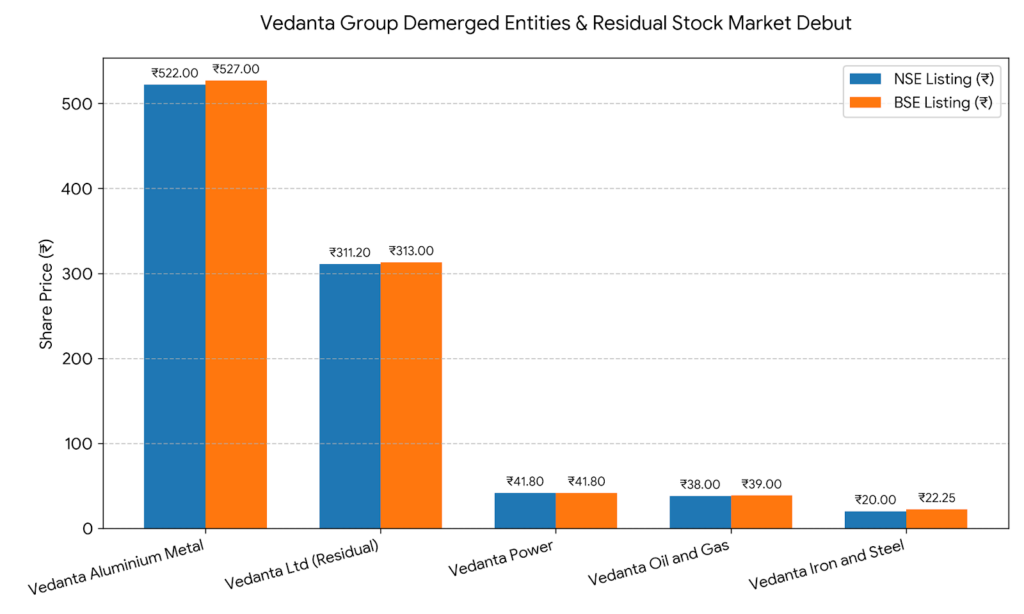
Shares of Vedanta Aluminium Metal Ltd began trading at ₹522 on the NSE and ₹527 on BSE and moved up to hit ₹538 on BSE. The aluminium vertical debuted as the largest of the new entities, commanding a market capitalisation of about ₹2 lakh crore.
Vedanta Power Ltd listed at ₹41.80 on the NSE on BSE, and moved up to ₹43.35 on BSE. In the energy sector, Vedanta Oil and Gas Ltd started trading at ₹38 per share on the NSE and ₹39 on BSE.
Meanwhile, Vedanta Iron and Steel Ltd shares listed at ₹20 on the NSE and ₹22.25 on BSE.
Shares of Vedanta Ltd, the residual listed entity which continues to hold the group’s zinc and other residual businesses, traded steadily between ₹311.2 and ₹313 on Monday morning, up around 1.6 per cent.
The listings follow the final completion of the group’s massive demerger process, led by billionaire Anil Agarwal, which effectively spins off the key natural resources businesses into pure-play, sector-focused independent companies. The restructuring plan had previously received the green light from the National Company Law Tribunal (NCLT).
Vedanta had earlier stated that the strategic split will simplify its corporate structure and provide global institutions, sovereign wealth funds, and retail investors with direct investment opportunities tied specifically to individual sectors. The management noted that the structure will also provide a platform for the individual units to pursue strategic agendas more freely, allowing them to align better with independent investment cycles, distinct customer bases, and specific global end markets.
Most Popular
4 days ago
Infosys Q2 net profit rises 6% to ₹7,823 crore
India's second-largest IT services company trims FY27 revenue guidance

4 days ago
DCGI Approves Toripalimab Combination Therapy for Advanced Oesophageal Cancer in India
Dr Reddy’s Laboratories’ Zytorvi, combined with cisplatin and paclitaxel, gains a first-line indication for…

4 days ago
CG Power’s consolidated Q2 net profit rises 44% to ₹409 crore
A sharp rise in Power Systems margins, swelling order book underpin the engineering conglomerate's…

3 days ago
Tech Mahindra partners with SpaceXSI to bring Grok AI coding tools into enterprise workflows
The collaboration will target legacy application modernisation, software development and developer productivity, with a…
