
Analysis
10 - 06 - 2026
Rising energy prices, WA war to drag India FY26 GDP growth to 7.4%: Fitch
The rating agency expects overall GDP growth to ease to 6.4% in FY27, a downward revision of 0.3pp from March.
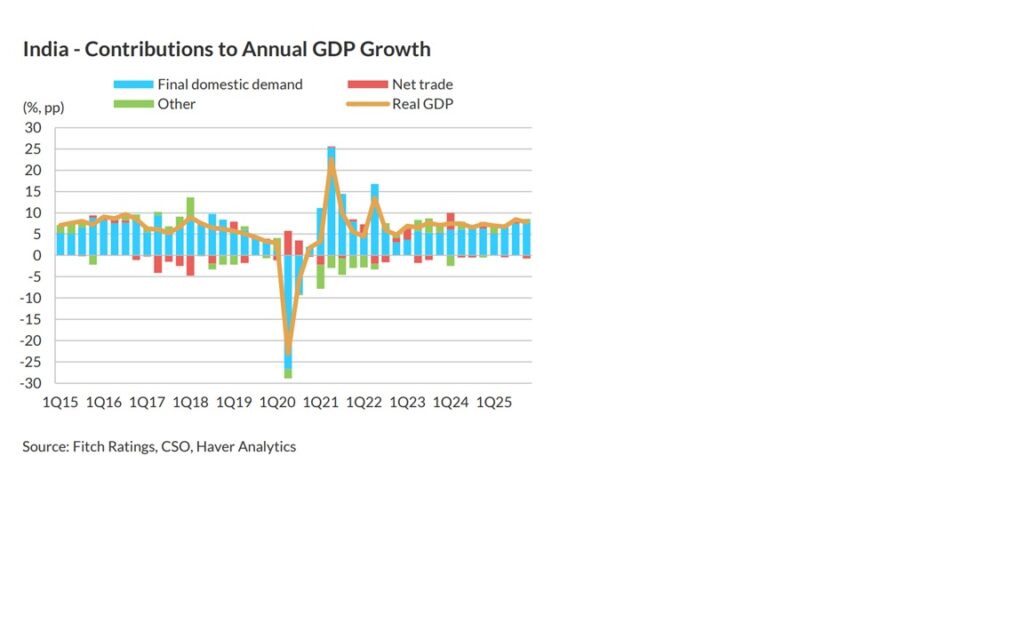
Fitch has marginally trimmed India’s GDP forecast for the financial year 2026 (FY26) to 7.4 per cent from its earlier 7.5 per cent, attributing the moderation to a deceleration in industrial output and softening business and consumer sentiment.
The growth will slow further in FY27, as the US-Iran war impacts the economy. It will be most apparent in second and third quarters of the fiscal as rising prices erode real incomes and dampen consumer spending, according to Fitch’s Global Economic Outlook – June 2026.
Fuel prices have been capped, but in recent weeks petrol and diesel prices rose by 4-5 per cent. India’s capital spending is expected to be more resilient; credit growth rose in March and is still posting a double-digit growth. The loan demand has held up, and the government’s fiscal plans envisage public capital expenditure to rise in line with nominal GDP.
“Overall, we expect GDP growth to ease to 6.4 per cent in FY27 – a downward revision of 0.3pp from March. Domestic demand will be the main driver of growth, but lower imports in real terms imply positive contributions to growth from net external demand,” it added.
For FY28, GDP growth is expected to pick up as the energy shock unwinds, with stronger consumer spending and investment translating to a growth rate of 6.7 per cent for the full financial year, before easing towards an estimate of trend growth of 6.4 per cent in FY29.
The consumer price inflation (CPI) has not yet risen significantly, but price pressures are mounting, while wholesale prices rose by 8.3 per cent year-on-year in April. CPI inflation only ticked up to 3.5 per cent in April, from 3.4 per cent in March, but is expected to rise steadily over the months ahead, reaching 5.3 per cent by the end of the calendar year, reflecting a combination of base effects and higher energy prices.
Forecasts for below-average monsoon rains and the current heatwave in parts of India raise the risk of even stronger price rises.
India’s central bank, the Reserve Bank of India (RBI), has kept its policy rate at 5.25 per cent in April.
“But we think the RBI will change course and increase rates once this year to 5.5 per cent to address the rising price pressures from the adverse supply shock,” it said.
A significant fall in the Indian rupee over the rest of the year is not expected, and the depreciating pressures are anticipated to unwind to some extent as the energy shock subsides, followed by modest depreciations over the next two years.
China, Korea forecasts upped
Fitch Ratings has raised its China and Korea forecasts following “surprisingly” good data in first quarter of FY26 and the uplift to export prospects from the tech boom. China’s forecast has been raised by 0.3pp to 4.6 per cent. The impact of the oil shock on global activity is being cushioned by stronger-than-expected momentum in artificial intelligence-related (AI-related) investment, supporting world trade and Asian exports.
World growth prospects were hurt by the oil crisis prompted by the US-Iran war. Global growth in 2026 has been lowered by 0.2pp to 2.4 per cent, primarily in response to higher oil prices. Forecast cuts have been widespread as higher inflation squeezes real wages, dampens consumption and raises companies’ input costs. The GDP growth of United States for FY26 has been lowered by 0.3pp, and that of eurozone has been cut by 0.4pp to 0.9%. Growth in emerging markets, excluding China, has been lowered by 0.2pp to 3.2 per cent.
Most Popular
1 hour ago
L&T Q2 cons net profit rises 33% to at ₹5,202 crore
The group’s consolidated revenue rose 16% to ₹78,750 crore, driven by progress in its…

3 days ago
Tech Mahindra partners with SpaceXSI to bring Grok AI coding tools into enterprise workflows
The collaboration will target legacy application modernisation, software development and developer productivity, with a…

1 day ago
India’s Mumbai records 3,145 luxury property transactions in H1 FY27
The city registered 3,145 luxury residential property transactions worth ₹32,623 crore between April and…

4 days ago
DCGI Approves Toripalimab Combination Therapy for Advanced Oesophageal Cancer in India
Dr Reddy’s Laboratories’ Zytorvi, combined with cisplatin and paclitaxel, gains a first-line indication for…
