
News
05 - 06 - 2026
RBI keeps repo rate at 5.25% amid slowing growth, rising inflation risks
RBI has prioritised market agility and financial stability by freezing interest rates, even as intensifying geopolitical tensions force a sharp upward revision to inflation forecasts.
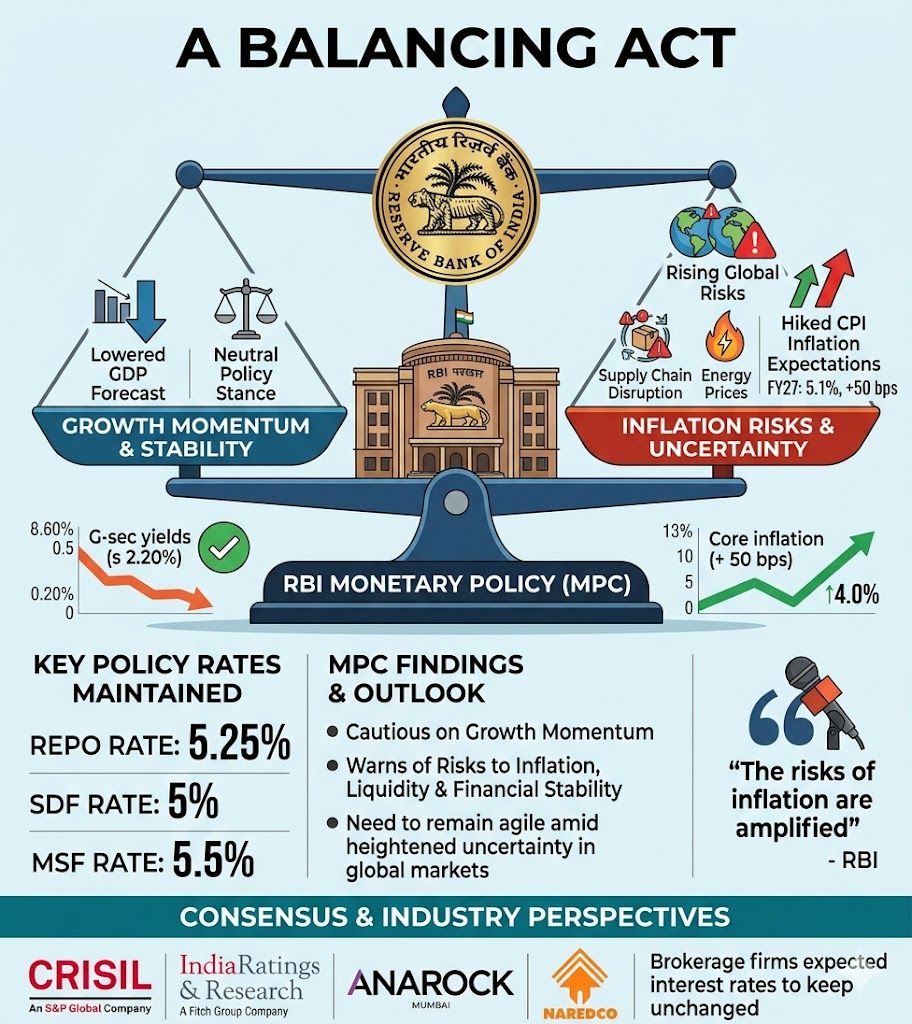
India’s central bank in its Monetary Policy Committee (MPC) meeting has maintained repo rate at 5.25%, Standing Deposit Facility (SDF) at 5% and Marginal Standing Facility (MSF) rate at 5.5%. A consensus estimate by brokerage firms had expected the Reserve Bank of India (RBI) to keep interest rates unchanged.
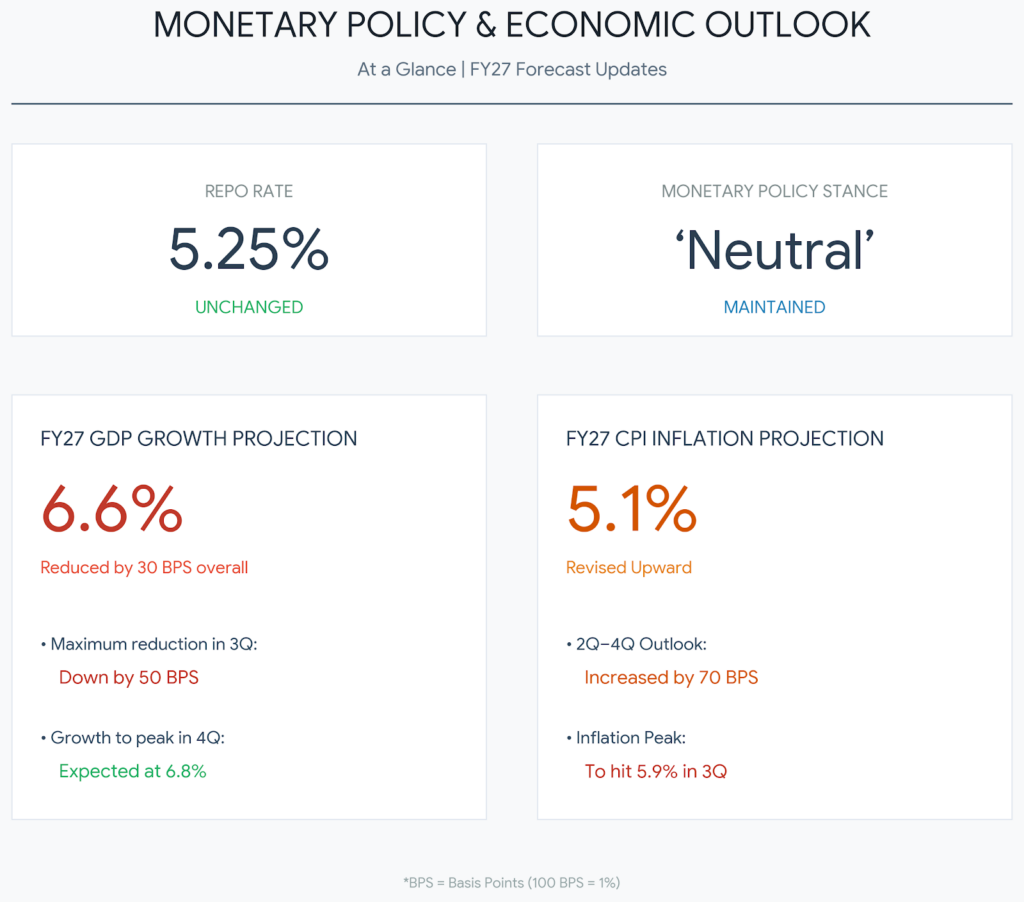
Maintaining a neutral stance, the Reserve Bank of India (RBI) kept interest rates unchanged and reaffirmed its neutral policy stance, while it turned cautious on the country’s growth momentum and warned of rising global risks to inflation, liquidity and financial stability.
RBI emphasised the need to remain agile amid heightened uncertainty in global financial markets. It flagged risks from supply chain disruption, energy prices reflected in lower growth and higher inflation.
While the policy rates were kept steady, RBI lowered the Gross Domestic Product (GDP) forecast but also hiked the inflation expectations amidst geopolitical uncertainty.
The Consumer Price Index (CPI) inflation for FY27 is now projected at 5.1 per cent, which is a 50 basis points jump from the central bank’s previous forecast. MPC’s inflation forecast has an upside bias.
“The risks of inflation are amplified,” according to RBI Governor’s Sanjay Malhotra.
Government security (G-sec) yields are firmed up. “Fuel inflation remained muted in March, April, while core inflation was stable at 3.7 per cent in March-April,” he noted.
A balancing act
The industry has termed the move to keep the repo rates unchanged as a balancing act.
“With a data-driven approach, the Monetary Policy Committee (MPC) is keenly watching risks on inflation and growth, which are yet to materialise meaningfully. Headline inflation has stayed below its 4 per cent target so far,” Dipti Deshpande, Principal Economist at Crisil said.
“The RBI focussed on easing domestic regulations for foreign capital investors. It, however, gave clear communication on its rupee management, which remains rooted in curbing excessive volatility and speculation rather than defending a specific level,” Deshpande said, adding MPC is expected to keep rates unchanged this fiscal.
“The economy is facing headwinds of disruption in supply chain, elevated energy prices and deficient rainfall due to El-Nino. The biggest unknown for the economy is the duration of war and time taken in supply normalisation,” Devendra Kumar Pant, Chief Economist at India Ratings & Research said.
“One of the major headwinds for the Indian economy is continuous portfolio outflows at a time when the current account deficit is likely to widen,” Pant added.
Real Estate welcomes status quo
The real estate sector welcomed RBI’s decision to keep the repo rate unchanged and retain its neutral policy stance, stating this as a prudent step towards preserving economic stability amidst rising geopolitical tensions and global market volatility.
The industry believes that stable interest rates will continue to support homebuyer confidence, housing demand and investment activities across residential and commercial segments. However, developers expressed concerns over the impact of the ongoing West Asia conflict, which has triggered a rise in energy prices, supply chain disruptions and escalating construction costs.
“Overall, the rate pause has shielded home loan structures, enabling the sector to absorb inventory gains and keep growth story going through 2026. The sector is witnessing strong annual growth amid short-term geopolitical shocks, and this rate pause reflects rising consumer pressures and volatile construction environments,” ANAROCK Group Chairman Anuj Puri said.
“Also, rising geopolitical uncertainty has led many potential Middle Eastern investors, who tend to put large amounts of money into Indian housing, to pause their buying. Constant borrowing costs mean that the market is not being punished by rising material costs and rising loan rates,” Puri added.
According to ANAROCK Research, residential sales declined 7 per cent on a quarter-on-quarter (QoQ) basis with about 1,01,675 units sold in the first quarter of 2026 versus 1,08,970 units in the sequential fourth quarter of 2025. The total value of sales fell 5% QoQ basis to ₹1.51 trillion. On the other hand, demand is still strong YoY, with sales volume growing by 9 per cent and sales value by 6 per cent in first quarter over the same year-ago period. The sales during the quarter stood at 93,280 units worth ₹1.42 trillion.
“The RBI’s stance reflects a balanced and prudent approach amid prevailing economic uncertainties. While monetary policy stability provides confidence to the real estate sector, the continuing West Asia crisis and escalating geopolitical tensions are creating significant cost pressures for developers,” Kamlesh Thakur, President, NAREDCO Maharashtra and Co-Founder & Managing Director at Srishti Group said.
“Rising energy prices, disruptions in global supply chains, and higher transportation costs have led to a sharp increase in the prices of key construction materials such as steel and cement, while also pushing up the landing costs of imported inputs. These factors are likely to impact project viability and housing affordability in the coming months,” he added.
“The RBI’s stance underscores the importance of balancing growth with inflation management at a time when geopolitical tensions and energy price volatility are influencing global markets. An unchanged repo rate provides continuity and predictability for both homebuyers and investors. Residential demand has remained healthy across key urban markets, and stable borrowing costs should support buyer confidence. If inflation remains contained and economic fundamentals stay strong, the real estate sector is well positioned to maintain momentum through the second half of the year,” Kaushal Agarwal, Chairman at The Guardians Real Estate Advisory said.
“The RBI has sent a reassuring message that macroeconomic stability remains a priority. For developers involved in redevelopment and urban housing projects, stable financing conditions are essential for planning and execution. The Governor’s observation that inflation pressures have had limited domestic pass-through is encouraging, although the industry will remain watchful of any upward movement in inflation in the coming quarters. Overall, the policy supports continuity in housing demand and project development,” Rohan Brahmdev Shukla, Director and Chief Civil Officer at DGS Group said.
“The RBI’s decision reflects a balanced approach towards supporting economic growth while remaining vigilant on inflationary pressures arising from global geopolitical developments. For the commercial real estate sector, policy stability is a significant positive as it provides businesses, occupiers and investors with greater confidence in their expansion and investment decisions,” Shilpin Tater, Managing Director at Superb Realty said.
“India’s office, warehousing and retail real estate segments have demonstrated strong resilience, supported by robust domestic consumption, growing corporate activity and sustained demand from global capability centres (GCCs). While rising energy prices and supply chain disruptions may exert some pressure on construction and operating costs, the sector’s long-term fundamentals remain strong. Stable interest rates will help maintain investment momentum, support leasing activity and encourage the development of high-quality commercial assets across key growth markets,” Tater added.
“The RBI’s stance is a measured move in the current global context. For the real estate sector, this continuity is positive because it keeps financing conditions broadly stable for homebuyers and developers alike. Mumbai’s housing market has continued to demonstrate resilience, and steady interest rates help sustain purchase decisions, especially in the premium and upper-mid segments. We appreciate the RBI’s focus on inflation management while ensuring that growth momentum is not disrupted,” Shraddha Kedia-Agarwal, Director, at Transcon Developers said.
“The RBI has taken a prudent approach by prioritising stability amid geopolitical and supply chain uncertainties. For real estate, an unchanged repo rate helps preserve affordability and buyer confidence. The market has shown resilience despite global volatility, and stable policy conditions should support continued traction in residential demand. We also welcome the RBI’s acknowledgement that India’s economic fundamentals are stronger than in previous periods of global turbulence, which bodes well for long-term investment in real estate,” Dhruman Shah, Promoter at Ariha Group said.
“The RBI’s decision reflects a balanced reading of the economy. For the real estate ecosystem, predictability in the interest rate environment is crucial because it influences homebuyer sentiment, financing decisions and investment planning. The central bank’s confidence in India’s resilience amidst global disruptions is encouraging. If the inflation remains broadly contained, we expect residential demand, especially in well-connected urban micro-markets, to remain healthy and supportive of sustained sectoral growth,” Nihar Jayesh Thakkar, Founder, The Mandate House Private Limited, said.
Outlook
The RBI has also mentioned that the future monetary policy decisions will be data dependent.
“In our opinion the assessment of second round impact of energy prices and likely impact of El Nino on inflation would decide the future course of action of RBI. System liquidity maintained by the RBI would be a lead indicator of RBIs next policy action,” India Ratings’ Pant said.
Ind-Ra’s base case is a hold on policy rates even in the next monetary policy (August), driven primarily by decline in inflation from 4Q. However, if the monsoons deviate more than 10% from normal and the war continues for longer period and oil prices remain higher, RBI may policy action even before the scheduled MPC meeting.
“We expect the MPC to keep policy rates unchanged this fiscal. We forecast 5.1 per cent CPI inflation and 6.6 per cent GDP growth for fiscal 2027, same as the MPC. Accordingly, headline inflation should broadly stay within the MPC’s target range of 2-6 per cent this fiscal. GDP growth faces downside risks from deepening cost pressure to industry and a weaker export environment,” Crisil said.
Most Popular

3 days ago
Kotak Mahindra Bank’s profits soar, but margins refuse to join the party
Management expects the full-quarter impact of FCNR(B) deposits to weigh on margins in the…

1 day ago
India’s Mumbai records 3,145 luxury property transactions in H1 FY27
The city registered 3,145 luxury residential property transactions worth ₹32,623 crore between April and…

4 days ago
CG Power’s consolidated Q2 net profit rises 44% to ₹409 crore
A sharp rise in Power Systems margins, swelling order book underpin the engineering conglomerate's…
2 hours ago
L&T Q2 cons net profit rises 33% to at ₹5,202 crore
The group’s consolidated revenue rose 16% to ₹78,750 crore, driven by progress in its…
