
Features
2 hours ago
Streamflation: Is the era of cheap binge-watching over for Indian OTT viewers?
As “cheap and easy” streaming fades, consumer behaviour is shifting dynamically.
As high prices and subscription fatigue reshape the OTT ecosystem, hybrid AVOD-SVOD models seem the only way forward
When Netflix reported its third-quarter earnings last week—extending a volatile stretch in which its stock hit a two-year low amid high subscriber churn and executive shakeups—it instantly captured global headlines. However, the intense scrutiny has since gone far beyond the company’s ledger.
The world watches Netflix with a magnifying glass because it serves as the primary bellwether for the entire digital entertainment economy. Naturally, its recent turbulence reflects the broader systemic pressures facing every Over-the-Top (OTT) video platform worldwide, exposing a pervasive force that has subtly become the ultimate swing factor for the entire industry: streamflation.
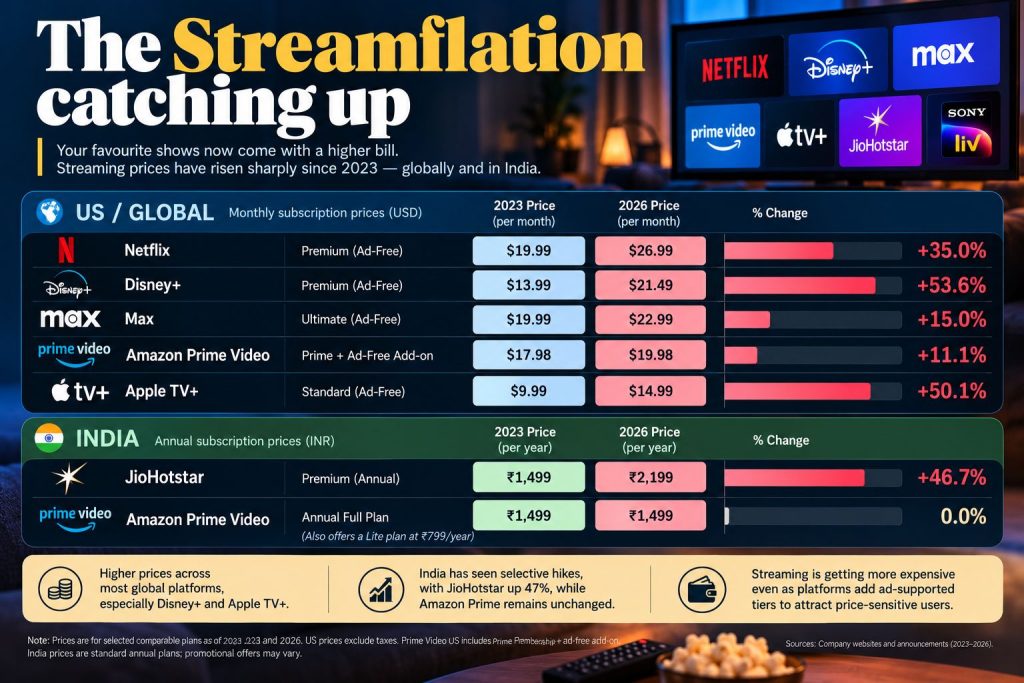
Driven by compound price hikes, unbundled resolution tiers, and password-sharing bans, streamflation has replaced the golden era of cheap entertainment amid growing subscription fatigue and “binge-and-cancel” habits.
This global reckoning points to an impending, explosive inflection point in India, where streaming capital investments have already overtaken traditional television (46% versus 42%). Yet, platforms remain trapped in a high-engagement, low-ARPU dilemma as domestic consumers continue to face mounting cost-of-living pressures.
Now, in a price-sensitive market like ours, general inflation—currently hovering around 5.45%—acts as the final straw, pinching disposable budgets and instantly triggering waves of cancellations. Perhaps streamflation was literally hiding in plain sight, masked while platforms absorbed its impact during their initial bid to gain critical mass.
This can progress in only one direction: rising subscription fees will trigger large-scale churn, forcing Indian OTT channels to abandon pure subscription models in favour of aggressive programmatic advertising, low-cost mobile tiers,and increased telecom bundling to survive.
Today, our OTT bills easily exceed traditional cable or DTH bills, even though Average Revenue Per User and free cash flow for most OTT services remain a distant dream.
Furthermore, platforms are actively unbundling premium features, pushing hi-res video (using hybrid monetisation models like Advertising Video on Demand and Subscription VOD) and spatial audio into more expensive top-tier plans.They are also eliminating basic ad-free options to push budget-conscious users into ad-supported tiers.
As “cheap and easy” streaming fades, consumer behaviour is shifting dynamically. Many price-sensitive subscribers are adopting a “binge-and-cancel” strategy, subscribing to a platform for just one month to watch a specific flagship series and cancelling immediately afterward.
Simultaneously, high subscription price points are accelerating viewer adoption of free ad-supported streaming platforms.Consumers are reluctantly accepting commercial breaks in exchange for lower monthly fees, making ad-supported tiers the primary growth driver for modern subscription services.
So, if you sat through too many tasteless ads from Vi or UltraTechCement on SonyLiv during the India-New Zealand match on airtelxstream once too often, don’t blame the platforms—it is simply the growing pressure of streamflation competing with surging domestic inflation and creating an inescapable structural dilemma.
By Sreevalsan M
Most Popular
4 days ago
Infosys Q2 net profit rises 6% to ₹7,823 crore
India's second-largest IT services company trims FY27 revenue guidance

4 days ago
CG Power’s consolidated Q2 net profit rises 44% to ₹409 crore
A sharp rise in Power Systems margins, swelling order book underpin the engineering conglomerate's…
2 hours ago
Streamflation: Is the era of cheap binge-watching over for Indian OTT viewers?
As "cheap and easy" streaming fades, consumer behaviour is shifting dynamically.

1 day ago
India’s Mumbai records 3,145 luxury property transactions in H1 FY27
The city registered 3,145 luxury residential property transactions worth ₹32,623 crore between April and…
