
Features
17 - 10 - 2026
The Rs 3 lakh crore problem: Why are our states borrowing while sitting on cash piles?
Some valuable insights come from the Reserve Bank of India’s 2026 report of the Advisory Committee on Ways and Means Advances (WMA) that shines light on an often-overlooked aspect of the general public finance.
“Very important functions can be performed very wastefully and often are.” Eminent economist John Kenneth Galbraith wrote this in his landmark 1958 book, The Affluent Society.
The observation is particularly relevant to public finance today. When assessing the financial health of Indian states, we usually look at their revenue, expenditure, fiscal deficit and outstanding debt. But these numbers tell only part of the story. How efficiently do states manage the money they raise and are they paying interest on borrowings while substantial sums remain invested in short-term government securities?
Some valuable insights come from the Reserve Bank of India’s 2026 report of the Advisory Committee on Ways and Means Advances (WMA) that shines light on an often-overlooked aspect of the general public finance.
Its message is simple: fiscal discipline is not just about how much a state borrows. It is also about when it borrows, how much cash it holds and how well it predicts its financial needs.
While the central bank is not saying that every state – holding significant cash – is borrowing wastefully, it does point towards a broader underlying risk: States that finance deficits through market borrowing can incur negative carry when large cash balances earn less than the cost of borrowing. The question for each state is whether its cash buffer is justified by upcoming payments or larger than it needs to be.
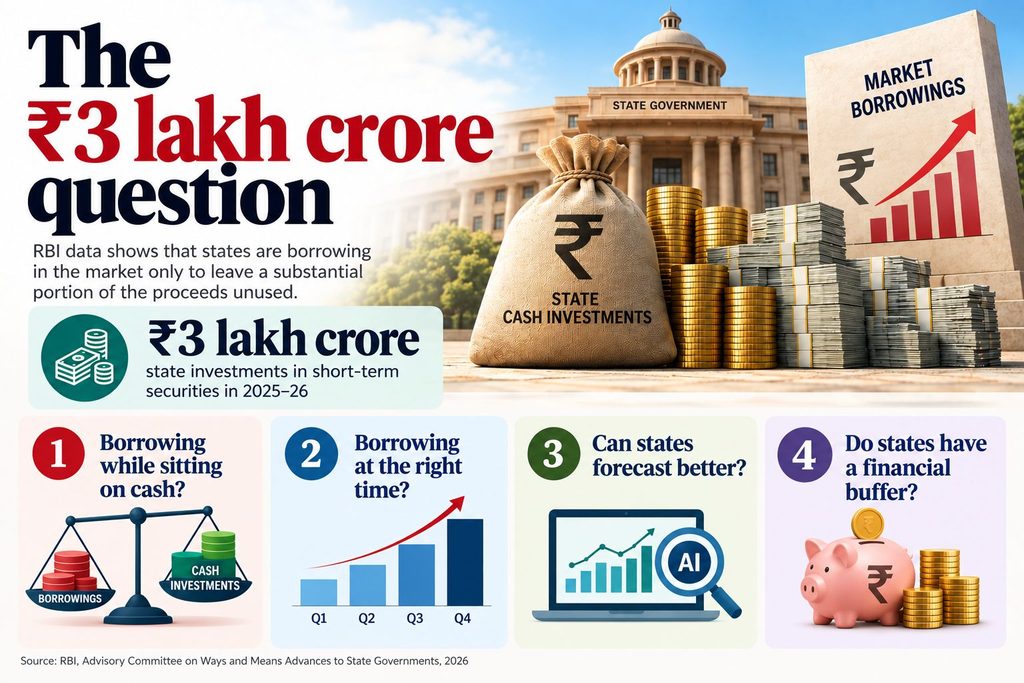
In this context, let us look at four key aspects to assess a state’s cash management.
Are states really borrowing while sitting on cash? The RBI’s analysis shows that states follow very different cash-management practices. Some regularly need short-term liquidity support; others manage their balances more closely; and some maintain large precautionary cash reserves. The scale is substantial.
The average investments by states in Intermediate Treasury Bills (ITBs) and Auction Treasury Bills (ATBs) were about ₹3 lakh crore in 2025–26. That figure shows the scale of balances being parked. Holding cash is not necessarily a problem but the cost arises when a state borrows in the market and leaves a substantial part of that money idle.
If the interest paid on borrowing exceeds the return earned on the cash, the state incurs negative carry.
The real test, therefore, is not whether a state has cash, but whether it is holding the right amount at the right time. Of course, the caveat here is that it does not prove conclusively that the entire amount was unnecessary or financed through borrowing.
Are states borrowing at the right time? Some states raise a large share of their annual market borrowings in the January–March quarter. This may reflect expenditure patterns or a desire to secure borrowing before the financial year closes. But concentrating borrowing in a short period can increase the supply of state government securities and potentially push up borrowing costs for states.
The RBI recommends spreading market borrowings more evenly through the year. Its Benchmark Issuance Strategy, introduced from 2026–27, is intended to support more effective cash and debt management. A majority of states had adopted the strategy, the report notes.
Can’t states forecast their cash needs better? Better forecasting can reduce both emergency borrowing and excess cash holdings. The RBI recommends that states map their daily, weekly and monthly receipts and expenditure to estimate how much cash they actually need.
It also suggests that states may consider using artificial intelligence and machine learning to analyse historical data and improve cash-flow forecasts. These are possible tools, not a substitute for sound forecasting. For Finance Departments, the broader shift is from relying mainly on annual budgets to more active, forward-looking cash management.
Do states have a financial any shock absorber left? Efficient cash management must be backed by reserves for future obligations. The RBI considers a Consolidated Sinking Fund (CSF) equal to at least 5% of outstanding marketable debt a desirable benchmark to help states meet debt repayments. This is a guide to the size of a repayment buffer—not a pass/fail test of a state’s overall fiscal health.
At end-July 2026, the CSF stood at 9.6% of marketable debt in Maharashtra, 4.7% in Karnataka, 1.3% in Kerala and 0.5% in Tamil Nadu. Madhya Pradesh reported no outstanding CSF balance in the table. These figures measure the debt-repayment buffer, not overall fiscal health.
What the test tells us The broader lesson is that a state’s financial strength depends – not only on its ability to raise money, but also on its ability to manage liquidity, time its borrowing and build reserves without unnecessarily increasing its debt burden.
For a State Finance Minister, the most revealing question may not be “How much can we borrow?” but “Are we borrowing wisely and making the best use of the money we already have?”
By Sreevalsan M
If you spotted a mistake or have feedback on this story, write to us at editor@newsassociate.com. Email us your press releases on the same ID.
Most Popular

4 days ago
DCGI Approves Toripalimab Combination Therapy for Advanced Oesophageal Cancer in India
Dr Reddy’s Laboratories’ Zytorvi, combined with cisplatin and paclitaxel, gains a first-line indication for…

1 day ago
India’s Mumbai records 3,145 luxury property transactions in H1 FY27
The city registered 3,145 luxury residential property transactions worth ₹32,623 crore between April and…
3 days ago
Kotak Mahindra Bank’s profits soar, but margins refuse to join the party
Management expects the full-quarter impact of FCNR(B) deposits to weigh on margins in the…

3 days ago
Tech Mahindra partners with SpaceXSI to bring Grok AI coding tools into enterprise workflows
The collaboration will target legacy application modernisation, software development and developer productivity, with a…
