
Analysis
11 - 10 - 2026
Forget the chip. India’s real semiconductor is its middle class
As Ray Dalio warns the AI bubble is close to bursting and global rates rise to decade highs, a billion consumers look like the better bet
On October 7, Ray Dalio walked onto a stage at the Forbes Global CEO Conference in Singapore and said what a growing number of serious investors have long been hesitant to say aloud. The Bridgewater founder called artificial intelligence a “classic bubble” — placing it alongside the 1929 crash and the 2000 dot-com collapse — and said we are “close” to the point where it bursts.
His diagnosis was spot on. A massive amount of debt is being taken out to fund AI, interest rates are climbing, and at some point investors must sell wealth to generate cash. “In order to spend that,” Dalio said, “you have to sell wealth in order to get money — and so the bubble usually pricks at that.”
Surging bond yields
The current interest rate backdrop makes his warning considerably more serious. Bond yields around the world have surged to their highest levels in decades simultaneously — a global rate reset making AI’s debt-fuelled ambitions exponentially more expensive to sustain. The 30-year US Treasury yield has climbed above 5.31%, its highest since 2007.
UK gilt yields have approached 6%, levels last seen in 1998. France’s 30-year borrowing cost has crossed its 2008 levels, Germany’s is hovering around the euro-area debt crisis levels of 2011, and in Asia, Japan’s 30-year yield has neared an all-time high. In the corporate bond market — where AI’s bills are actually being paid — credit spreads have started widening sharply as the supply of AI-linked debt has hit record levels.
The numbers behind Dalio’s warning are already staggering at current rates. Amazon, Microsoft, Alphabet, Meta, and Oracle have together issued roughly $200 billion in investment-grade bonds in just the first six months of 2026 — nearly twice their combined issuance for all of 2025. Morgan Stanley estimates global AI-linked debt issuance will approach $570 billion this year.
Dalio is not alone. The IMF has flagged the same risks through multiple reports. Its January 2026 World Economic Outlook blog drew an explicit parallel with the dot-com boom of 1995–2000, calculating that even a moderate correction in AI stock valuations could reduce global growth by 0.4%. Its July 2026 update warned of “frothy equity valuations” in AI-exposed markets — naming Japan, Korea, and Taiwan as the most vulnerable to an abrupt retrenchment in technology investment.
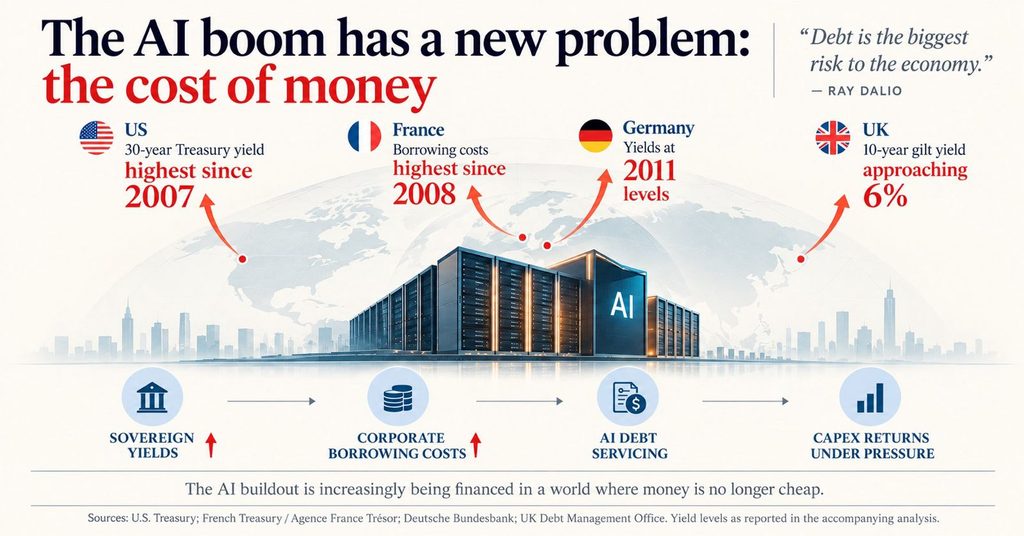
That turns the focus to India — pushed down the global equity league table by Taiwan on the back of TSMC’s extraordinary AI-driven rally, and hit by significant foreign portfolio outflows in the process. Did we do the right thing by staying out of the AI super-cycle — and by never building our own TSMC? The answer looks increasingly like yes.
India’s middle class: Asset beyond bubbles
India’s strength will always be something very few countries can boast of: its vast middle class. In computing parlance, we have a powerful parallel processing architecture in our unique demographic dividend — one that does not run on a single-core model, à la TSMC.The country runs on distributed processing, with millions of simultaneous economic transactions executed across hundreds of cities, powered by the largest youth cohort on the planet. The system does not crash when one processor fails, because no single processor carries the entire load. And critically — it does not depend on bond markets to keep running.
No doubt the world marvels at Taiwan’s TSMC, which controls 67% of the global semiconductor foundry market. But India’s most powerful growth engine is neither a fab nor a foundry — it is 1.45 billion people with a median age of 29 and a consumption record not easily disrupted by tariffs, export controls, Hormuz and Taiwan Strait standoffs, or rate cycles.
A throughput no fab can match. India’s private final consumption expenditure reached 61.5% of GDP in FY2025-26, with private consumption growing 7% year-on-year. This is India’s foundry output: a massive, internally powered demand engine funded by income growth, agricultural recovery, tax rationalisation, and rising real wages — not by bond issuance.
A well-distributed architecture. When the AI cycle turns — as Dalio argues it soon must — there is no second thread to keep the index running for a country like Taiwan. India’s consumption story is engineered on the opposite principle: massively parallel and fault-tolerant by design. The WEF estimates 93% of urban consumer growth will emerge outside India’s top five cities.
McKinsey projects 18 Tier 2 cities generating $2 trillion in revenues by 2030, up from $690 billion in 2023. When growth executes across this many parallel threads, no rate shock, no production cut, and no earnings miss can crash the entire system simultaneously.
Sanctions and obsolescence proof. When Warren Buffett exited his $5 billion TSMC position, he explicitly noted: “I don’t like its location.” TSMC’s own annual 20-F filing lists geopolitical exposure, US export controls, Taiwan Strait risk, and customer concentration as existential threats. A billion young consumers cannot be placed on an export control list or sanctioned.
The UNFPA designates India’s demographic window as running from 2005 to 2055 — the longest of any major economy — and unlike an AI investment thesis, it cannot be short-circuited by a rate hike. An open-source stack immune to rising rates.
The money-guzzling AI physical infrastructure — fabs, data centres, power plants, cooling systems — requires sustained investment to stay relevant and is always vulnerable to global yield curves. India has built the most consequential financial infrastructure of this era in UPI: an open-source public digital architecture at near-zero marginal cost, with no debt obligation and no rate sensitivity.
The KOSPI circuit breaker as the AI bubble’s dress rehearsal. On June 22, 2026, SK Hynix — supplier of roughly half the world’s high-bandwidth memory chips — quietly announced it was slowing its next-generation HBM4 production ramp, redirecting capacity toward conventional DRAM which had a record margin. It was a rational, profit-maximising decision yet the market did not read that way.
Leveraged ETFs built to amplify SK Hynix and Samsung — which together account for over 50% of the KOSPI — began unwinding simultaneously. By close on June 23, the KOSPI had fallen almost 10% and approximately 742.76 trillion won was erased from the exchange in a single session. One chipmaker optimised its product mix. An entire national market paid the price.
India continues to run its stress tests -cushioning $27 billion in foreign portfolio outflows so far — without triggering a single circuit breaker. The architecture held firm because the load was distributed across hundreds of companies, dozens of sectors, and a domestic investor base adding $90 billion to Indian equities in the same period. That fault tolerance may prove to be the most valuable feature that any emerging market can offer a global investor, looking for somewhere to reallocate.
By Sreevalsan M
If you spotted a mistake or have feedback on this story, write to us at editor@newsassociate.com. Email us your press releases on the same ID.
Most Popular
4 minutes ago
L&T Q2 cons net profit rises 33% to at ₹5,202 crore
The group’s consolidated revenue rose 16% to ₹78,750 crore, driven by progress in its…
4 days ago
Infosys Q2 net profit rises 6% to ₹7,823 crore
India's second-largest IT services company trims FY27 revenue guidance
3 days ago
Kotak Mahindra Bank’s profits soar, but margins refuse to join the party
Management expects the full-quarter impact of FCNR(B) deposits to weigh on margins in the…

3 days ago
Tech Mahindra partners with SpaceXSI to bring Grok AI coding tools into enterprise workflows
The collaboration will target legacy application modernisation, software development and developer productivity, with a…
