
Analysis
01 - 10 - 2026
Explainer: What India’s new CAFE-III norms mean for carmakers
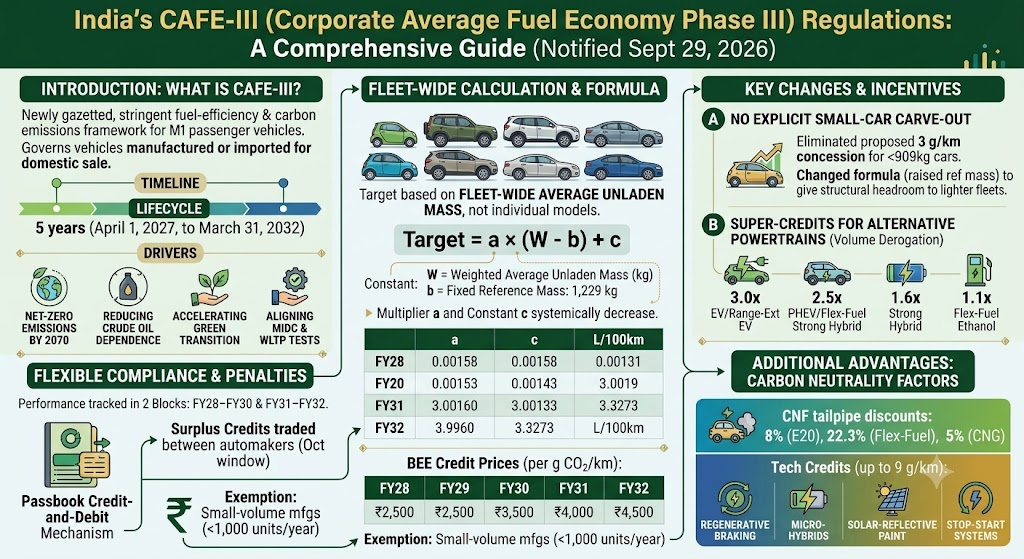
Under this policy, an automaker’s target is determined not by individual car models but by the weighted average unladen mass of its total sales volume using the formula a×(W-b)+c
The Corporate Average Fuel Economy Phase III (CAFE-III) regulations are India’s newly gazetted, stringent fuel-efficiency and carbon emissions framework for passenger vehicles. Notified on September 29, 2026, the policy governs category M1 motor vehicles manufactured or imported for domestic sale across a five-year lifecycle running from April 1, 2027, through March 31, 2032.
The driving force behind rolling out these standards now stems from India’s commitment to achieving net-zero emissions by 2070, reducing national dependence on imported crude oil, accelerating the automotive sector’s green transition, and aligning domestic testing procedures with the Worldwide Harmonized Light Vehicles Test Procedure alongside the existing Modified Indian Driving Cycle.
Under this fleet-wide policy, an automaker’s target is determined not by individual car models but by the weighted average unladen mass of its total sales volume using the formula , where
is set at a fixed reference mass of 1,229 kg, while the multiplier
systematically decreases from 0.00158 in FY28 down to 0.00131 in FY32 and the constant
drops from 3.9960 to 3.3273 litres per 100 km.
Rather than keeping the controversial 3 g/km emissions deduction for petrol cars weighing under 909 kg originally proposed in earlier drafts, a point of fierce debate between certain vehicle manufacturers, the final rules eliminate the explicit small-car carve-out. Instead, the rules flatter the main mathematical equation by raising the reference mass, thereby granting lighter vehicle fleets structural headroom without singling out one specific segment.
Crucially, the policy heavily incentivises electrified and alternative-fuel powertrains through generous volume derogation factors that allow battery electric vehicles and range-extended EVs to count as three vehicles in fleet calculations, while plug-in and flex-fuel strong hybrids receive a 2.5x multiplier, strong hybrids get 1.6x, and flex-fuel ethanol cars get 1.1x.
Further advantages include Carbon Neutrality Factors that discount tailpipe emissions by 8 per cent for E20 ethanol-blended petrol cars, 22.3 per cent for flex-fuel models, and at least 5 per cent for CNG vehicles, alongside tech credits up to 9 g/km for installing fuel-saving innovations like regenerative braking, micro-hybrids, solar-reflective paint, and stop-start systems.
To ensure flexible compliance over time, performance is tracked in two blocks covering FY28–FY30 and FY31–FY32 using a passbook credit-and-debit mechanism where surplus credits can be traded between automakers during an annual October trading window or purchased directly from the Bureau of Energy Efficiency at prices scaling from ₹2,500 per g /km in FY28 up to ₹4,500 in FY32, while small-volume manufacturers producing under 1,000 units annually remain exempt from target penalties.
Industry voices
“The CAFÉ-III norms introduce a progressive and forward-looking framework that recognises India’s mobility transition towards greener and cleaner technologies, something required to reduce the dependence on imported fossil fuels that place a significant burden on the country’s foreign exchange resources. The 3 norms recognise that the road to electrification will be a multi-powertrain journey, with batteries acting as the bedrock of this green transition,” Ranjan Nayak, CEO at JSW Motors said.
“The government’s decision to support a range of clean and increasingly efficient technologies – including battery electric vehicles (BEVs), range-extended electric vehicles (REEVs) and plug-in hybrid electric vehicles (PHEVs) – will help accelerate fuel efficiency, drive technology adoption and increasingly de-carbonise passenger vehicles in the country,” Nayak added.
If you spotted a mistake or have feedback on this story, write to us at editor@newsassociate.com. Email us your press releases on the same ID.
Most Popular

4 days ago
CG Power’s consolidated Q2 net profit rises 44% to ₹409 crore
A sharp rise in Power Systems margins, swelling order book underpin the engineering conglomerate's…

1 day ago
India’s Mumbai records 3,145 luxury property transactions in H1 FY27
The city registered 3,145 luxury residential property transactions worth ₹32,623 crore between April and…

3 days ago
Tech Mahindra partners with SpaceXSI to bring Grok AI coding tools into enterprise workflows
The collaboration will target legacy application modernisation, software development and developer productivity, with a…

4 days ago
Infosys Q2 net profit rises 6% to ₹7,823 crore
India's second-largest IT services company trims FY27 revenue guidance
