
News
21 - 09 - 2026
India Set to Require 1,000 Civil Helicopters Within 5–8 Years: Aviation Minister
Civil Aviation Minister urges faster Dhruv NG deliveries and deeper defence–civil aerospace integration to meet India’s rapidly expanding helicopter demand
India will need nearly 1,000 civil helicopters over the next five to eight years, more than four times its current fleet of around 250, Union Civil Aviation Minister K. Rammohan Naidu said on Friday, signalling a potentially significant expansion of the domestic market for indigenous helicopter manufacturers.
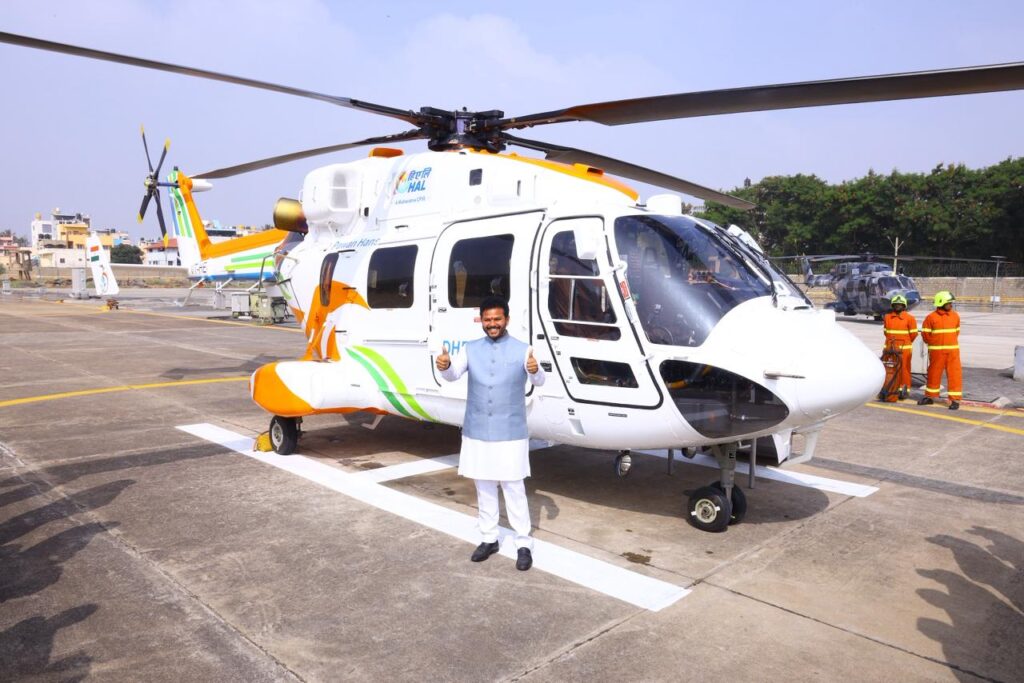
Speaking at a ceremony marking the certification and handover of Hindustan Aeronautics Limited’s (HAL) Dhruv Next Generation (NG) civil helicopter, Naidu urged HAL to accelerate deliveries, saying the market for helicopters already exists and that faster production would allow aircraft to be deployed more quickly across emerging civilian applications.
“Today India operates around 250 civil helicopters across the country, but with the growing needs and growing capabilities of the country, we see that we are going to need 1,000 civil helicopters in the next five to eight years,” Naidu said.
HAL has an order for 10 Dhruv NG helicopters from Pawan Hans Limited, of which four were handed over at the ceremony. The remaining six are expected to be delivered under the order.
“We have a very good market right now for helicopters. So as fast as you can deliver, we can put them out in the market,” Naidu said.
The minister identified offshore oil and gas operations, emergency medical services, connectivity to remote areas, highway operations, religious tourism, heli-tourism and government logistics among the areas where demand for helicopters could grow.
The Dhruv NG’s civil type certification therefore marks an important step for HAL as it seeks to take an indigenous helicopter platform beyond its established military role and into commercial aviation.
Dhruv NG opens civil aviation opportunity
The Dhruv NG received its civil type certificate from DGCA Deputy Director General Manoj Kumar Saun, who handed the certification document to HAL Executive Director for Research and Development Jasvinder Singh.
The certification confirms the helicopter’s compliance with applicable civil airworthiness requirements and enables it to enter civilian operations. The 5.5-tonne, twin-engine helicopter incorporates a glass cockpit, advanced avionics and the indigenous Shakti engine.
Pawan Hans Chairman and Managing Director Sunil Kumar Abrol received the four helicopters handed over by HAL.
Naidu said the government was simultaneously working to create the infrastructure and regulatory environment needed to support a larger helicopter ecosystem. The government plans to develop around 200 helipads over the next decade under the modified UDAN scheme and is working towards its longer-term objective of establishing a heliport in every district.
The government has also created a dedicated helicopter directorate within the Directorate General of Civil Aviation and is working to streamline helicopter operations, including route approvals and slot allocation through the Heli Sewa portal. Measures to facilitate instrument flight rules operations are also being pursued.
The minister said such measures would be important if India is to translate its projected helicopter demand into actual operations.
Defence technology to drive civil aviation
Naidu also called for a stronger connection between India’s defence and civil aerospace sectors, arguing that technologies and manufacturing capabilities developed for military programmes should increasingly be adapted for civilian applications.
“Whenever we want to make an order, the first thing civil aviation is looking at is some of the other countries. But today, thanks to the efforts of HAL, when we need something, we are first saying, let us look inside the country. Let us look at HAL,” he said.
He said India should increasingly look within the domestic aerospace ecosystem before turning to overseas suppliers and expressed confidence that the country’s ambition to manufacture a civilian aircraft domestically would also become a reality.
Naidu said the government was targeting the manufacture of a civilian aircraft in India within two years, with HAL expected to play an important role in that effort.
He cited the C-295 aircraft manufacturing programme in Vadodara as evidence of India’s expanding aircraft manufacturing capabilities, while arguing that similar capabilities need to be developed for the civil aviation sector.
The minister also pointed to HAL’s Dornier 228 as an example of an indigenous aircraft already supporting regional connectivity. The aircraft operates on difficult routes in the Northeast, including the Guwahati–Itanagar sector, where larger Airbus and Boeing aircraft are not suited to the operating environment.
“Airbus and Boeing cannot go into that area. Our Dornier, which is manufactured by HAL, is proudly flying into those difficult sectors in the Himalayan and hilly regions,” Naidu said.
He also highlighted the government’s efforts to advance other indigenous aviation programmes. DGCA and CEMILAC, he said, are working towards simultaneous certification of the NAL Saras Mk2, while the Hansa trainer is being positioned to meet the requirements of flying training organisations.
Three platforms, one aerospace ecosystem
The ceremony also marked the formal movement of three indigenous HAL platforms across different stages of India’s aerospace capability. The HTT-40 Ankur basic trainer was formally moved into Indian Air Force service, the Dhruv NG received its civil type certification and four aircraft were handed over to Pawan Hans, while the LCA Tejas FOC Trainer received its final certification for IAF use.
The HTT-40 represents the foundational stage of military pilot training. Its Restricted Military Type Certificate documents were handed over by CEMILAC Chief Executive A. P. V. S. Prasad to HAL Director of Engineering and R&D Ajay Kumar Srivastava. Release-of-service documents were presented to IAF Training Command, represented by Air Marshal S. Srinivasan.
The LCA Tejas FOC Trainer represents the next stage of fighter-pilot development, providing instructor-led training as pilots transition towards operational combat aircraft while retaining the combat capability of the single-seat Tejas configuration.
The LCA programme involves more than 500 private-sector partners, including over 350 MSMEs, while more than 100 MSMEs, startups, private-sector partners and academic institutions have contributed to the Dhruv programme.
If you spotted a mistake or have feedback on this story, write to us at editor@newsassociate.com. Email us your press releases on the same ID.
Most Popular

3 days ago
Tech Mahindra partners with SpaceXSI to bring Grok AI coding tools into enterprise workflows
The collaboration will target legacy application modernisation, software development and developer productivity, with a…

1 hour ago
L&T Q2 cons net profit rises 33% to at ₹5,202 crore
The group’s consolidated revenue rose 16% to ₹78,750 crore, driven by progress in its…
4 days ago
DCGI Approves Toripalimab Combination Therapy for Advanced Oesophageal Cancer in India
Dr Reddy’s Laboratories’ Zytorvi, combined with cisplatin and paclitaxel, gains a first-line indication for…

4 days ago
Infosys Q2 net profit rises 6% to ₹7,823 crore
India's second-largest IT services company trims FY27 revenue guidance
