
News
21 - 09 - 2026
HAL Marks Major Aerospace Milestone with Handover of HTT-40, Dhruv NG and LCA Tejas Trainer
Three indigenous platforms move from certification to service as India seeks to build a unified civil–military aerospace ecosystem
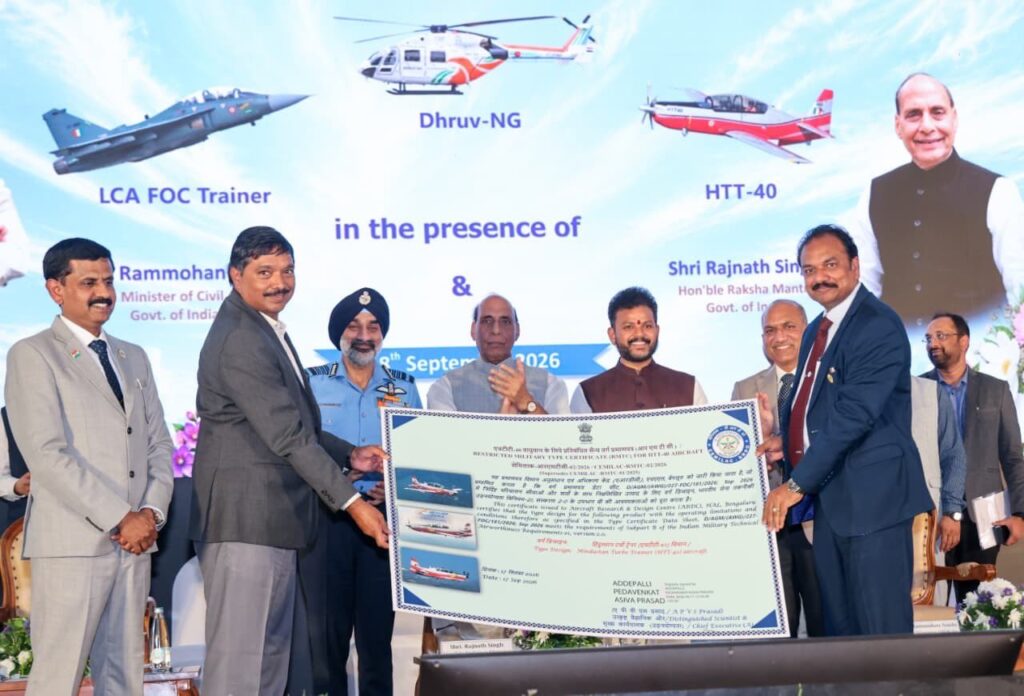
Hindustan Aeronautics Limited (HAL) on Friday marked a major milestone in India’s aerospace development with the formal certification and handover of three indigenous platforms—the HTT-40 basic trainer, Dhruv NG civil helicopter and LCA Tejas FOC Trainer.
The ceremony, attended by Defence Minister Rajnath Singh and Union Minister for Civil Aviation K. Rammohan Naidu, brought together senior representatives from the Indian Air Force, Directorate General of Civil Aviation (DGCA), CEMILAC, DGAQA, DRDO, industry, startups and micro, small and medium enterprises.
The three platforms represent different but interconnected segments of India’s aviation ambitions. The HTT-40 is aimed at foundational pilot training, the LCA Tejas Trainer supports the transition of pilots to operational fighter aircraft, while the civil-certified Dhruv NG opens a pathway for indigenous military-derived aerospace technology into commercial aviation.
For the HTT-40 Ankur, CEMILAC Chief Executive APVS Prasad handed the Restricted Military Type Certificate documents to HAL Director of Engineering and R&D Ajay Kumar Srivastava. Release-of-service documents were subsequently handed over to the IAF Training Command, represented by Air Marshal S. Srinivasan. DGAQA Director General C. Ramesh also handed over delivery documents and associated certificates to the Indian Air Force.
The formalities mark the movement of the HTT-40 from certification into operational service. Designed and developed by HAL, the basic trainer is intended to support the initial flying training of IAF pilots while reducing dependence on imported trainer aircraft. The aircraft features a modern glass cockpit and stable handling characteristics and underwent extensive flight testing, including spin trials.
The Dhruv NG marked another important transition with the receipt of its civil type certificate from the DGCA. Deputy Director General Manoj Kumar Saun handed the certificate to HAL Executive Director for Research and Development Jasvinder Singh, confirming the helicopter’s compliance with applicable civil airworthiness requirements.
HAL also handed over four Dhruv NG helicopters to Pawan Hans Limited. Pawan Hans Chairman and Managing Director Sunil Kumar Abrol received the aircraft. The operator has ordered 10 Dhruv NG helicopters, leaving six aircraft to be delivered.
The civil certification creates a pathway for the Dhruv NG to serve commercial applications including offshore energy operations, emergency medical services, regional connectivity, search and rescue, casualty evacuation and utility transport. The twin-engine helicopter incorporates a glass cockpit, advanced avionics and the indigenous Shakti engine.
The third platform at the ceremony was the LCA Tejas FOC Trainer. DGAQA handed over the final certification document to the Indian Air Force, with Group Captain Divyansh Mittal receiving it on behalf of the service and Air Vice Marshal Ashish Srivastava joining the handover.
The trainer is intended to bridge the gap between basic flying instruction and operational fighter aircraft training. Although configured for instructor-led training, it retains the combat capability of the single-seat fighter, adding another capability to the Tejas programme.
In his keynote address, Defence Minister Rajnath Singh said the ceremony represented more than the exchange of certification and delivery documents, describing it as a reflection of progress in Indian engineering, aerospace technology, manufacturing and the broader national objective of Atmanirbharta.
Singh emphasised that aerospace self-reliance would require a long-term roadmap, clearly defined milestones, sustained investment and patience. He cautioned that complex aerospace programmes cannot be developed overnight and that prolonged delays can create the risk of technology becoming obsolete before a system enters service.
The Defence Minister also called for greater integration between civil and military aerospace. Capabilities developed in aircraft design, avionics, flight-control systems, manufacturing, certification and subsystem development, he said, can create benefits across both sectors.
“The aerospace sector must not be limited to fulfilling defence requirements alone,” Singh said, calling for an integrated ecosystem capable of addressing the requirements of civil as well as military aviation.
Singh highlighted the HTT-40 as an example of India replacing dependence on imported basic trainers and said the aircraft could potentially find demand in international markets. He described the LCA Tejas Trainer as evidence of growing Indian capabilities in complex fighter-aircraft technologies, including flight-control laws, composite structures, avionics, weapons integration and certification.
He also called on HAL to strengthen the complete aerospace value chain, extending from design and development to manufacturing, certification, lifecycle support, overhaul, repair and maintenance. Greater investment in research and development and realistic budgeting, he said, would be critical to sustaining the sector’s growth.
“Research and development is an area where a breakthrough can change everything,” Singh said, encouraging young scientists, engineers and designers to pursue technologies that do not yet exist.
Evolve together
Addressing the gathering, Civil Aviation Minister K. Rammohan Naidu described the occasion as an important step towards aerospace self-reliance and globally competitive Indian manufacturing. He stressed the need to increasingly adapt capabilities developed for defence to civil aviation instead of allowing the two sectors to evolve independently.
Naidu cited HAL’s Do-228 as an example of an Indian aircraft that can address specialised regional aviation requirements, particularly in the Northeast, where larger Airbus and Boeing aircraft may not be suitable for certain routes. He urged HAL to expand its defence-sector capabilities into civil aviation and reiterated the government’s ambition to manufacture civilian aircraft in India.
The minister also highlighted measures intended to expand helicopter operations, including the creation of a dedicated helicopter directorate within the DGCA, digitisation of route approvals and slot allocation through the Heli Sewa portal, and initiatives supporting instrument flight rules operations. He said the long-term objective was to establish a heliport in every district.
Naidu also pointed to the potential role of the Dhruv NG in offshore operations, emergency response, remote-area connectivity and regional aviation, arguing that India’s civil helicopter sector has significant room for expansion.
The ceremony also highlighted the increasing contribution of private industry, startups, academic institutions and MSMEs to India’s aerospace ecosystem. More than 100 partners have contributed to the Dhruv programme, while the LCA programme involves more than 500 private-sector partners, including more than 350 MSMEs.
HAL’s leadership presented the three platforms as outcomes of a wider national industrial and technological ecosystem rather than the achievement of a single organisation. Together, the HTT-40, Dhruv NG and LCA Trainer illustrate India’s broader transition from licensed production and technology absorption towards indigenous design, certification, manufacturing and lifecycle support.
The immediate task will now be to complete delivery of the remaining six Dhruv NG helicopters to Pawan Hans while sustaining production of the HTT-40 and LCA Trainer and expanding collaboration among public-sector institutions, private companies, startups, MSMEs and research organisations.
For India’s aerospace industry, the handovers therefore represent more than individual programme milestones. They point towards an emerging strategy in which defence manufacturing capabilities, indigenous research and development and civil aviation requirements are increasingly connected within a common aerospace ecosystem.
If you spotted a mistake or have feedback on this story, write to us at editor@newsassociate.com. Email us your press releases on the same ID.
Most Popular

3 days ago
Kotak Mahindra Bank’s profits soar, but margins refuse to join the party
Management expects the full-quarter impact of FCNR(B) deposits to weigh on margins in the…

3 days ago
Tech Mahindra partners with SpaceXSI to bring Grok AI coding tools into enterprise workflows
The collaboration will target legacy application modernisation, software development and developer productivity, with a…

4 days ago
Infosys Q2 net profit rises 6% to ₹7,823 crore
India's second-largest IT services company trims FY27 revenue guidance
4 days ago
DCGI Approves Toripalimab Combination Therapy for Advanced Oesophageal Cancer in India
Dr Reddy’s Laboratories’ Zytorvi, combined with cisplatin and paclitaxel, gains a first-line indication for…
